What a first dive actually feels like, Try Dive vs Open Water, swimming requirements, safety rules, nerves, costs and how to pick a beginner-friendly dive school on Koh Tao.
10 May 2024 · updated 8 July 2026 · by Bryan Roseman
Key takeaways
- Koh Tao is one of the best places for beginner scuba divers because of its warm water, shallow dive sites, calm beginner-friendly conditions, regular dive boats and a wide choice of professional dive schools.
- First-time divers can choose between a Try Dive and an Open Water course depending on their goal. A Try Dive is best for one-day beginners who only want to experience scuba, while the Open Water course is better for those who want an internationally recognised certification.
- You do not need to be a strong swimmer to try scuba diving, but you should be reasonably comfortable in the water. Certification courses usually require basic swimming and floating ability, while Try Dives are more closely supervised.
- Beginner dive safety depends on simple but important rules: never hold your breath, equalise early and often, stay close to your instructor, ascend slowly and avoid contact with coral or marine life.
- Feeling nervous before your first dive is completely normal, and a good instructor should help you slow down, practise breathing, understand hand signals and continue only when you feel comfortable.
Taking your first scuba dive is an exciting experience, but it is natural to have questions before getting started. Many first-time divers want to know whether scuba diving is safe, if they need to be strong swimmers, what it feels like to breathe underwater, how deep beginners typically dive, and whether a Try Dive or Open Water course is the better option.
As one of the world’s leading destinations for entry-level diver training, Koh Tao attracts thousands of beginners each year. The island is renowned for its warm waters, accessible dive sites, favourable conditions and extensive choice of professional dive schools. These factors have made it a popular location for both introductory dives and internationally recognised scuba certifications.
This guide provides a practical overview of scuba diving in Koh Tao for beginners. Whether you are simply curious about scuba diving or planning to earn your first certification, it will help you make an informed decision before entering the water.
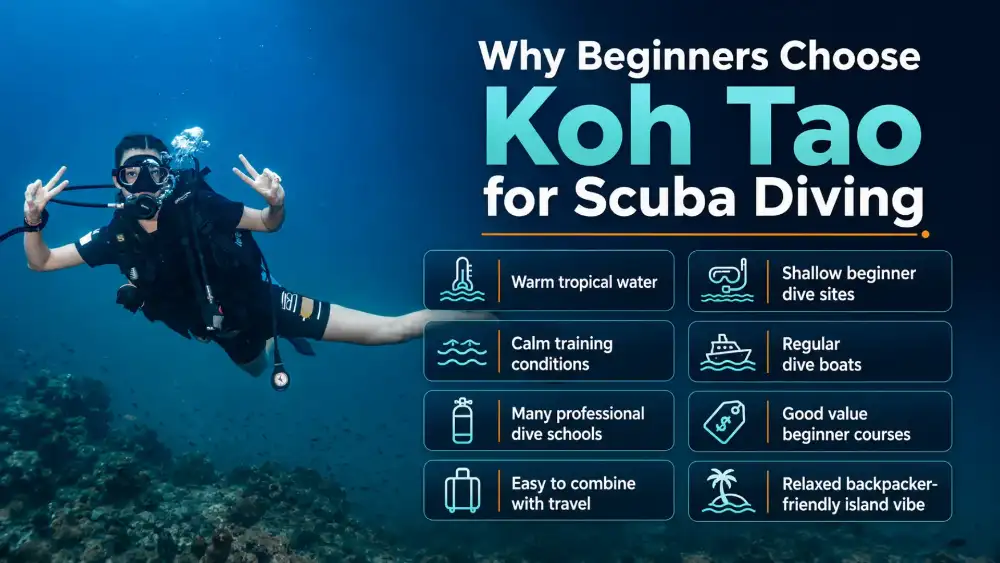
Koh Tao has earned a reputation as one of the best places in the world for beginner divers.
The island offers warm tropical water year-round, accessible dive sites, a large selection of professional dive schools and beginner-friendly conditions that make learning less intimidating than in many other destinations.
For beginners, the main advantages are:
| Why beginners like Koh Tao | Why it helps |
|---|---|
| Warm water | Easier to relax and focus on learning |
| Shallow dive sites | Good for first dives and beginner skills |
| Regular dive boats | Flexible course and Try Dive schedules |
| Many dive schools | More choice for training style and language |
| Popular backpacker destination | Easy to combine diving with travel |
| Calm beginner sites | Helps nervous divers build confidence |
| Good value courses | Helpful for travellers on a budget |
Koh Tao also works well for beginners because you can usually choose between:
| Beginner option | Best for | Typical time needed | Certification? |
|---|---|---|---|
| Try Dive | First-time divers who want to explore the underwater world with an instructor | 1 day | No |
| Open Water course | Beginners who want to become certified divers | 4 days | Yes |
| Refresh dive | Certified divers who have not dived recently | Half day or 1 day | No new certification — your existing certification still applies |
| Fun dives | Already-certified divers | Half day or full day | Existing certification required |
If you have never dived before and only have one day, a Try Dive is usually the best starting point. If you want to learn properly and continue diving around the world, the Open Water course is the better choice.
Most beginners are surprised by how comfortable scuba diving feels once they’re underwater. Before the dive, your instructor will guide you through the equipment, safety procedures and basic skills needed for the experience.
A typical first dive includes:
What most beginners notice:
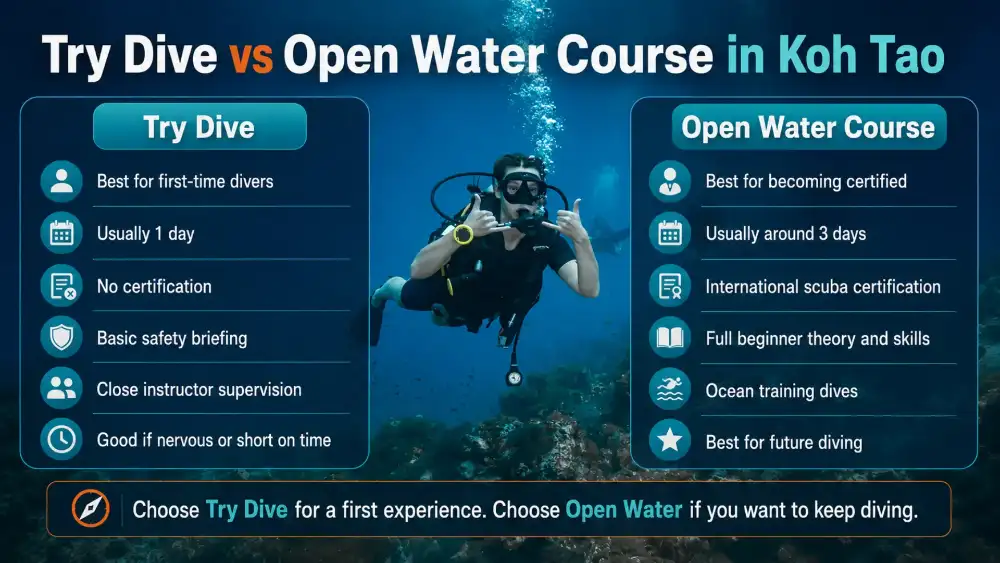
One of the biggest beginner questions is whether to book a Try Dive or an Open Water course. Both are beginner-friendly, but they serve different purposes.
A Try Dive is a one-day introductory scuba experience for people who want to try breathing underwater without committing to a full course. It is ideal if you are curious, nervous, short on time, or unsure whether scuba diving is for you.
You do not become certified after a Try Dive. You dive under close instructor supervision and stay within beginner limits.
Choose a Try Dive if:
The Open Water course is the entry-level scuba certification. After completing it, you can dive with a buddy within your certification limits anywhere in the world, as long as conditions are similar to your training and you stay within safe recreational-diving practices.
Choose an Open Water course if:
| Question | Try Dive | Open Water course |
|---|---|---|
| Is it for complete beginners? | Yes | Yes |
| Do I need previous experience? | No | No |
| How long does it take? | Usually 1 day | 4 days |
| Do I get certified? | No | Yes |
| Is there theory? | Basic safety briefing | Full beginner theory |
| Are there skills? | Basic beginner skills | Full required training skills |
| How deep can I go? | Usually up to beginner Try Dive limits | Certifies you to 18 m |
| Best for nervous beginners? | Yes, especially if unsure | Yes, if you want full training |
| Best for future diving? | Good first step | Best long-term choice |
A good first dive is not just “jump in and hope for the best.” It should follow a clear, calm process that helps beginners understand what is happening before they enter the water.
Before diving, you normally complete a medical questionnaire. This is not meant to scare you. It helps the dive school understand whether you are fit to dive or whether you need medical clearance before entering the water.
Be honest when completing the form. Diving is safe for many people, but certain medical conditions, medications, surgeries, respiratory issues, heart conditions or pregnancy can affect whether scuba is appropriate.
Before your first dive, your instructor should explain the basics clearly. This usually includes:
This briefing is important because beginners feel calmer when they know what to expect.
Your dive team will help you with your wetsuit, mask, fins, buoyancy control device, tank, weights and regulator. You do not need to understand every technical detail immediately, but you should know the basics of what each piece does.
The most important beginner equipment points are:
| Equipment | What it does |
|---|---|
| Mask | Helps you see underwater |
| Fins | Help you move efficiently |
| Regulator | Lets you breathe from the tank |
| BCD | Helps control buoyancy |
| Tank | Holds compressed breathing gas |
| Weights | Help you descend safely |
| Wetsuit | Keeps you comfortable and protected |
Before entering the water, your instructor or dive team should help with an equipment and buddy check. This confirms that your air is on, your equipment is secure, your weights are correct, and your releases and gauges are working.
For beginners, this step builds trust because you know someone has checked the important details before the dive begins.
Many beginner dives start with simple practice in shallow water or a controlled area. This gives you time to get used to breathing through the regulator, putting your face underwater, clearing your mask and using hand signals.
This is often the moment when nervous beginners realise, “Okay, I can do this.”
Once you are comfortable, your instructor guides you slowly underwater. You do not need to swim quickly or chase marine life. Most beginner dives are calm, slow and closely supervised.
You will focus on:
After the dive, you return to the boat or dive centre, remove your equipment, drink water and talk about what you saw. If you enjoyed the experience, you may be able to do a second dive or continue toward a full Open Water course.
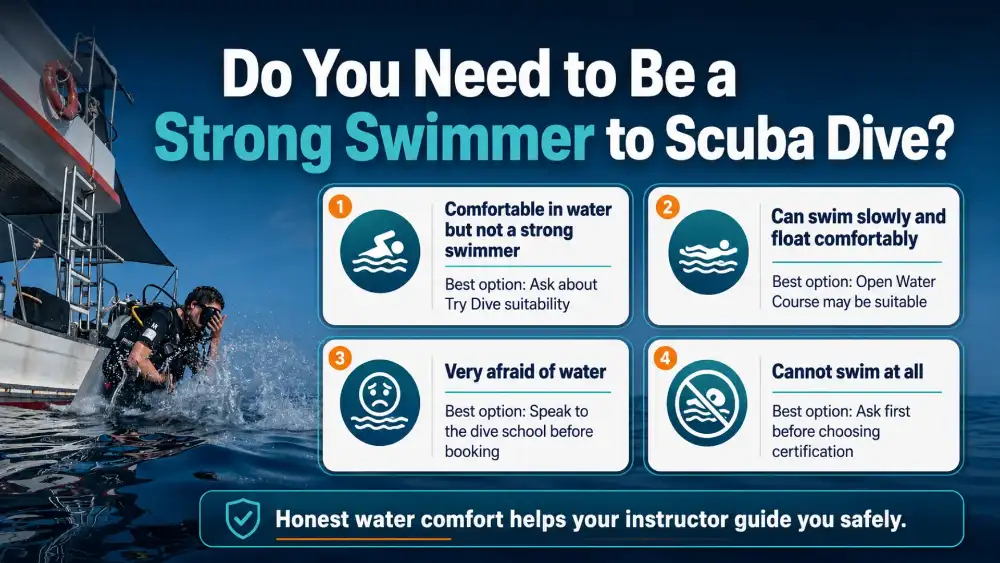
You do not need to be an athlete or a perfect swimmer to try scuba diving, but you should be reasonably comfortable in the water.
For a Try Dive, requirements are usually lighter because you are closely supervised by an instructor and not earning an independent certification. For an Open Water course, you normally need to demonstrate basic water comfort, such as swimming a set distance and floating or treading water.
A simple way to think about it:
| Your water comfort | Best beginner option |
|---|---|
| Comfortable putting your face in water, but not a strong swimmer | Ask about Try Dive suitability |
| Can swim slowly and float comfortably | Open Water may be suitable |
| Very afraid of water | Speak to the dive school before booking |
| Cannot swim at all | Ask first; a full certification may not be suitable yet |
Being honest about your swimming ability helps the dive school guide you properly.
| Safety rule | Why it matters |
|---|---|
| Never hold your breath | Continuous breathing is one of the most important scuba rules |
| Equalise early and often | Helps prevent ear discomfort |
| Stay close to your instructor or buddy | Makes communication and support easier |
| Ascend slowly | Helps keep the dive safe and controlled |
| Do not touch coral or marine life | Protects you and the reef |
| Tell your instructor if you feel nervous | Problems are easier to solve early |
| Listen carefully during briefings | Most beginner stress comes from not knowing what to expect |
A good instructor will not expect you to be confident immediately. Their job is to help you build comfort step by step.
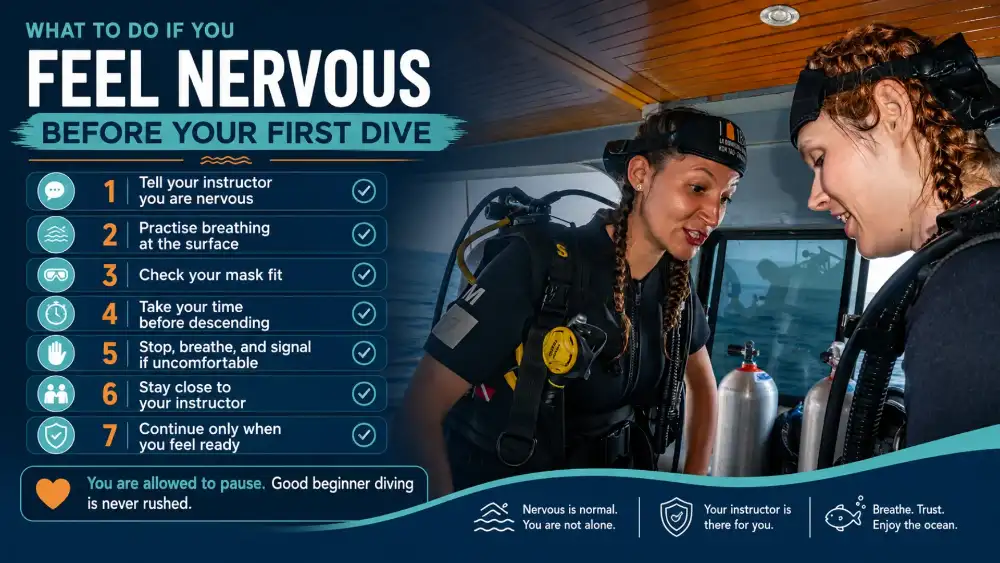
Feeling nervous before your first scuba dive is very common. Many beginners worry about breathing underwater, going too deep, clearing the mask or feeling trapped. This does not mean you cannot dive. It means you need calm instruction, clear explanations and time to adjust.
Before entering the water:
If you feel panic underwater, the most important thing is to stop, breathe and signal your instructor. You do not need to solve everything alone. Instructors are trained to calm beginners, make eye contact, help control buoyancy and guide you safely.
A simple beginner panic plan:
You are allowed to pause. You are allowed to feel nervous. You are allowed to end the dive if you are not comfortable. Good beginner diving is not about pressure; it is about confidence. For more information, check the detailed guide on Koh Tao diving anxiety management: first dive techniques and tips.
Use this checklist before booking your first dive or Open Water course:
| Question to ask | Why it matters |
|---|---|
| Is the experience suitable for complete beginners? | Confirms the dive is beginner-friendly |
| What is included in the price? | Avoids surprise fees |
| Will I complete a medical form? | Shows that safety procedures are taken seriously |
| How many students are with each instructor? | Smaller groups can mean more support |
| How much shallow-water practice is included? | Helps nervous beginners build comfort |
| What happens if I feel anxious? | Shows whether the school supports nervous divers |
| Is equipment rental included? | Important for budgeting |
| What language will the instructor speak? | Clear communication matters underwater |
| How long does the day or course take? | Helps you plan travel days |
| Which dive sites are used for beginners? | Conditions should match your level |
| Can I upgrade from Try Dive to a course? | Helpful if you enjoy the first dive |
| What is the cancellation or weather policy? | Important for travel planning |
Prices vary by dive school, certification agency, inclusions and season. As a general guide, beginner scuba diving in Koh Tao often falls into these ranges:
| Diving option | Typical Koh Tao price range | Notes |
|---|---|---|
| Try Dive | Around 2,500–3,500 ฿ | Usually one beginner experience, no certification |
| Open Water course | Around 11,000–13,500 ฿ | Usually includes training, equipment and certification materials |
| Refresh dive | Varies by school, but usually around 2,500–3,500 ฿ | For already-certified divers who need practice |
| Fun dives | Around 2,000–3,500 ฿ | For certified divers only |
When comparing dive schools, look beyond the headline price. At La Bombona Diving, beginner courses are structured to include the training, equipment and support needed for a safe and enjoyable first diving experience.
Before booking, ask whether the price includes:
For beginner divers, value is not only about price. It is about safety, comfort, instructor attention and honest guidance.
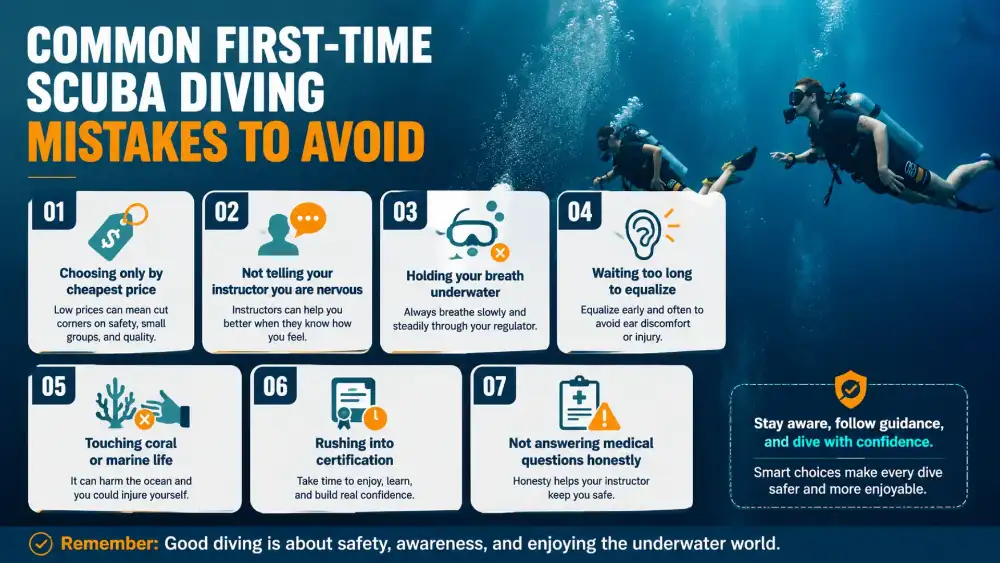
Most first-time divers have similar concerns and make similar mistakes. The good news is that they’re easy to avoid with the right preparation and guidance.
It’s tempting to book the cheapest option, but scuba diving is not something where price should be the only factor. Consider instructor experience, safety standards, group sizes and what is included in the package. A slightly higher price often provides a better overall experience.
Many beginners feel anxious before their first dive, especially about breathing underwater or descending below the surface. Letting your instructor know how you feel allows them to adapt the pace, provide extra reassurance and help you feel more comfortable throughout the experience.
One of the most important rules in scuba diving is to breathe continuously. New divers sometimes instinctively hold their breath when concentrating or feeling uncertain. Focus on slow, relaxed breathing and follow your instructor’s guidance at all times.
Pressure changes are a normal part of diving. Equalising your ears early and often during descent is much easier than trying to fix discomfort once it starts. If you experience pain or difficulty equalising, stop and communicate with your instructor immediately.
Coral reefs are living ecosystems that can be easily damaged by contact. Some marine animals may also sting, bite or become stressed when disturbed. The best approach is to observe marine life from a respectful distance and avoid touching anything underwater.
If you’re short on time or unsure whether diving is right for you, a Try Dive can be a better starting point than immediately enrolling in a full certification course. Taking the option that matches your goals often leads to a more enjoyable experience.
Medical questionnaires are an important part of dive safety. Certain health conditions may require additional medical clearance before diving. Providing accurate information helps ensure that diving is safe and appropriate for you.
Choosing a dive school is one of the most important decisions you will make. For beginners, the best dive school is not always the biggest, cheapest or most famous. It is the one that helps you feel safe, informed and supported.
Look for:
Red flags before booking
Be careful if a dive school:
A good dive school will welcome beginner questions. You should never feel silly for asking how the day works, how deep you will go, or what happens if you panic. For more information, you can check the detailed guide on how to choose the best dive school in Koh Tao.
Scuba diving may seem intimidating at first, but for most beginners the experience is far more comfortable and enjoyable than expected. With the right instruction, proper safety procedures and realistic expectations, your first dive can be both safe and memorable.
Whether you choose a Try Dive to experience breathing underwater for the first time or an Open Water course to become a certified diver, Koh Tao offers an excellent environment to begin your diving journey.
At La Bombona Diving, we specialise in helping first-time divers feel comfortable, confident and excited about exploring the underwater world. Our experienced instructors provide personalised guidance, patient support and a relaxed learning environment designed specifically for beginners.
If you’re ready to discover what scuba diving is really like, get in touch with our team today. We’ll help you choose the right option for your experience level, answer your questions, and make your first diving experience in Koh Tao one to remember.
Koh Tao’s beginner-friendly dive sites are home to a variety of tropical marine life and healthy coral reefs. While every dive is different, first-time divers commonly spot colourful reef fish, coral formations and a range of smaller marine creatures. Some of the marine life you may encounter includes butterflyfish, angelfish, parrotfish, bannerfish, rabbitfish, fusiliers, wrasse, gobies, blue-spotted stingrays, moray eels, sea cucumbers, Christmas tree worms and colourful coral gardens. Lucky divers may also occasionally encounter sea turtles, depending on the dive site and conditions.
It’s important to remember that marine life sightings can never be guaranteed. Factors such as season, visibility, currents and natural animal behaviour all influence what you see underwater. The best beginner dives focus on enjoying the reef responsibly and appreciating the underwater environment rather than chasing specific animals.
Both Koh Tao and Phuket are popular diving destinations in Thailand, but they offer different experiences for first-time divers.
Koh Tao is one of the world’s most popular destinations for learning scuba diving, with a strong beginner-focused training culture. Open Water courses and introductory dives are generally more budget-friendly, a large number of dive schools sit within a compact area (so it is easy to compare options and schedules), the island has a relaxed atmosphere where diving is the main focus for many visitors, and many beginner-friendly dive sites are close to the island, which means shorter boat trips and more time in the water.
Phuket offers good scuba training, but diving is often just one of many holiday activities. Courses and overall holiday costs are typically higher than in Koh Tao, dive operators are spread across a larger region (so travel between accommodation and dive centres may take longer), and some popular dive sites require longer boat journeys. It is better suited to travellers who want to combine diving with beaches, sightseeing, shopping, island tours and nightlife.
If your main goal is to try scuba diving for the first time or complete an Open Water course, Koh Tao is often considered the better choice. The island is built around diving, with beginner-friendly conditions, a wide range of training options and a strong community of new divers. Phuket can be a good option if you’re planning a broader holiday. For many first-time divers, though, Koh Tao’s dive-focused environment makes learning feel simpler, more convenient and less intimidating.
No, you do not need to be a strong or competitive swimmer to try scuba diving in Koh Tao. However, you should feel reasonably comfortable in the water and be able to stay calm while following your instructor’s guidance. For introductory experiences such as a Try Dive, you remain under close instructor supervision throughout the dive, which makes it suitable for many beginners with limited swimming experience. Open Water certification courses, on the other hand, include basic water-skill requirements, such as swimming a set distance and floating or treading water for a specific period. If you’re unsure whether your swimming ability is suitable, speak with the dive school before booking. They can explain the requirements, assess your situation and recommend the most appropriate beginner option.
It’s completely normal to feel nervous before your first scuba dive. After all, breathing underwater is something most people have never experienced before. Common concerns include breathing through a regulator, descending below the surface, or simply not knowing what to expect. The good news is that most beginners become much more comfortable once they enter the water and start breathing slowly through the regulator. A well-structured beginner dive includes a thorough briefing, shallow-water practice and close instructor supervision, so you build confidence step by step. You are never expected to rush: a good instructor moves at a pace that feels comfortable, answers your questions and helps you relax before progressing. For many first-time divers, the initial nerves disappear within the first few minutes underwater.
Your first scuba diving experience is designed to be gradual, structured and beginner-friendly. You won’t be expected to know anything beforehand, as your instructor guides you through every step. A typical first dive usually includes completing a medical questionnaire, a beginner-friendly theory and safety briefing, getting fitted with scuba equipment, learning basic underwater hand signals, practising a few simple skills in shallow water, a slow guided descent with your instructor, and exploring the reef under close supervision. The goal is to help you feel comfortable before moving deeper. Most beginners find that once they are familiar with breathing through the regulator, the experience quickly becomes more relaxed and enjoyable.
Most healthy people can try scuba diving in Koh Tao, but certain medical conditions may require additional medical clearance or make diving unsuitable. Before any dive or certification course, you’ll be asked to complete a medical questionnaire to help ensure diving can be done safely. Conditions that may require further assessment include asthma or certain respiratory conditions, heart or cardiovascular problems, recent surgery or serious injury, epilepsy or seizure disorders, lung conditions such as a collapsed lung (pneumothorax), certain medications or ongoing medical treatments, and pregnancy. Having one of these conditions does not automatically mean you cannot dive: in many cases a doctor with diving medicine knowledge can determine whether it is safe for you to participate. The most important thing is to answer all medical questions honestly. If you’re unsure whether a condition may affect your ability to dive, contact the dive school before booking.
The PADI Open Water course is the most popular beginner scuba diving certification in Koh Tao. It is designed for people with little or no previous diving experience and teaches the essential skills needed to dive safely and confidently. During the course you learn basic scuba theory and safety principles, how scuba equipment works and how to use it correctly, essential underwater skills in confined or shallow water, buoyancy control and underwater communication, dive planning and buddy procedures, safe ascent, descent and equalisation techniques, and open-water diving skills under instructor supervision. Once certified, you are qualified to dive with a buddy within the limits of your certification and continue exploring dive sites around the world. While PADI is the best-known training agency, other organisations such as SSI and RAID also offer internationally recognised beginner certifications. Although course structures may vary slightly, all major agencies teach the same core diving skills, safety procedures and beginner knowledge required to become a certified diver.
More in Diving Tips
 Diving Tips
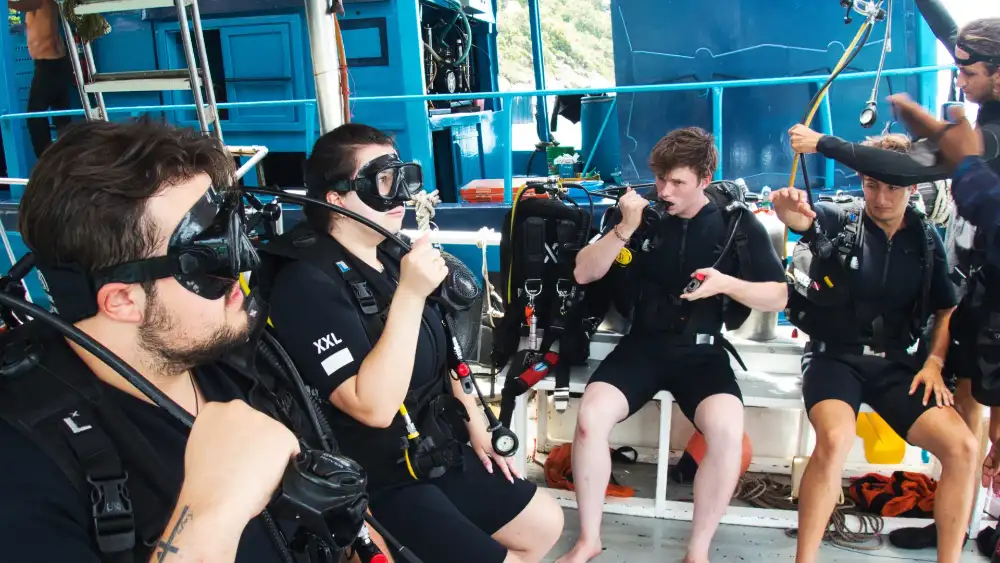
Depth, breathing, training, safety, equipment and cost compared side by side, so you can decide whether a snorkel afternoon, a Try Dive or a full Open Water course is the right fit for your Koh Tao trip.
 Diving Tips
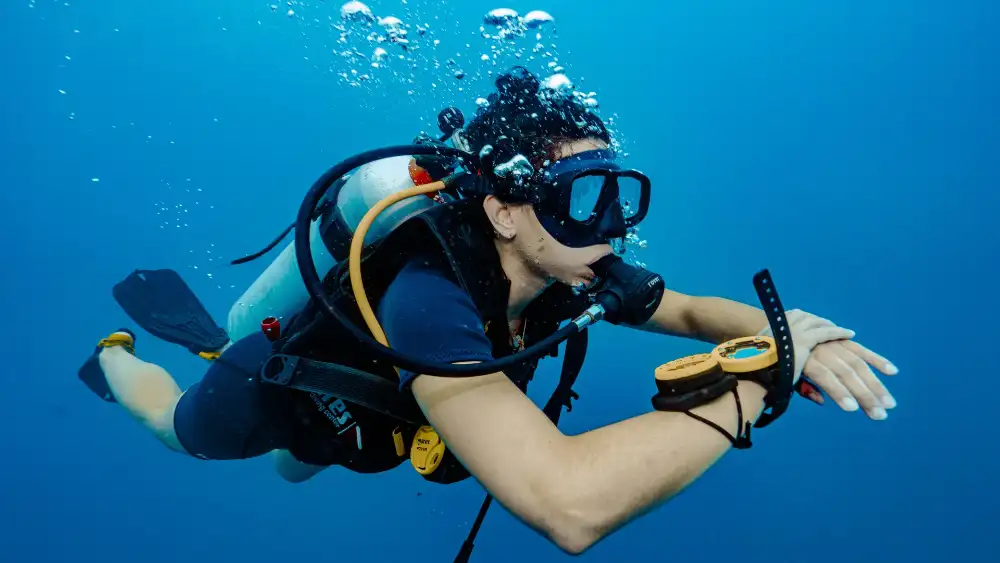
An Open Water course in Koh Tao usually takes three to four days — but the advertised number of days tells only part of the story. Here is what actually fills those days, why schedules differ between dive schools, and how to plan your stay around the course.
 Diving Tips
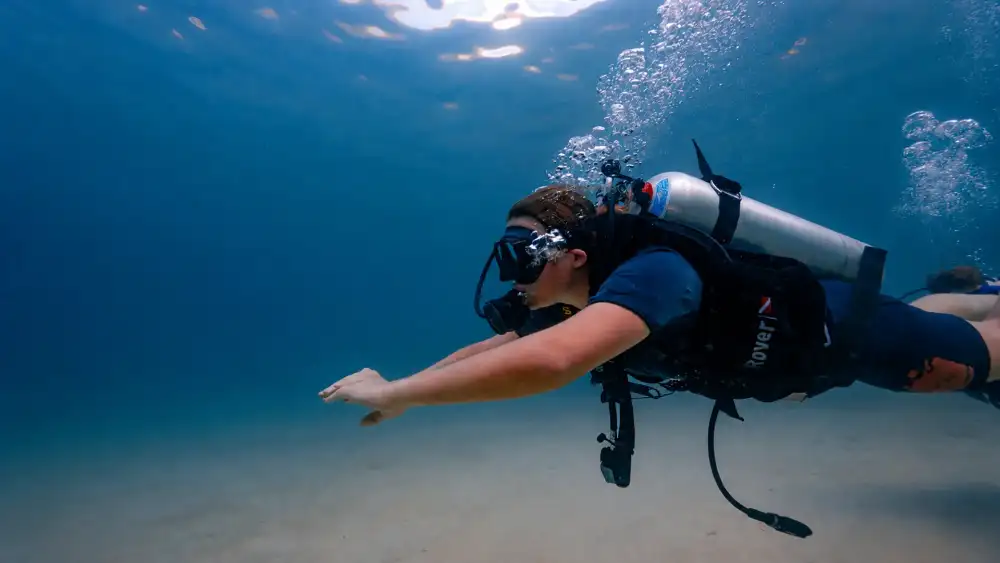
PADI, RAID and SSI compared across the whole training pathway — Open Water, advanced, rescue, specialities, Divemaster, instructor and technical — plus what actually decides the quality of your course in Koh Tao.
Message us on WhatsApp — courses, fun dives and honest advice about Koh Tao.
Chat on WhatsApp