Visibility, sea conditions, water temperature and whale shark windows for every month of the year — plus which dive sites work in each season and when to come for the best value.
22 May 2025 · updated 15 August 2026 · by Bryan Roseman
Key takeaways
- Best overall window: March–May and September–October bring the calmest seas and the best visibility of the year (20–30 m+).
- Single best month: April — peak visibility, warmest water and the highest whale shark activity, though also the busiest and priciest.
- Whale sharks: best chances are March–April and September–October, driven by seasonal plankton blooms.
- Monsoon season: November–January brings rougher seas and lower visibility (5–15 m), but diving still runs daily by shifting to sheltered sites.
- Best value: February and October–November combine solid conditions with lower accommodation and course rates.
- Water temperature: warm year-round (26–30°C). A 3 mm shorty covers most months.
- Beginners: March–May gives the calmest, most predictable conditions for certification courses.
- Site access shifts by season: the outer pinnacles (Chumphon, Southwest, Sail Rock) run March–October; sheltered east-coast and southwest sites take over during monsoon.
Choosing the best time to dive Koh Tao makes a real difference to your underwater adventure on Thailand’s premier diving destination. This small island in the Gulf of Thailand has distinct seasonal patterns that affect visibility, marine life encounters and overall diving conditions, so knowing how the seasons change will help you plan your trip.
Whether you’re after optimal conditions for your Open Water certification, hoping for a whale shark encounter, or looking for budget-friendly dates, timing your visit strategically can turn a good diving trip into an extraordinary one.
So here is everything you need to know about the best time to dive in Koh Tao.
| Season | Months | Visibility | Sea conditions | Water temp | Marine life |
|---|---|---|---|---|---|
| Hot season | Mar – Sep | 20–30 m | Calm & clear | 28–30°C | Excellent |
| Whale shark season | Mar–Apr, Sep–Oct | 15–25 m | Good | 28–29°C | Peak encounters |
| Shoulder season | Feb, Oct–Nov | 10–20 m | Variable | 26–28°C | Good |
| Monsoon season | Nov – Jan | 5–15 m | Changeable | 26–27°C | Variable |
The best time to dive in Koh Tao falls within this extended hot season, when the island shows its underwater world at its finest. Koh Tao’s reputation as a world-class diving destination was built on the consistent conditions of these months.
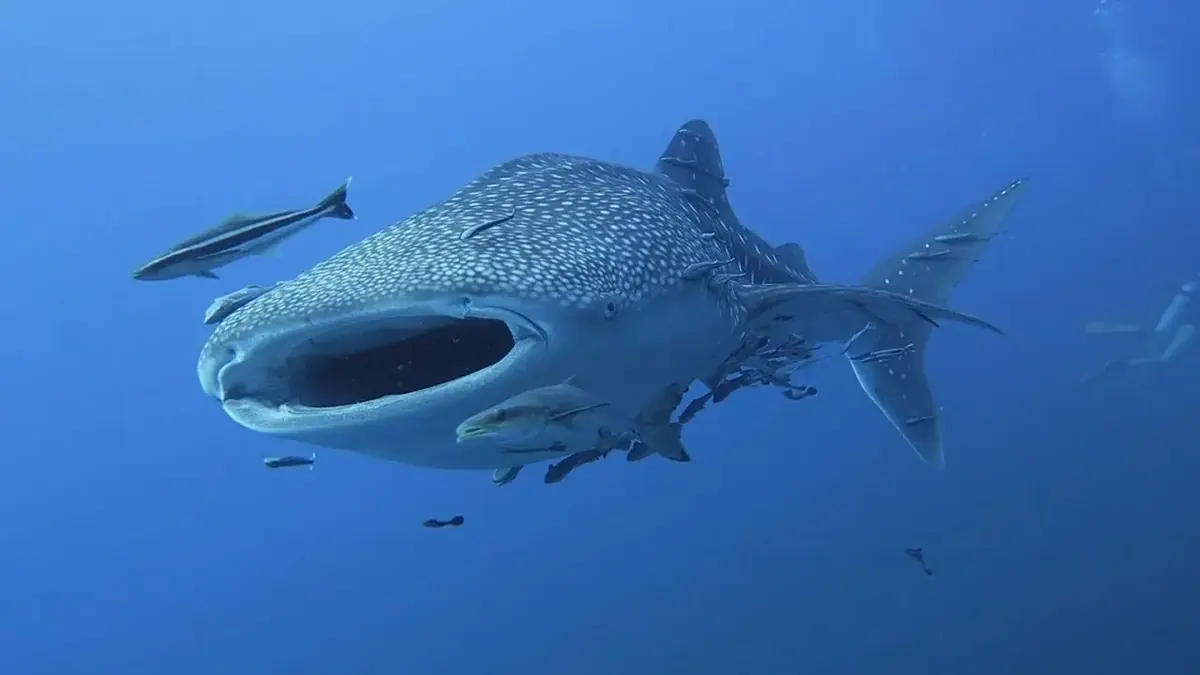
Understanding seasonal marine life patterns helps you plan encounters with specific species during the best time to dive Koh Tao for your interests.
Typical mid-range visibility. Any given day can sit above or below — see the month-by-month table for the full ranges.
While the hot season offers the best time to dive Koh Tao for optimal conditions, budget-conscious divers can find excellent value during the shoulder seasons without giving up much of the diving experience.
February often surprises visitors as one of the best times to dive Koh Tao for value seekers. As the island emerges from monsoon season, the reefs look refreshed and marine life becomes increasingly active. Visibility typically sits at 15–20 metres, while accommodation costs drop significantly from peak season rates.
The transition into monsoon season offers another excellent window for budget diving. Early October often keeps good visibility and calm conditions, while late October through November brings opportunities for unusual marine encounters as the changing conditions attract different species.
Traditionally considered the challenging period, monsoon season still offers plenty of diving for flexible travellers. Koh Tao’s rich marine ecosystem keeps thriving through these months, just with more variable conditions.
Eastern dive sites often stay accessible when the western sites get rough, and the reduced number of divers means more intimate underwater encounters. Advanced divers in particular enjoy the challenge and rewards of diving during this period.
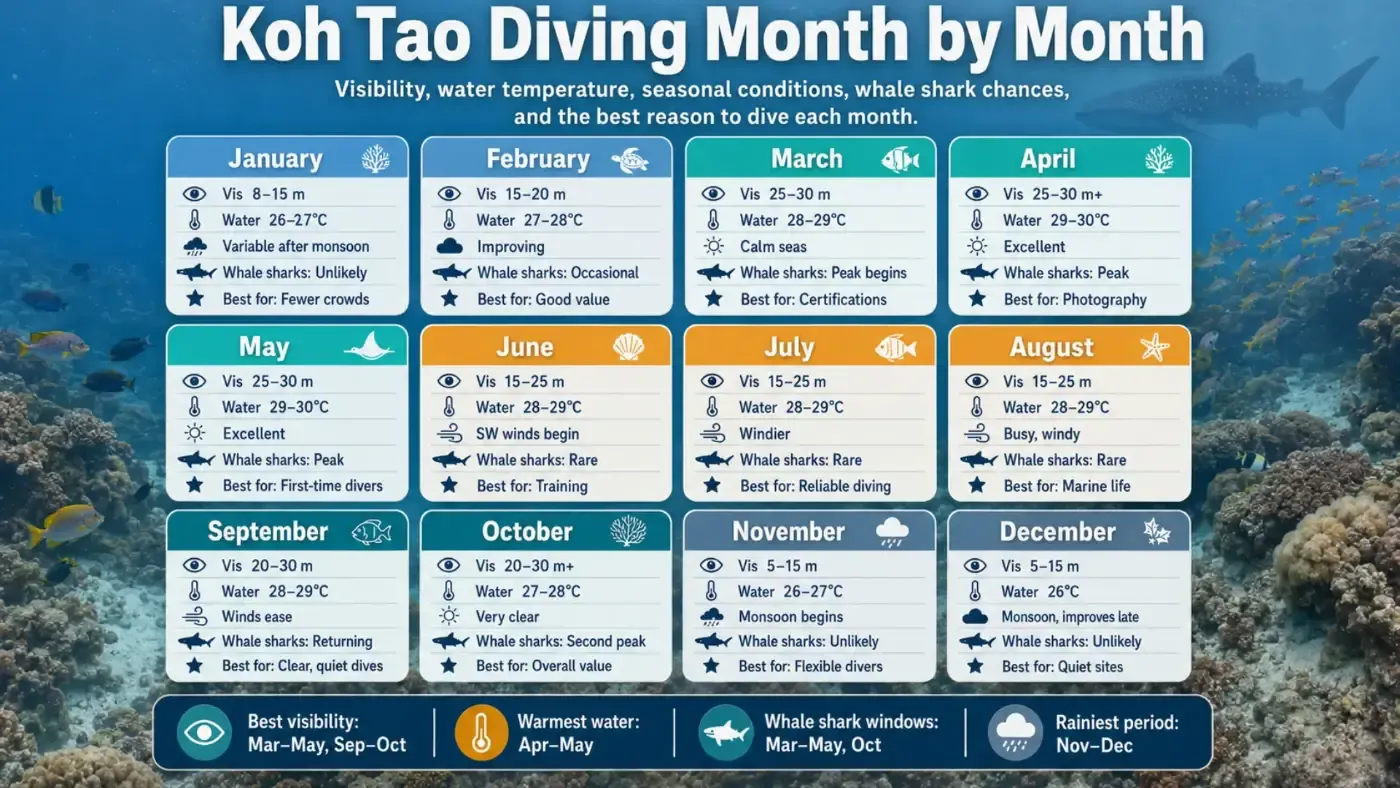
If you want the answer for one specific month, this table covers every month of the year.
| Month | Visibility | Water temp | Conditions | Whale sharks | Best for |
|---|---|---|---|---|---|
| January | 8–15 m | 26–27°C | Seas calming after monsoon, still variable | Unlikely | Fewer crowds, budget diving |
| February | 15–20 m | 27–28°C | Improving fast, often glassy | Occasional | Value + good conditions combo |
| March | 25–30 m | 28–29°C | Calm, flat seas | Peak season begins | Certifications, whale sharks |
| April | 25–30 m+ | 29–30°C | Best conditions of the year | Peak | Photography, first-time divers |
| May | 25–30 m | 29–30°C | Best conditions of the year | Peak | Photography, first-time divers |
| June | 15–25 m | 28–29°C | Southwest wind begins, east coast sheltered | Rare | Training courses, quieter boats |
| July | 15–25 m | 28–29°C | Windier, boats shift to east coast | Rare | Reliable diving despite wind |
| August | 15–25 m | 28–29°C | Similar to July, busiest month | Rare | Marine life diversity |
| September | 20–30 m | 28–29°C | Wind drops, visibility climbing | Returning | Quiet boats, excellent clarity |
| October | 20–30 m+ | 27–28°C | Often the clearest water of the year | Peak (2nd window) | Best overall value-to-conditions ratio |
| November | 5–15 m | 26–27°C | Northeast monsoon begins, unpredictable | Unlikely | Flexible, adventurous divers |
| December | 5–15 m | 26°C | Peak monsoon, improves late in the month | Unlikely | Quiet sites, off-season rates |
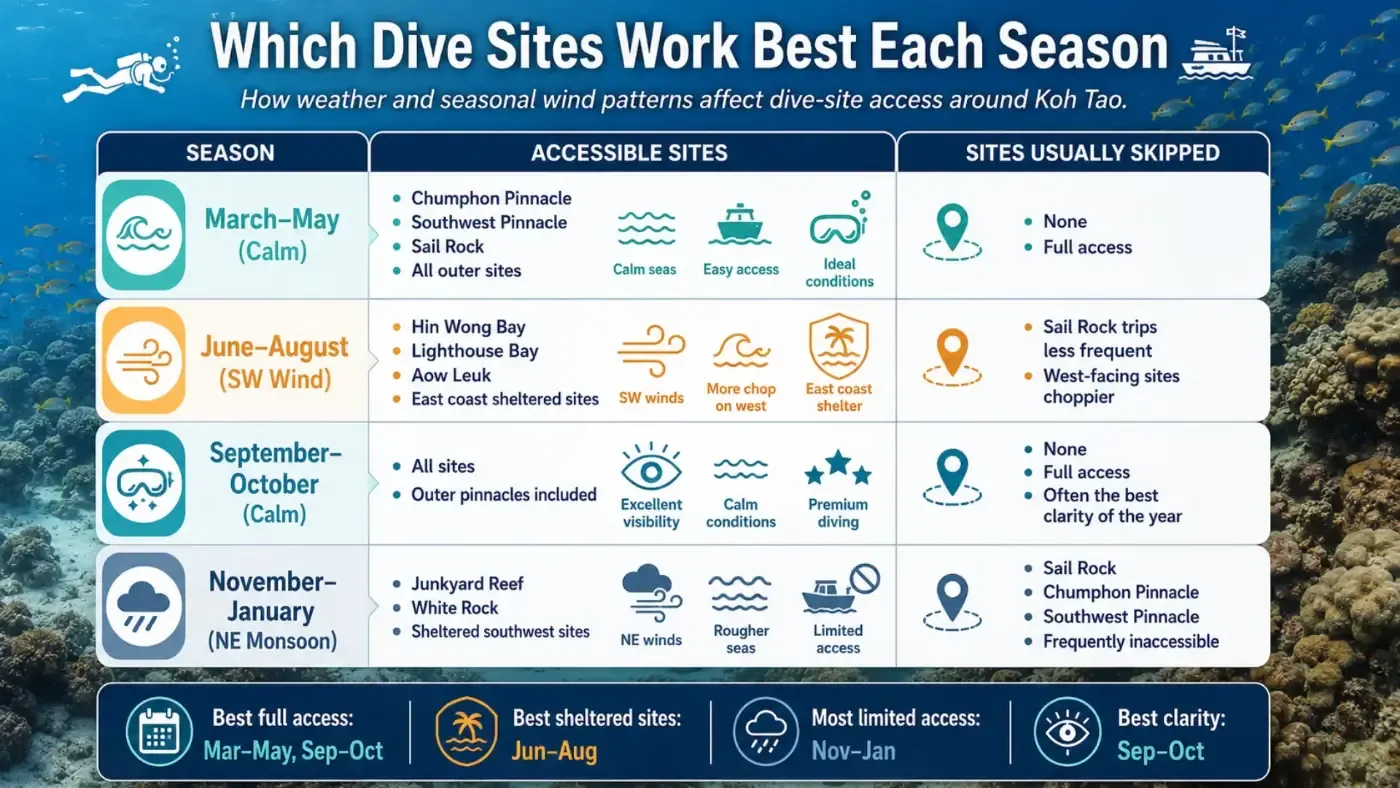
| Season | Accessible sites | Sites usually skipped |
|---|---|---|
| March–May (calm) | Chumphon Pinnacle, Southwest Pinnacle, Sail Rock, all outer sites | None — full access |
| June–August (SW wind) | Hin Wong Bay, Lighthouse Bay, Aow Leuk (east coast, sheltered) | Sail Rock trips less frequent, west-facing sites choppier |
| September–October (calm) | All sites, including the outer pinnacles | None — full access, often the best clarity of the year |
| November–January (NE monsoon) | Junkyard Reef, White Rock, sheltered southwest sites | Sail Rock, Chumphon Pinnacle, Southwest Pinnacle — frequently inaccessible |
Whatever season you choose to visit, La Bombona Diving makes sure you get exceptional diving year-round. Our experienced team knows exactly when and where to dive based on the conditions on the day, maximising your chances of incredible encounters in any season.
Open Water certification: 11,000 ฿ — perfect for any season. 4 ocean dives over 4 days · all equipment included · year-round availability.
April and May are the optimal months for beginner divers visiting Koh Tao. The combination of exceptional visibility (25–30 metres), calm seas and stable weather creates ideal learning conditions. The water stays a comfortable 28–30°C, so you need only minimal thermal protection, and the predictable conditions let instructors focus entirely on skill development rather than managing the environment.
Popular dive sites can get busy during the hot season (especially July–August), but experienced dive centres like La Bombona Diving manage crowding through strategic scheduling and alternative site selection. Early-morning departures often reach sites before the crowds arrive, and having several boat options gives us the flexibility to visit less-frequented spots. More divers also means more frequent boat schedules and more specialised courses on offer, which many visitors find improves the overall experience.
Experienced divers often find monsoon season (November–January) particularly rewarding despite the challenges. The changing conditions attract pelagic species not commonly seen in calmer months, while fewer divers means more intimate encounters. Eastern sites such as Hin Wong Bay frequently stay accessible when the western sites get rough, and the dramatic underwater topography looks even more impressive under the changing light created by the weather above.
Dive course prices stay stable year-round at reputable centres, but accommodation costs move a lot with seasonal demand. Peak season sees accommodation rise 30–50% above low-season rates, particularly during the European summer holidays (July–August) and around major festivals. The best-value periods are February and October–November, when many dive centres offer packages combining courses with accommodation. Because course prices are consistent, choosing a shoulder season mainly saves you money on lodging and meals rather than on certification costs.
Whale shark sightings peak in two distinct periods: late March through early May and mid-September through October. These windows line up with plankton bloom cycles that draw the gentle giants to feed around Koh Tao's pinnacles — particularly Chumphon Pinnacle, Southwest Pinnacle and Sail Rock. Sightings can never be guaranteed, but diving in these months raises your chances significantly: some periods show encounter rates of 15–20%, compared with 2–5% at other times of the year.
Yes. Koh Tao's rainy season (roughly November to January) rarely cancels diving outright. The island's position in the Gulf of Thailand keeps it sheltered, so dive boats simply shift to protected sites like Junkyard Reef and White Rock when the exposed pinnacles get too rough. Visibility typically drops to 5–15 metres and schedules can change on the morning of the dive, but diving is available nearly every day.
Yes. Koh Tao is a year-round dive destination. Conditions shift with two monsoon cycles, so visibility and sea state vary from around 5 metres during the peak monsoon (November to December) to more than 30 metres in the dry season (March to May and September to October). Dive centres operate daily throughout the year by adjusting which sites they visit.
Early to mid December falls within the monsoon season, with rougher seas and visibility typically 5–15 metres. Conditions usually start improving in the second half of the month. Diving is possible throughout December, but if calm water and consistent visibility are your priorities, March to May or September to October are better choices.
April is widely considered the best month for scuba diving in Koh Tao. It combines the year's most consistent visibility, often beyond 25–30 metres, with calm seas and peak whale shark activity. The trade-off is that it is also the busiest and most expensive month, because it coincides with Songkran, the Thai New Year festival.
Koh Tao is one of the world's largest scuba certification hubs, with courses running year-round from Open Water through Divemaster and Instructor level. Calmer months such as March to May and September to October make skill development easier for beginners because instructors spend less time managing surface conditions, but certification courses run all year.
Most divers spend 4 to 7 days on Koh Tao. That is enough to complete an Open Water certification (usually 3 to 4 days) plus a couple of fun dives. Certified divers often stay long enough for 8 to 10 fun dives across multiple sites. If you're hoping to see whale sharks or dive both coasts, a few extra days give you flexibility for changing weather, especially outside the March–May and September–October seasons.
Water temperatures stay between 26°C and 30°C all year, so a 3 mm shorty wetsuit suits most months. A full 3 mm wetsuit is a good choice from November to January, when the water cools closer to 26°C. Reef-safe sunscreen, a rash guard for surface intervals and a light jacket for boat rides in the cooler monsoon months are also worth packing. Dive centres provide the rest of the scuba equipment.
Koh Tao generally offers clearer water and is better known for scuba certifications and whale shark encounters. Its dive sites are close to shore, so boat rides are short. Phuket has a more developed tourism infrastructure and access to offshore sites such as the Similan Islands, but trips are usually more expensive and involve longer travel. Koh Tao is the better choice for certification courses and budget-friendly diving; Phuket is stronger for wreck diving and liveaboard trips to remote reefs.
Koh Tao's dive sites are generally calmer, shallower and better suited to beginners and certification courses, and the island is known for affordable training. Koh Phi Phi has dramatic limestone scenery and access to more advanced sites with stronger currents, making it a better option for experienced certified divers looking for more challenging conditions.
More in Diving Tips
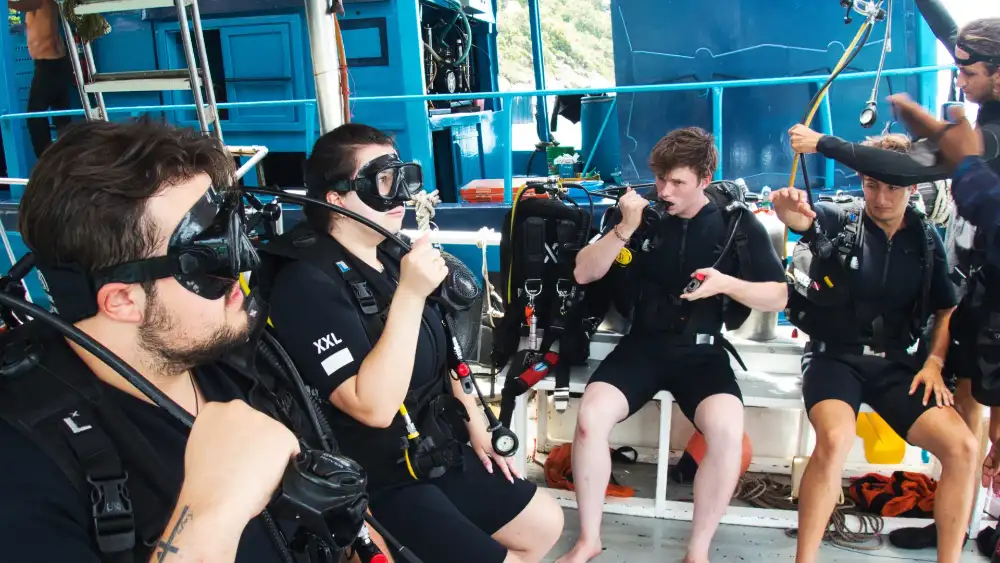 Diving Tips
Depth, breathing, training, safety, equipment and cost compared side by side, so you can decide whether a snorkel afternoon, a Try Dive or a full Open Water course is the right fit for your Koh Tao trip.
 Diving Tips
An Open Water course in Koh Tao usually takes three to four days — but the advertised number of days tells only part of the story. Here is what actually fills those days, why schedules differ between dive schools, and how to plan your stay around the course.
 Diving Tips
PADI, RAID and SSI compared across the whole training pathway — Open Water, advanced, rescue, specialities, Divemaster, instructor and technical — plus what actually decides the quality of your course in Koh Tao.
Message us on WhatsApp — courses, fun dives and honest advice about Koh Tao.
Chat on WhatsApp