The full answer
Why is the Open Water course the best choice for most beginners?
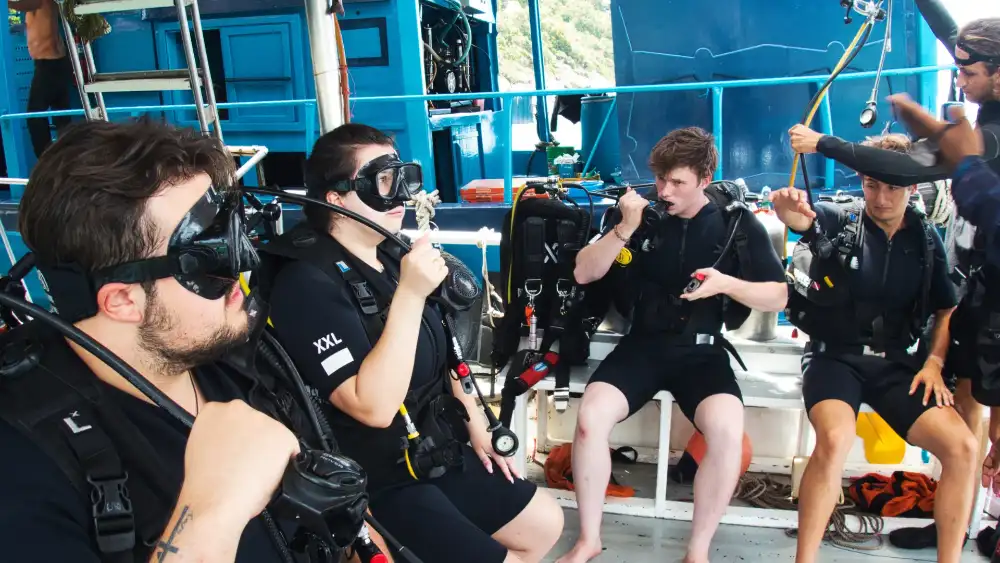
The Open Water course is designed to take someone who has never dived and turn them into a competent, safe diver. That’s the whole point of it. It’s paced so you can ease in: theory first, then the pool, then the ocean, with time at every step to ask questions and get to know your instructor.
After every dive there’s a debrief, where we talk about what you enjoyed and what you found tricky. By the end, you’re not just following someone around underwater. You can plan a dive, look after your own kit and look after your buddy, and the certification lasts for life.
On Koh Tao that’s also the course we know best. In 12 years on the island we’ve issued over 20,000 certifications, and most of the people we teach have never breathed underwater before.
What’s the difference between a Try Dive and the Open Water course?
A Try Dive is a one-day taste of diving, while the Open Water course makes you a certified diver. Here’s how they compare on Koh Tao:
| Try Dive | Open Water course | |
|---|---|---|
| How long | 1 day | 3.5 days |
| Price at La Bombona Diving | 2,500 ฿ (a second dive is 1,000 ฿ more) | 11,000 ฿ |
| Where you learn the skills | In the ocean, in a shallow sandy area | In a pool first, then the ocean |
| Deepest dive | 12 m, with your instructor right beside you | 18 m once certified |
| Swim test | None | 200 m swim and a 10-minute float |
| What you leave with | A great day and a feel for diving | A certification recognised worldwide, for life |
| Best for | People with one day, or who just want a taste | Anyone with a few days who thinks they’ll dive again |
Both are taught with a maximum of 4 people per instructor, so you’re never one of a crowd. The only extra on either is the mandatory dive insurance, 100 ฿. Prices checked November 2026.
Why does starting in the pool make such a difference?
Starting in a pool lets you practise every skill in calm, predictable water before you take the step to the ocean. Clearing your mask, finding your regulator, getting your buoyancy right: it’s all much easier to learn when there are no waves and you can stand up whenever you like.
I once taught a woman who struggled with almost every skill in the pool. The next morning she told me she didn’t want to go in the ocean, because she hated being on the surface not knowing what was underneath. Good job we weren’t staying on the surface. At the boat she refused to jump in and had what I can only describe as a panic attack, so I got back on, helped her calm down and we tried again together. Once she was under the water she was amazing. She went on to do her Advanced course, and afterwards she thanked me for helping her get over a lifelong fear. That’s what a course gives you that a single day can’t: time.
When does a Try Dive make more sense?
A Try Dive makes sense if you’ve only got one day on Koh Tao, or you just want a taste before you commit. It’s a closely supervised experience, and it’s a brilliant day out.
Be aware, though, that on a Try Dive the skills and the dive all happen in the ocean. For some people that’s a lot to take in at once, especially if you’re not very comfortable in the water. If that sounds like you, the Open Water course is the gentler way in, even though it’s the bigger course.
What happens if I do a Try Dive first and want to carry on?
If you do a Try Dive and want to carry on, you can move on to the Open Water course, and we make that easy. Try divers get 10% off the course, and because the Try Dive safety briefing covers some of the same ground, we can shorten the course a little.
If you do the Try Dive’s second dive, it can count towards the Open Water course. Our boat trips run two dives each, though, so the schedule doesn’t fit neatly around it. That’s why, if you’ve got the time, we usually recommend going straight into the full course.
What if I start the course and decide diving isn’t for me?
If you decide during the pool session that diving isn’t for you, at La Bombona Diving we refund the part of the course you haven’t done. Most dive centres do something similar, but check the refund policy before you book wherever you go.
That’s the point of starting in the pool: you find out how diving feels in calm water, before you’ve committed to the ocean.
When should I do my course on Koh Tao?
Do your course at the start of your trip, not the end. Lots of travellers leave it until last and then regret it, because they’ve missed the chance to dive in other places around Southeast Asia. Get certified first, and you can dive anywhere else on your trip.
Questions people also ask
Do I need to be a strong swimmer for the Open Water course?
No, but you do need to be comfortable in the water. The Open Water course asks for a 200 m swim with no time limit and any stroke (or 300 m with a mask, fins and snorkel), plus a 10-minute float or tread. A Try Dive has no swim test.
Can I do a Try Dive first and then the Open Water course?
Yes. If you do the Try Dive's second dive, that dive can count towards the Open Water course, and try divers get 10% off the Open Water course if they carry on. Some of the theory is covered in the Try Dive's safety briefing, so the course can be shortened a little.
What if I have a medical condition?
Everyone fills in a standard diver medical questionnaire before diving. If you answer yes to any question on it, you'll need a doctor to sign you off before you dive. If you answer no to every question, you don't need a medical.
Does an Open Water certification expire?
No. The certification is recognised worldwide and never expires. If you haven't dived for a while, a refresher before your next dive is a good idea.
How long does the Open Water course take on Koh Tao?
The Open Water course on Koh Tao takes 3.5 days, with a pool session and four ocean dives. Leave yourself a spare day after your last dive before you fly: the usual advice is at least 18 hours after several days of diving.
Test yourself
Which course is right for you?
Four quick questions on what you've just read.
-
Where do you practise your first skills on the Open Water course?
The Open Water course starts with a pool session, so you practise in calm, predictable water before you take the step to the ocean.
-
What do you have at the end of a Try Dive?
A Try Dive is a closely supervised experience. It shows you what diving feels like, but it doesn't certify you to dive.
-
How deep can you dive once you're certified on the Open Water course?
An Open Water certification lets you dive to 18 m. A Try Dive goes to a maximum of 12 m with an instructor right beside you.
-
What happens at La Bombona Diving if you decide after the pool session that diving isn't for you?
We refund the unused part of the course. Nobody should go into the ocean feeling forced.
Sources
Written by