An Open Water course in Koh Tao usually takes three to four days — but the advertised number of days tells only part of the story. Here is what actually fills those days, why schedules differ between dive schools, and how to plan your stay around the course.
4 August 2026 · by Bryan Roseman
Key takeaways
- An Open Water course in Koh Tao typically takes 3–4 days, but the advertised duration doesn’t always reflect the actual amount of training. Always compare the daily schedule, not just the number of days.
- Course length varies for good reasons, including online learning, boat schedules, weather, group size, student progress and medical clearance.
- A shorter course isn’t automatically better. The best Open Water programme gives you enough time to build confidence, practise essential skills and learn at a comfortable pace.
- When comparing dive schools, look beyond the price. Consider instructor experience, student-to-instructor ratio, equipment quality, what’s included, and the support available if you need extra practice.
- Choosing the right dive centre is just as important as choosing the course. A school that prioritises safety, small groups and personalised instruction will help you become a confident diver, not just earn a certification.
An Open Water course in Koh Tao usually takes three to four calendar days. Some dive schools also offer compressed schedules of approximately two and a half days, particularly when students complete most of the theory before arriving.
The difference is often about scheduling rather than the amount of training provided.
Therefore, when comparing the Koh Tao Open Water course duration, do not look only at the advertised number of days. Check what happens on each day, how much time is allocated to confined-water practice, when the four ocean dives take place and whether online learning must be completed before arrival.
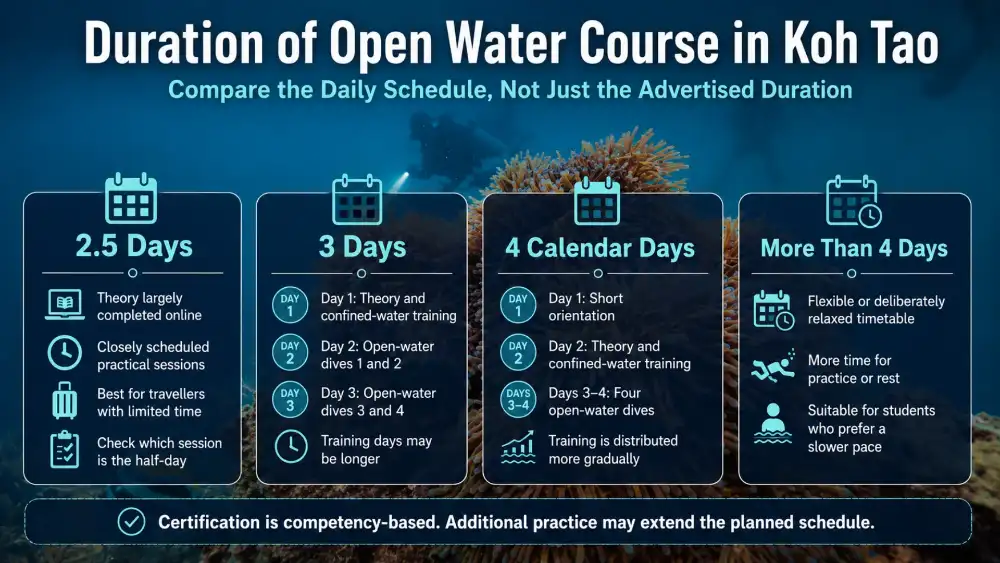
Quick answer: an Open Water course in Koh Tao normally takes three to four calendar days, although some dive centres offer compressed schedules lasting about 2.5 days.
Note. Current Koh Tao course schedules vary because different schools organise orientation, theory, confined-water practice and ocean dives differently. PADI also explains that students who complete knowledge development through eLearning may finish the confined- and open-water parts of a course over three or four days.
Here is how the most common schedules are organised.
| Advertised duration | Typical structure | What to check before booking |
|---|---|---|
| 2.5 days | Theory completed largely online, followed by closely scheduled confined-water training and ocean dives | Which day is the half-day, how long the training days are and whether all theory must be completed before arrival |
| 3 days | One full day for orientation, theory and pool skills, followed by two days of ocean diving | Exact start and finish times and whether the first day is generally longer than the others |
| 4 calendar days | Short orientation on Day 1, theory and pool training on Day 2, followed by two ocean-diving days | Clarify whether Day 1 is primarily an introductory and orientation session or a full day of training |
| More than 4 days | Part-time, flexible or deliberately relaxed training | Whether additional days are included from the beginning or used only when a student needs more time |
An Open Water scuba course in Koh Tao is not simply a collection of recreational dives. It is an entry-level certification programme that teaches a beginner the knowledge and practical skills needed to dive safely within the limits of the qualification.
The course normally contains three main parts:
Students must also complete the required assessments, paperwork and skill evaluations before certification can be issued.
The academic section explains the principles that every beginner needs to understand before diving independently with a certified buddy.
The topics commonly include:
Depending on the dive centre and certification agency, students may complete this section through an app, online learning platform, classroom sessions or a mixture of all three.
Completing online theory before arriving can reduce the amount of classroom study needed on the island. However, it does not replace instructor reviews, confined-water training or ocean dives.
It can reduce the time spent studying at the dive centre, but it does not automatically turn every four-day timetable into a three-day course.
Even after completing the academic modules, students still need to:
Online learning makes the schedule more efficient, but the practical training cannot be skipped.
Open Water training normally includes an assessment of basic swimming ability and comfort in the water.
This is not usually a race or a test of athletic performance. Its purpose is to confirm that the student can move through the water and remain at the surface without assistance.
The exact assessment depends on the certification programme. It may include:
Students who are uncertain about their swimming ability should tell the dive centre before booking. Basic swimming practice before travelling can make the course more comfortable and reduce anxiety during the confined-water session.
Being a weak swimmer does not automatically mean someone cannot learn to dive. However, hiding serious discomfort in the water can make the course more difficult and less safe.
Before completing ocean dives, students practise essential skills in a swimming pool or another controlled environment with pool-like conditions.
Confined-water training allows beginners to become familiar with scuba equipment without immediately dealing with the depth, movement and changing conditions of the ocean.
Skills commonly practised include:
PADI describes confined water as a pool or a body of water with pool-like conditions and states that students practise until they are comfortable before moving into open water.
This part of the course does not take exactly the same amount of time for every student. One beginner may become comfortable clearing a mask quickly, while another may need several calm repetitions.
Additional practice should not be treated as a failure. It means the instructor is making sure that the student can perform an important skill before progressing.
A complete beginner certification commonly includes four open-water training dives.
These dives are separate from the pool or confined-water session. During the ocean dives, students apply the skills they first practised in a controlled environment.
PADI specifies four open-water dives, usually completed over at least two days. SSI also lists four open-water sessions within its current Open Water Diver programme. Currently, many Koh Tao RAID course packages likewise include four ocean dives.
A typical progression looks like this:
| Training stage | Main purpose |
|---|---|
| Open-water dive 1 | Become comfortable breathing and moving in the ocean while practising basic skills |
| Open-water dive 2 | Improve buoyancy, communication and equipment awareness |
| Open-water dive 3 | Complete additional skills and begin taking greater responsibility under supervision |
| Open-water dive 4 | Consolidate skills, practise navigation and demonstrate greater comfort and control |
The exact skills completed on each dive depend on the training programme and the instructor’s plan.
Note. Dive sites may also change according to:
- Wind and waves
- Current
- Underwater visibility
- Boat operations
- Student comfort
- Training depth
- Suitability of the site for beginner skills
Completing the scheduled course days does not automatically guarantee certification.
To earn an Open Water certification, students must demonstrate that they understand the required theory and can safely perform the essential scuba skills during training dives. Depending on the training agency and dive school, the certification process typically includes:
Open Water training is competency-based, not time-based. In other words, certification is awarded only after a student has met all the required performance standards, not simply because they have attended the course for a set number of days.
This approach helps ensure every newly certified diver has the knowledge, skills and confidence needed to dive safely.
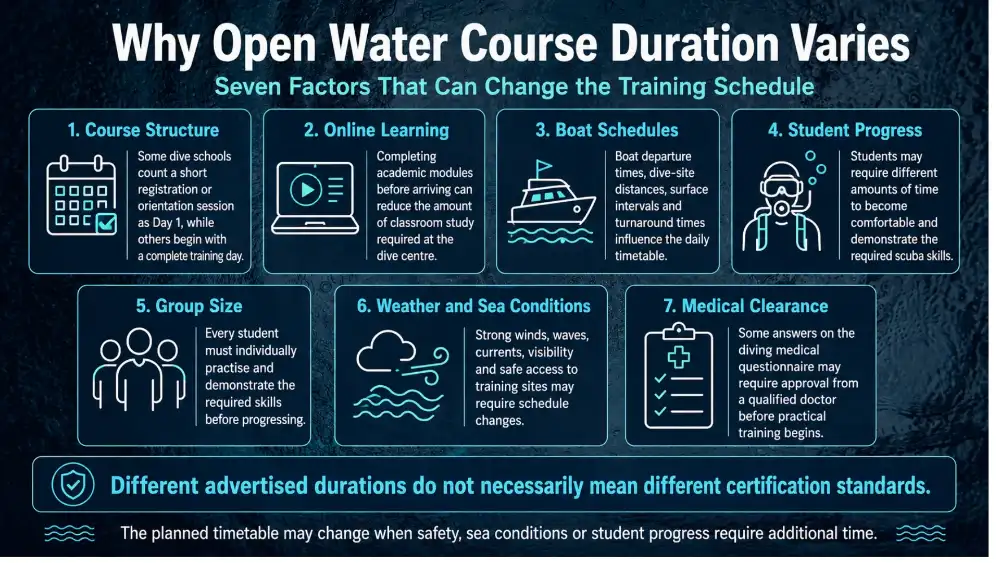
The Open Water scuba course in Koh Tao doesn’t always take the same number of days. While agencies like PADI, SSI and RAID set minimum training standards, individual dive schools have flexibility in how they organise the required theory, confined-water training and open-water dives.
Here are the main reasons why the duration can vary.
Not every dive school defines the “first day” in the same way.
For example, one school may schedule registration, equipment fitting and a course briefing at 4:00 p.m. and count it as Day 1. Another may complete registration before the advertised start date or include it within a full day of theory and confined-water training.
As a result, one school may advertise its programme as a 3-day Open Water course, while another promotes a 4-day course, even though both meet the certification agency’s required training standards and include a similar amount of practical instruction.
Many certification agencies now offer digital learning that students can complete before travelling to Koh Tao.
Students who finish the required online theory before arriving usually spend less time in classroom sessions at the dive centre and can focus more on practical training. Those who haven’t completed the theory may need to use evenings or additional course time to finish the academic requirements before progressing.
Before booking, it’s worth asking:
The four required open-water dives must fit around the dive centre’s boat schedule.
Depending on how a school operates, your training may include:
The distance to the chosen dive sites, surface intervals between dives and the boat’s turnaround time all influence the daily timetable.
Scuba certification is based on demonstrated competence rather than simply attending the course for a certain number of days.
Some students become comfortable underwater almost immediately, while others need additional time and practice to master essential skills such as:
A well-run Open Water course provides enough flexibility for instructors to repeat skills when necessary rather than rushing students through the programme.
Every student must individually demonstrate the required scuba skills before certification.
In group courses, instructors need time to demonstrate each skill, observe every student’s performance, provide feedback and assess competency.
Larger groups may naturally require more time to complete training sessions because every participant must successfully perform the required exercises. Smaller groups often allow more individual attention, although group size alone doesn’t determine the overall quality of instruction.
Light rain doesn’t automatically stop scuba diving. However, conditions such as strong winds, rough seas, currents, poor visibility and safe access to suitable dive sites generally have a much greater impact on scheduling.
When conditions aren’t suitable, a dive centre may:
For this reason, the published course timetable should be viewed as the planned schedule rather than an absolute guarantee.
Before entering the water, students complete a medical questionnaire.
Depending on the answers provided, some students may need medical clearance from a qualified doctor before participating in practical training. If this hasn’t been arranged before arriving in Koh Tao, it can delay the start of the course.
Medical questions should always be answered honestly. Taking the time to obtain proper medical clearance is far safer than diving with an unassessed medical condition.
Yes. Completing an Open Water course in three days is realistic for many beginners.
Several Koh Tao dive centres currently publish three-day programmes. A common structure is:
PADI states that confined- and open-water training can be completed in three or four days when knowledge development is completed through eLearning or another home-study option.
A three-day course is most realistic when:
However, a three-day booking should not be understood as a guarantee that every student will receive certification on the third day.
Certification is earned by demonstrating competence. If a student needs more time with a skill, the safer decision is to continue practising rather than rush to maintain the advertised timetable.
Not necessarily, but it is important to understand how the timetable works.
A compressed course may be suitable when:
The concern is not the number “2.5” itself. The important question is whether the programme still provides enough time for:
Travellers considering a compressed course should request the complete timetable rather than relying on the headline duration.
No. A shorter Open Water course isn’t automatically better, and a longer course isn’t automatically higher quality. The best course is one that gives you enough time to develop the required knowledge, skills and confidence to dive safely.
The number of advertised course days tells only part of the story. Two dive schools may offer courses of different lengths while still meeting the same certification standards. What matters most is how the training is delivered, whether you have enough time to practise essential skills, and whether the schedule suits your learning pace.
Here’s how shorter and longer course schedules typically compare:
| Shorter schedule | More relaxed schedule |
|---|---|
| Uses fewer holiday days, making it convenient for travellers with limited time. | Spreads the training over more days, allowing extra rest between sessions. |
| Works well for students who complete the theory before arriving. | Gives more time for instructor feedback, questions and skill repetition. |
| Can be a good choice for confident swimmers who are comfortable in the water. | May be better suited to nervous beginners or those with limited water confidence. |
| May involve longer or more intensive training days. | Distributes the physical and mental workload more evenly. |
| Leaves less flexibility if weather or other factors disrupt the schedule. | Makes it easier to adjust the timetable if conditions change or extra practice is needed. |
Ultimately, course quality depends far more on the instructor, teaching approach, student-to-instructor ratio and time available to master the required skills than on whether the course is advertised as three or four days.
Before booking an Open Water course in Koh Tao, ask these questions:
These questions will help you compare dive schools more effectively than simply choosing the one with the shortest advertised duration. A course that matches your experience level, learning style and travel plans is more likely to provide a safe, enjoyable and rewarding introduction to scuba diving.
RAID, PADI and SSI are internationally recognised scuba training agencies. A simple way to think of them is like different education boards: they all teach the same core scuba skills and certify divers to recognised standards, but they may differ in their learning platforms, teaching methods, terminology and course structure.
The certification agency doesn’t usually determine the exact day-to-day schedule. Instead, the dive centre organises the theory sessions, confined-water training and open-water dives in accordance with the agency’s standards, while also considering local logistics, boat schedules, sea conditions and students’ learning progress.
| Training organisation | Published approach to duration | Important point |
|---|---|---|
| RAID | RAID provides online academic learning and requires students to complete practical training through an affiliated dive centre | The public RAID course page does not prescribe one universal number of calendar days; the centre organises the practical timetable |
| PADI | Confined- and open-water training may be completed in three or four days when theory is completed through eLearning or home study | The course is performance-based, so progress depends on skill mastery |
| SSI | SSI publishes a suggested duration of 16–32 hours, with six academic sessions, six confined-water sessions and four open-water sessions | The hours may be distributed across different numbers of calendar days |
Plan to stay in Koh Tao for longer than the advertised course duration. Arriving early and avoiding immediate onward travel gives you more flexibility and helps ensure you can complete your training without unnecessary stress.
Whether your Open Water scuba course in Koh Tao is scheduled over three or four days, it’s best to arrive before the course begins rather than on the same day.
For example:
This gives you enough time to settle into your accommodation, complete any registration requirements, prepare your equipment and start the course feeling rested.
When planning your stay, allow time for:
If your schedule allows, consider staying one extra night after certification. It gives you time to relax, explore more of Koh Tao, celebrate earning your certification, or enjoy a fun dive as a newly qualified diver without feeling rushed.
Yes, but it’s usually better to leave a time buffer rather than booking the first available ferry after your course is expected to finish.
Unlike flying, travelling by ferry keeps you at sea level and does not require the same post-dive waiting period. However, the final day of an Open Water course doesn’t always finish exactly as scheduled.
The return to the dive centre may take longer than expected because of:
Even after returning from the boat, you’ll typically need to rinse and return equipment, log your qualifying dives, complete any remaining paperwork and receive your certification details.
For this reason, ask the dive centre what time students usually finish on the final day and leave a comfortable buffer before booking a ferry.
No. You should not fly immediately after completing your Open Water course.
Flying too soon after scuba diving increases the risk of decompression sickness (DCS) because the reduced air pressure at altitude can allow dissolved nitrogen in the body to form bubbles.
Since an Open Water course includes multiple dives over several days, divers should follow the recommended pre-flight surface interval before boarding an aircraft.
Current diving guidance generally recommends waiting at least 18 hours after multiple dives or multiple days of diving before flying. Many divers choose to wait 24 hours where possible, as this provides an additional safety margin and is often easier to plan into a travel itinerary.
Always follow the most conservative guidance provided by:
If you’re planning onward travel after your course, it’s a good idea to schedule your flight for the following day rather than immediately after your final dives. This not only supports safer diving practices but also gives you flexibility if your course timetable changes because of weather or operational factors.
An Open Water course can take longer than planned if a student needs extra time to complete the required training, or if operational factors such as weather, medical clearance or scheduling affect the course timetable.
While many students complete the course within the advertised timeframe, scuba certification is competency-based, not simply time-based. This means you’ll progress only after meeting the required knowledge and skill standards. Here are the most common reasons a course may take longer than expected.
Many dive schools ask students to complete some or all of the theory before arriving in Koh Tao. If the required online learning hasn’t been finished, additional study time may be needed before practical training can continue.
Before participating in scuba training, students complete a medical questionnaire. Depending on the answers provided, some individuals may need approval from a qualified doctor before entering the water. If this hasn’t been arranged in advance, the course may be delayed.
Equalising ear pressure is an essential scuba skill, and some beginners need extra time to learn it comfortably. Descents should never be rushed or forced simply to keep the course on schedule.
It’s completely normal for new divers to feel nervous during their first underwater experiences. Some students benefit from extra time at the surface, slower descents or additional practice in shallow water before moving on to the next stage of training.
Every student learns at a different pace. Skills such as mask clearing, buoyancy control, regulator recovery and underwater communication may require extra practice before an instructor is confident that the certification standards have been met.
Open Water courses often involve early mornings, boat trips, physical activity and concentrated learning. If a student becomes unwell or excessively tired, the instructor may recommend postponing training until it is safe to continue.
Missing a theory lesson, confined-water session or open-water dive usually means those requirements must be completed before the course can continue. Depending on the dive centre’s schedule, this may extend the overall course duration.
Although light rain rarely prevents diving, strong winds, rough seas, currents, poor visibility or operational factors such as boat scheduling may require instructors to change dive sites, adjust departure times or reschedule ocean dives. These changes can occasionally extend the course beyond the original timetable.
The best course is not necessarily the shortest or cheapest.
Look for a dive centre that clearly explains:
The instructor is also extremely important.
A recognised certification framework establishes the course requirements, but the instructor controls how clearly those requirements are explained and how calmly the student is supported.
For more information about the course, check our blog post Which Diving Course Is Right For You in Koh Tao?
The Open Water course in Koh Tao typically takes three to four calendar days, but the advertised duration doesn’t tell the whole story. Course length depends on factors such as how the dive centre structures its timetable, whether theory is completed in advance, boat schedules, weather conditions and, most importantly, each student’s progress. Since scuba certification is competency-based, the goal isn’t to finish as quickly as possible — it’s to develop the knowledge, practical skills and confidence needed to dive safely.
When comparing dive schools, look beyond the number of days. Ask about the daily schedule, student-to-instructor ratio, confined-water training, the four required open-water dives and what happens if you need additional practice. Choosing a dive centre that prioritises quality instruction and personalised support will make a far bigger difference than simply choosing the shortest course.
Choosing an Open Water course isn’t just about finding the shortest schedule; it’s about learning to dive with confidence, developing safe diving habits and enjoying every step of the journey. By understanding how the course is structured, what influences its duration and what to expect each day, you can plan your trip with confidence and choose a dive centre that’s the right fit for you.
At La Bombona Diving Koh Tao, we teach the RAID Open Water course in small groups, giving every student the time, attention and support they need to become a safe and confident diver. From your first pool session to your final ocean dive, our experienced instructors guide you through every stage of the course at a comfortable pace, ensuring you don’t just earn a certification — you gain the skills to enjoy diving anywhere in the world. Our course includes online learning, confined-water training, four open-water dives, equipment rental, dive computer rental and a globally recognised RAID certification; the only extra is the mandatory dive insurance.
If you’re ready to begin your underwater adventure, book your RAID Open Water course with La Bombona Diving Koh Tao and discover why so many new divers choose us for a relaxed, personal and safety-focused introduction to scuba diving.
The RAID Open Water course typically takes three to four calendar days in Koh Tao, although the exact duration depends on how the individual RAID dive centre schedules the course. Students must complete the required online learning, confined-water training, open-water dives and performance assessments before certification is issued.
Unlike some travellers assume, RAID does not prescribe a single fixed timetable for every dive centre worldwide. Instead, it sets the training standards and certification requirements, while each authorised RAID dive centre organises the daily schedule based on its operations, teaching approach, local conditions and student progress.
The RAID Open Water course combines digital academic learning with instructor-led practical training. Depending on the dive centre, students may complete the online theory before arriving or as part of the course before progressing to confined-water and open-water training.
In Koh Tao, many RAID Open Water courses are completed over three to four calendar days. Some dive centres begin with a short orientation session, while others start with a full day of theory and confined-water training before moving on to the four required open-water dives.
Regardless of the schedule, students must complete all required theory, confined-water skills, open-water dives and performance assessments before certification is issued. Because the course is competency-based, additional practice may be needed if an instructor believes a student requires more time to safely master the required skills.
A PADI Open Water course in Koh Tao typically takes three to four calendar days, depending on the dive centre's schedule and whether the knowledge development is completed through PADI eLearning or another approved home-study option before the course begins.
PADI requires students to complete knowledge development, confined-water training and four open-water dives to earn certification. The four training dives are normally completed over at least two days, while the theory can be completed either before arrival or during the course.
The exact course duration varies between dive centres and depends on how the timetable is organised, as well as the student's progress. Since the PADI Open Water course is performance-based, certification is awarded only after all required knowledge and practical skills have been successfully demonstrated, rather than after a fixed number of calendar days.
The SSI Open Water course typically takes three to four calendar days in Koh Tao, although SSI suggests a total programme duration of 16–32 hours. The exact timetable depends on how the individual dive centre organises the course and the student's progress.
SSI's Open Water Diver programme is structured around three core components:
Dive centres can organise these sessions in different ways, which is why the calendar duration may vary. Some spread the training over four days, while others offer a more condensed three-day schedule when the theory is completed in advance.
Like other major certification agencies, SSI training is performance-based rather than strictly time-based. Students receive their certification only after successfully completing all required theory, practical skills and open-water dives.
A complete beginner can often earn an entry-level scuba certification in three to four days when training full-time at a dive destination such as Koh Tao. In other locations, the same course may be spread across several evenings or weekends to fit around work or study schedules.
The overall duration depends on several factors, including:
Ultimately, scuba certification is competency-based rather than time-based. You'll earn your certification once you've successfully completed all required knowledge sessions, water skills and open-water dives, not simply because a set number of days has passed.
A standard Open Water scuba course typically includes four open-water training dives, in addition to confined-water or pool training.
The confined-water session is where you'll learn and practise essential scuba skills in a controlled environment. Once you're comfortable, you'll complete four open-water dives to apply those skills in real diving conditions under the supervision of your instructor.
When comparing dive courses, it's worth checking what the advertised dive count includes. Some operators refer only to the four open-water dives, while others may include confined-water sessions or introductory dives in the total number. Always confirm exactly what's included before booking.
Published prices at established dive centres in Koh Tao generally place a standard group Open Water course at around THB 11,000–12,500, although prices and inclusions vary between operators.
When comparing courses, don't focus on the headline price alone. Check whether the course fee includes:
The best value isn't always the cheapest course. Compare the complete package, instructor-to-student ratio, safety standards and what's included before making your decision. A slightly higher price may provide better training, smaller groups or valuable extras that improve the overall learning experience.
Koh Tao is home to many well-regarded dive centres, and the best choice depends on your learning style and priorities. If you're looking for a school that consistently receives excellent feedback for beginner training, La Bombona Diving is one of the standout options. It is known for its experienced instructors, small-group approach, well-maintained equipment and supportive environment for new divers. The school also offers multilingual instruction and has built a strong reputation for safety and personalised training.
When choosing any dive school, consider factors such as:
Before booking, ask how much confined-water practice is included, what happens if you need extra time to master a skill, and whether the course schedule fits your travel plans.
A reputable dive centre will answer these questions clearly, prioritise your comfort and safety, and never rush you through the course simply to finish on time.
Not entirely. Online learning lets you complete the theory portion of your Open Water course at your own pace before you arrive. This can save time at the dive centre and give you more flexibility during your holiday.
However, you'll still meet with your instructor to review key concepts, answer any questions and ensure you understand the safety principles before entering the water. Depending on the dive centre and certification agency, a short classroom review or briefing may still be part of the course.
It's also important to remember that online theory only replaces part of the classroom learning. You must still complete all required practical training, including equipment familiarisation, confined-water skill sessions and the four open-water training dives to earn your certification.
If you can't complete your Open Water course as planned, don't panic. The options available will depend on the dive centre, certification agency and the reason your training was interrupted.
Depending on your situation, you may be able to:
Before booking, ask about the dive centre's rescheduling, referral and incomplete-course policies, especially if you're travelling on a tight schedule. A reputable dive centre will explain your options clearly and focus on helping you complete the course safely rather than rushing you through the required skills.
More in Diving Tips
 Diving Tips
Depth, breathing, training, safety, equipment and cost compared side by side, so you can decide whether a snorkel afternoon, a Try Dive or a full Open Water course is the right fit for your Koh Tao trip.
 Diving Tips
PADI, RAID and SSI compared across the whole training pathway — Open Water, advanced, rescue, specialities, Divemaster, instructor and technical — plus what actually decides the quality of your course in Koh Tao.
 Diving Tips
Scuba certifications never expire, but your dive history matters. When a refresher dive makes sense in Koh Tao, what to expect after a long break, and how La Bombona Diving's Reboot Course works.
Message us on WhatsApp — courses, fun dives and honest advice about Koh Tao.
Chat on WhatsApp