The enigmatic scribbled filefish of Koh Tao — how to identify these living artworks, how they behave, where to find them on the island's dive sites, and the conservation challenges they face.
19 May 2025 · updated 27 February 2026 · by Bryan Roseman
Key takeaways
- The scribbled filefish (Aluterus scriptus) is one of Koh Tao’s most distinctive reef inhabitants, recognised by its unique pattern of blue lines resembling handwritten script.
- These remarkable fish possess fascinating adaptations including specialised skin texture, impressive camouflage abilities and a unique method of locomotion.
- Koh Tao offers reliable opportunities to observe these elusive creatures at several dive sites under specific conditions.
- Conservation efforts are essential to protect these visually striking yet vulnerable members of Koh Tao’s reef community.
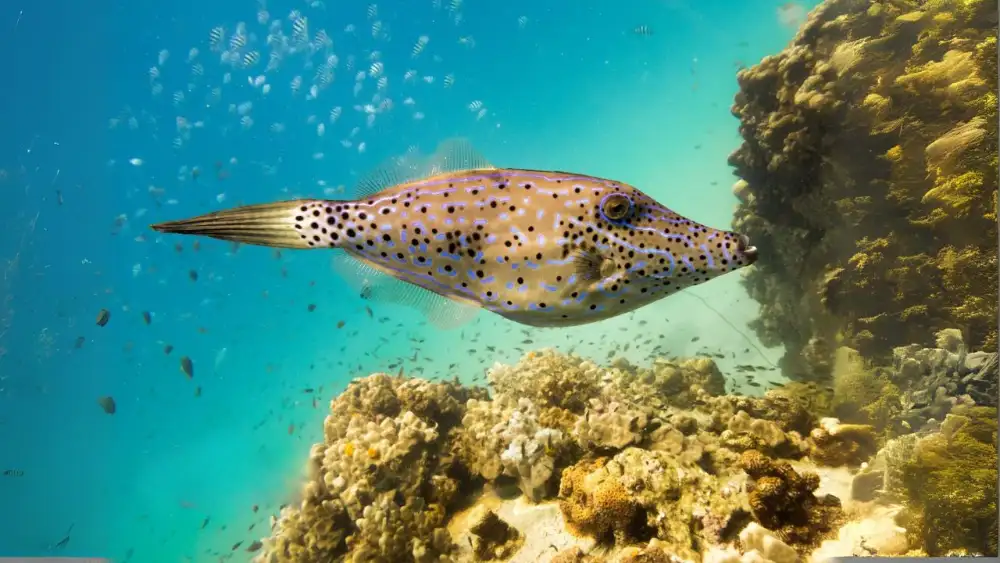
Beneath the turquoise waters surrounding Koh Tao swims a fish that appears to have emerged from an artist’s imagination rather than natural evolution. The scribbled filefish (Aluterus scriptus), with its elongated diamond-shaped body adorned with a mesmerising pattern of irregular blue lines and dots against a pale canvas, seems more like an underwater masterpiece than a living creature.
Yet these remarkable fish are very much alive, representing one of the most visually distinctive and behaviourally fascinating species encountered around Koh Tao’s diverse reefs. Their name derives from both their appearance — the blue markings resembling handwritten script — and their skin texture, which historically was dried and used as a natural form of sandpaper or “file” by craftspeople.
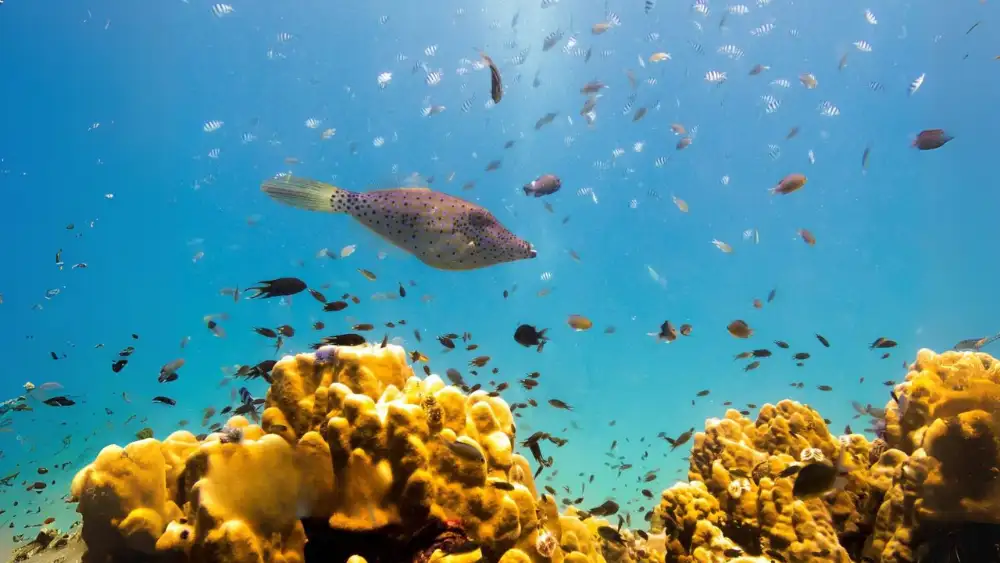
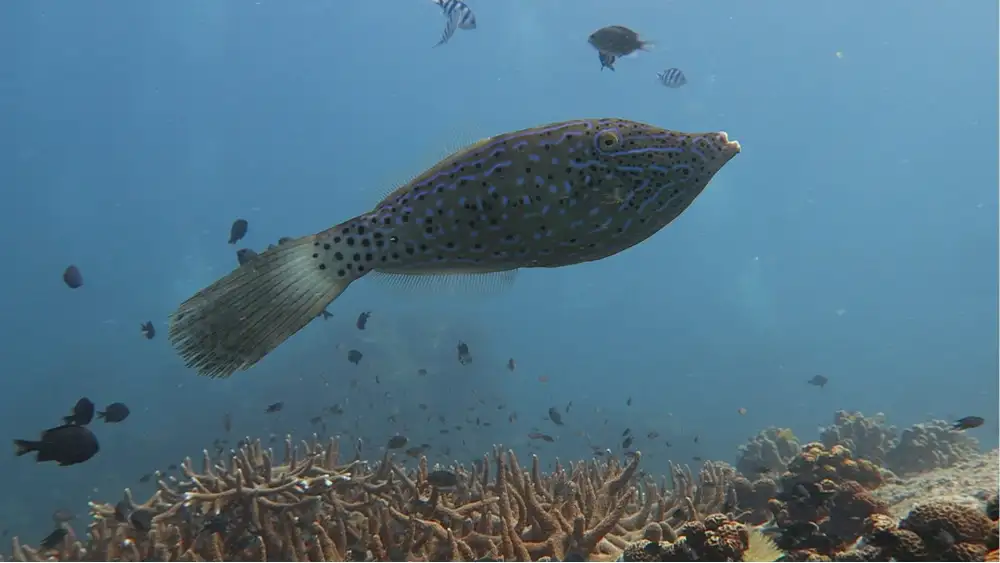
The scribbled filefish presents one of the most unmistakable profiles in Koh Tao’s waters. Growing to approximately 75–80 cm in length around the island (though capable of reaching nearly a metre elsewhere in their range), these elongated fish possess a highly compressed, oval to diamond-shaped body that appears almost two-dimensional when viewed head-on.
Their most distinctive feature — and the source of their common name — is the mesmerising pattern of blue-to-black lines, spots and swirls scattered across their otherwise pale yellowish to olive-green body. These markings truly resemble handwritten script or abstract calligraphy, with each individual fish displaying a unique pattern that’s as distinctive as a fingerprint. The intensity of these markings can vary with the fish’s emotional state, habitat background and health condition.
Unlike many reef fish that rely on vibrant colouration, the scribbled filefish employs a subtler yet equally effective form of visual distinction. The seemingly random arrangement of markings creates disruptive colouration that breaks up their body outline against complex reef backgrounds, providing camouflage despite their relatively large size.
Their distinctive profile features a small mouth at the end of a slightly elongated snout, containing specialised teeth designed for nibbling on their preferred diet of algae, sponges and colonial invertebrates. Small, almost imperceptible eyes often blend into the surrounding pattern, while their fins are relatively transparent except for subtle extensions of the scribbly pattern.
Perhaps their most unusual physical characteristic is the modified first dorsal spine — a single, small, often retractable spine positioned just above the eyes that gives the filefish family (Monacanthidae) its scientific name, which translates to “one spine”. Unlike the dramatic trigger mechanism seen in their triggerfish cousins, this spine serves primarily for protection rather than locomotion or defence.
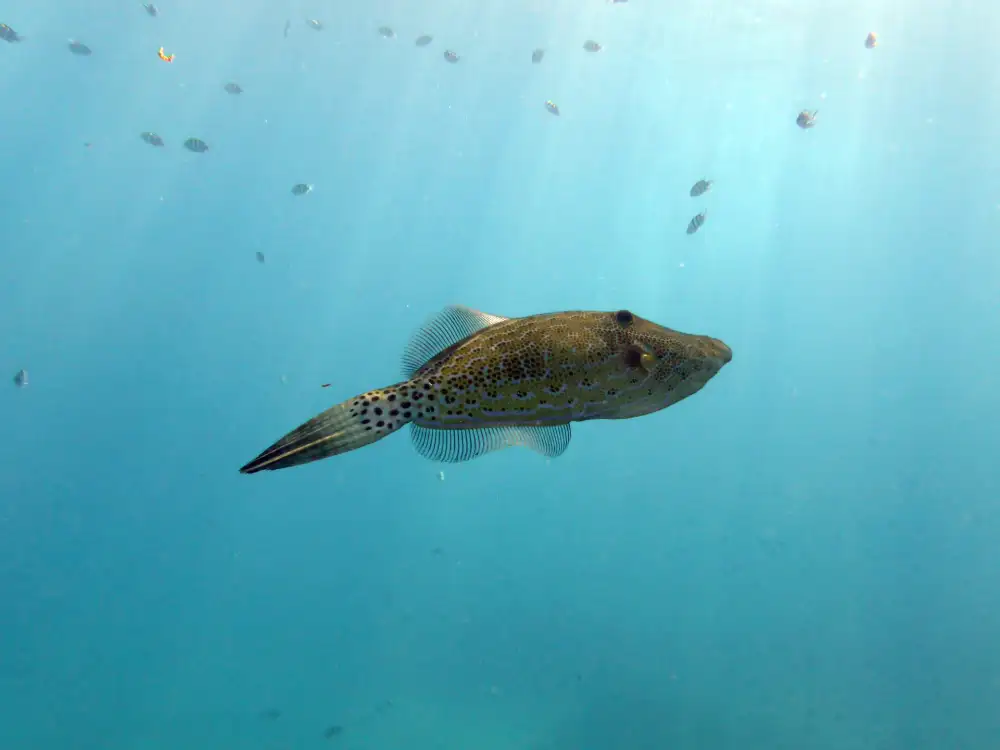
Scribbled filefish behaviour around Koh Tao reveals fascinating adaptations that complement their unique appearance. These typically solitary fish move through the water with a distinctive swimming style that relies primarily on undulations of their dorsal and anal fins rather than tail propulsion. This creates a hovering, gliding motion that seems almost effortless — like underwater ballet performers moving with deliberate grace.
Their natural demeanour tends toward shyness and caution, with individuals often retreating when approached too directly by divers. However, they frequently demonstrate curiosity from a distance, sometimes observing divers while maintaining what they perceive as a safe separation. This combination of wariness and inquisitiveness creates opportunities for patient observers to witness natural behaviours without causing undue stress to these sensitive creatures.
Feeding behaviour in scribbled filefish involves methodical grazing along reef surfaces, using their specialised mouth and teeth to delicately pick at algae, tunicates, hydroids, soft corals and sponges. Their diet makes them important contributors to reef health, as they help control algal growth that might otherwise compete with coral for space and light.
Around Koh Tao, scribbled filefish display clear habitat preferences, typically favouring areas with mixed reef structures and moderate water movement. They’re most commonly observed at depths between 5–25 metres, often positioning themselves near structures that provide quick access to shelter if threatened. Unlike some reef fish that maintain strict territorial boundaries, scribbled filefish tend to range relatively widely across suitable habitat, though individuals often demonstrate site fidelity to general areas over extended periods.
Perhaps their most remarkable behaviour is their capacity for dramatic colour and pattern adjustment. While the basic scribbly pattern remains consistent, they can modify its intensity and contrast, sometimes appearing strikingly bold and vivid, while at other times fading to an almost uniform pale colouration with just faint traces of their characteristic markings. This ability serves both camouflage purposes and likely plays a role in social and reproductive communication.
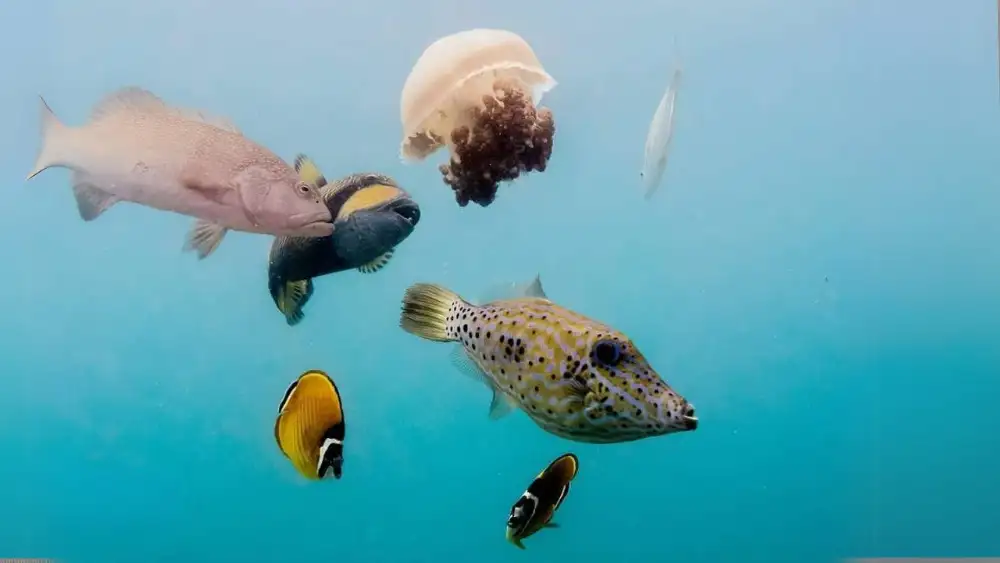
Several dive sites around Koh Tao offer particularly good opportunities for encountering these charismatic fish:
White Rock: This diverse site with its mixed hard coral formations and scattered coral bommies provides ideal habitat for scribbled filefish. Look for them particularly along the northeastern edge where coral growth transitions to more scattered formations.
Twins: The channels between the main reef structures at this popular site frequently host scribbled filefish, particularly in areas with abundant soft coral growth that provides both food sources and shelter opportunities.
Japanese Gardens: This shallow, accessible site occasionally rewards patient observers with scribbled filefish sightings, particularly in the slightly deeper sections (8–12 metres) along the reef edge where it meets sandy patches.
Shark Island: The western side of this site, with its diverse mix of hard corals, soft corals and sponge growth, creates prime habitat for scribbled filefish, though strong currents sometimes make observation challenging.
Hin Wong Bay: This less-visited site on the island’s eastern side offers excellent opportunities for undisturbed scribbled filefish encounters, particularly around the scattered coral bommies in the bay’s central section.
For more information on the top dive sites of Koh Tao, click here.
The reproductive biology of scribbled filefish reveals intriguing adaptations, though direct observations of spawning around Koh Tao remain relatively rare due to their shy nature and the specific conditions under which reproduction occurs.
Scribbled filefish are sequential hermaphrodites — specifically protogynous hermaphrodites — meaning they begin life as females, with some individuals later transitioning to males based on social and environmental factors. This adaptive reproductive strategy is common among reef fish but takes specific forms in the filefish family.
During courtship and spawning periods, which appear loosely correlated with seasonal temperature and current patterns around Koh Tao, male scribbled filefish establish loose territories and display enhanced colouration. Their characteristic scribbly patterns become more vivid, and some individuals develop subtle reddish tinges along their fin margins.
The spawning process typically involves a male and female pair rising up in the water column away from the reef, where they release eggs and sperm for external fertilisation. This pelagic spawning strategy, occurring in open water rather than on the reef substrate, helps disperse fertilised eggs more widely via currents, potentially reducing predation pressure on the developing embryos.
The fertilised eggs join the planktonic community, drifting with currents for approximately 7–10 days before hatching into larvae that continue a pelagic existence for several additional weeks. During this vulnerable stage, mortality rates are extremely high, with perhaps only a tiny fraction of one percent of eggs eventually developing into juvenile fish.
Young scribbled filefish eventually settle on the reef when they reach about 2–3 cm in length, initially seeking shelter in branching corals, seagrass beds or areas with fine algal growth that provides both concealment and initial food sources. Their juvenile colouration displays the characteristic scribbly pattern but often with more yellowish background colouration and relatively larger, more pronounced markings proportional to their body size.
Growth during the first year is relatively rapid, with juveniles potentially reaching 15–20 cm within 12 months under optimal conditions. Sexual maturity typically occurs at around 25–30 cm length, corresponding to approximately 2–3 years of age, though this may vary somewhat based on local conditions and food availability.
The maximum lifespan for scribbled filefish appears to be 7–8 years, though mortality from predation and environmental stressors means relatively few individuals likely reach this full potential age in natural settings. Around Koh Tao, the largest specimens, presumably representing older individuals, are most often encountered at slightly deeper sites with complex reef structures that provide superior protection from larger predators.
Despite their distinctive beauty and ecological contributions, scribbled filefish face several conservation challenges around Koh Tao and throughout their range:
Habitat Degradation: The complex reef structures they depend on are vulnerable to physical damage from storms, anchor damage and coral bleaching events associated with rising sea temperatures.
Collection Pressure: Their striking appearance makes them targets for the marine aquarium trade in some regions, though this pressure is relatively limited around Koh Tao specifically.
Fishing Impact: While not typically targeted by food fisheries due to their limited meat yield and reports of occasional ciguatera toxicity, they can be caught as bycatch in less selective fishing methods.
Tourism Effects: Poorly managed marine tourism, including divers with inadequate buoyancy control or those who pursue filefish for photographs, can disrupt natural behaviours and cause stress to these sensitive creatures.
Water Quality Issues: As reef-dependent species that feed on sensitive organisms including soft corals and sponges, they’re vulnerable to declining water quality from coastal development, agricultural runoff and inadequate waste management.
Local conservation initiatives that benefit scribbled filefish include mooring buoy installations that reduce anchor damage to reef habitats, marine protected zones around key dive sites, and extensive diver education programmes emphasising responsible observation techniques and buoyancy control.
For more information on marine conservation in Koh Tao, click here.
The scribbled filefish (Aluterus scriptus) derives its common name from two distinctive characteristics. The "scribbled" portion refers to the unique pattern of irregular blue-to-black lines, dots and swirls that adorn their bodies, resembling handwritten script or calligraphy. In fact, their scientific name "scriptus" comes from the Latin word for "written". The "filefish" designation refers to their rough, sandpaper-like skin texture when dried, which was historically used as a natural abrasive or "file" for woodworking and finishing before modern sandpapers became widely available. This combination of distinctive appearance and traditional utility gave rise to their full common name. Each scribbled filefish displays a unique pattern of markings, making them individually identifiable to researchers who study them — essentially nature's version of a fingerprint system for these remarkable reef inhabitants.
Scribbled filefish and triggerfish are indeed closely related, both belonging to the order Tetraodontiformes, though they represent different families within this order. Filefish (family Monacanthidae) and triggerfish (family Balistidae) share several evolutionary adaptations, including similar body shapes, specialised scales and modified dorsal spines. The most notable difference is in this spine structure — triggerfish possess a three-spine system with a locking mechanism (the "trigger"), while filefish typically have just a single, often smaller spine (hence their family name Monacanthidae, meaning "one spine"). Filefish generally display less aggressive territorial behaviour than their triggerfish cousins and have more specialised diets focusing on algae, sponges and colonial invertebrates rather than the broader omnivorous diet of most triggerfish. Around Koh Tao, divers familiar with the common triggerfish species (such as the titan triggerfish) will notice that scribbled filefish move more slowly and demonstrate more skittish behaviour when approached.
To maximise your chances of observing scribbled filefish around Koh Tao, focus on sites with complex reef structures and mixed habitats like White Rock, Twins and the western side of Shark Island. Search methodically at depths between 5–25 metres, particularly in areas where hard coral formations transition to more scattered structures with soft coral growth. Dive during mid-morning hours (9:00–11:00 AM) when these fish are typically most active yet still feeding before the day's peak heat. Perfect your neutral buoyancy and approach very slowly, maintaining at least 3–4 metres distance initially. Rather than swimming directly toward them, which typically triggers their retreat response, approach diagonally and avoid sudden movements. Sometimes the most successful observation technique is simply remaining stationary near suitable habitat, allowing curious filefish to gradually emerge from hiding spots. Patient observation is key — quick passes over reef tops rarely yield filefish sightings, as these shy creatures often retreat temporarily when sensing approaching divers.
Scribbled filefish possess remarkable but somewhat limited colour-changing abilities. While they cannot produce the dramatic instant colour transformations seen in octopuses or the vibrant colour shifts of some wrasses, they can modify the intensity and contrast of their characteristic scribbly pattern significantly. The basic pattern of blue-to-black lines and swirls remains consistent for each individual fish, but they can adjust how boldly these markings display against their base colouration, which ranges from pale yellowish to olive-green. When stressed, threatened or resting, they often fade their markings to achieve better camouflage, sometimes appearing almost uniformly pale with just faint traces of their distinctive pattern. During courtship, territorial displays or active feeding, they typically enhance pattern contrast, making their scribbly markings more pronounced. This ability serves both protective camouflage functions and likely plays important roles in social and reproductive communication among members of their species.
Scribbled filefish are not currently considered endangered or threatened on a global scale (classified as Least Concern on the IUCN Red List), but local populations, including those around Koh Tao, face various conservation challenges. Their specialised habitat requirements make them vulnerable to coral reef degradation from climate change, physical damage and water quality issues. While Koh Tao's population appears relatively stable due to protection of key dive sites and limited targeted fishing, they remain indicators of overall reef health. The island's marine conservation initiatives, including mooring buoy installations, designated no-fishing zones and diver education programmes, provide some protection for these distinctive fish. However, their relatively slow reproductive rate and specialised diet mean they recover slowly from population declines. Continued monitoring by local conservation organisations helps track their status, with their visibility and distinctive appearance making them useful indicator species for assessing the effectiveness of marine protection efforts around the island.
More in Marine Life
 Marine Life
From barracuda and trevally to lionfish, cuttlefish, pufferfish, boxfish, moray eels, batfish and sea kraits — a species-by-species guide to the marine life you can meet on Koh Tao's reefs.
 Marine Life
Everything about Koh Tao's blacktip reef sharks — how to identify them, how they behave and hunt, the bays where you can reliably see them, the best time of day, and how to watch them responsibly.
 Marine Life
Bluefin, Bigeye, Golden and Gold-spotted trevally — how to tell Koh Tao's four trevally species apart, where and when to see them, how they hunt and school, and how to observe them responsibly.
Message us on WhatsApp — courses, fun dives and honest advice about Koh Tao.
Chat on WhatsApp