Koh Tao hosts three barracuda species — the Great, Chevron and Pickhandle — each with its own look, behaviour and favourite dive sites. Learn to tell them apart, where to find them and how to position yourself safely around a barracuda tornado.
10 May 2025 · updated 27 February 2026 · by Bryan Roseman
In short. Koh Tao is home to three distinct barracuda species that create some of the most thrilling underwater encounters in Thailand’s waters. The Great Barracuda (up to 1.8 m), Chevron Barracuda (famous for tornado-like schools) and Pickhandle Barracuda (recognisable by its yellow tail fin) each offer unique behaviours and sighting opportunities across different dive sites around the island.
Among the impressive marine predators that patrol Koh Tao’s tropical waters, barracuda stand out as some of the most captivating encounters for divers. While many visitors think of barracuda as a single species, Koh Tao actually hosts three distinct types, each with unique characteristics, behaviours and preferred habitats that make them fascinating subjects for underwater observation.
Understanding the differences between these silver predators enhances every dive, whether you’re witnessing the spectacular “barracuda tornadoes” at Chumphon Pinnacle or encountering a solitary Great Barracuda patrolling the edges of Shark Island’s rocky formations. These encounters are just a fraction of Koh Tao’s incredible marine biodiversity.
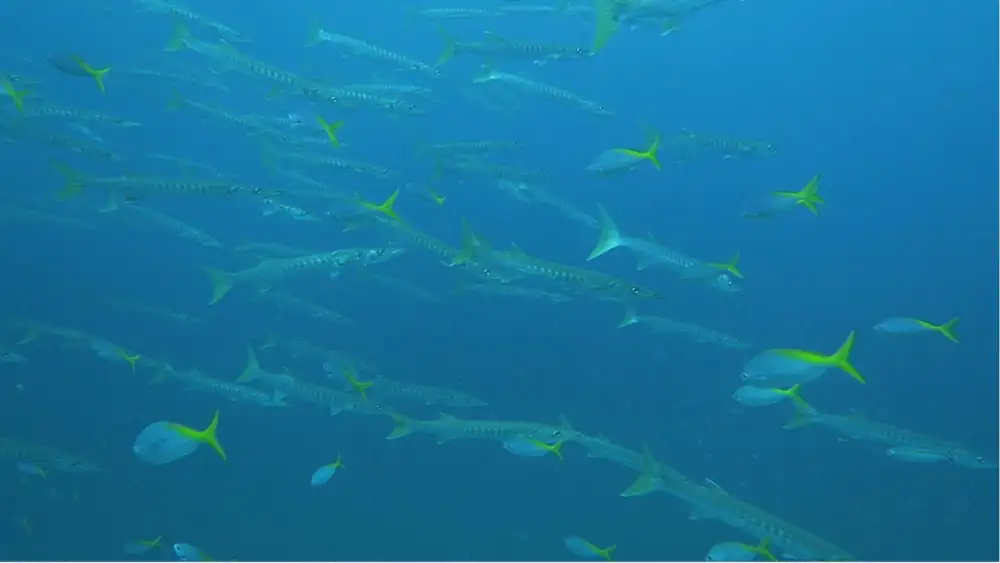
| Species | Scientific name | Visual characteristics | Size | Best observation sites |
|---|---|---|---|---|
| Great Barracuda | Sphyraena barracuda | Silver-grey body with a greenish tint. Dark bars/spots that fade with age. Pronounced underjaw with visible teeth. Crescent-shaped tail with white tips. | Up to 1.8 m (6 ft) | Shark Island, White Rock, Chumphon Pinnacle, Hin Pee Wee |
| Chevron Barracuda | Sphyraena putnamae | Silver body with distinctive V-shaped (chevron) markings along the sides. More slender build. Forked tail fin, typically blackish without white tips. | 60–90 cm (2–3 ft) | Chumphon Pinnacle, Southwest Pinnacle, Sail Rock, Twins |
| Pickhandle Barracuda | Sphyraena jello | Silver body with wavy bars along the sides. Black tips on the fins. Distinctive yellowish caudal (tail) fin. Most slender profile. | 40–60 cm (16–24 in) | Japanese Gardens, Twins, Southwest Pinnacle, Chumphon Pinnacle |
Can you identify the different barracuda species from their characteristics? Try this quick quiz to test your knowledge — the correct answer is marked in bold.
The Great Barracuda reigns as the largest of Koh Tao’s three barracuda species, with specimens reaching impressive lengths of up to 1.8 metres (6 feet). These formidable predators have elongated, torpedo-shaped bodies perfectly designed for explosive bursts of speed, and a pronounced underjaw with large, widely spaced teeth that remain visible even when the mouth is closed.
Their distinctive colouration features a silvery-grey base with a greenish tint across the upper body, often with dark bars or spots along the sides. These markings characteristically fade as the fish matures, so larger specimens look more uniformly silver. The combination of imposing size and a somewhat intimidating appearance makes Great Barracuda encounters truly memorable.
Unlike their schooling relatives, Great Barracudas are primarily solitary hunters that patrol reef edges and drop-offs. They often hover motionless in mid-water while surveying their territory, which makes them excellent photographic subjects — they frequently hold position when approached respectfully by divers.
Their hunting strategy relies on explosive acceleration — reaching speeds of over 35 mph (55 km/h) — to ambush prey with remarkable efficiency. As opportunistic feeders, they mainly target fish such as mullet, groupers and snappers, occasionally hunting squid and shrimp when the chance arises.
Premier location for resident Great Barracudas patrolling rocky outcrops and reef edges.
The deeper sections frequently host larger solitary specimens in open-water areas.
Great Barracudas often lurk around the edges of the reef structure, particularly during morning dives.
Occasional appearances by large solitary specimens, especially in the deeper sections.
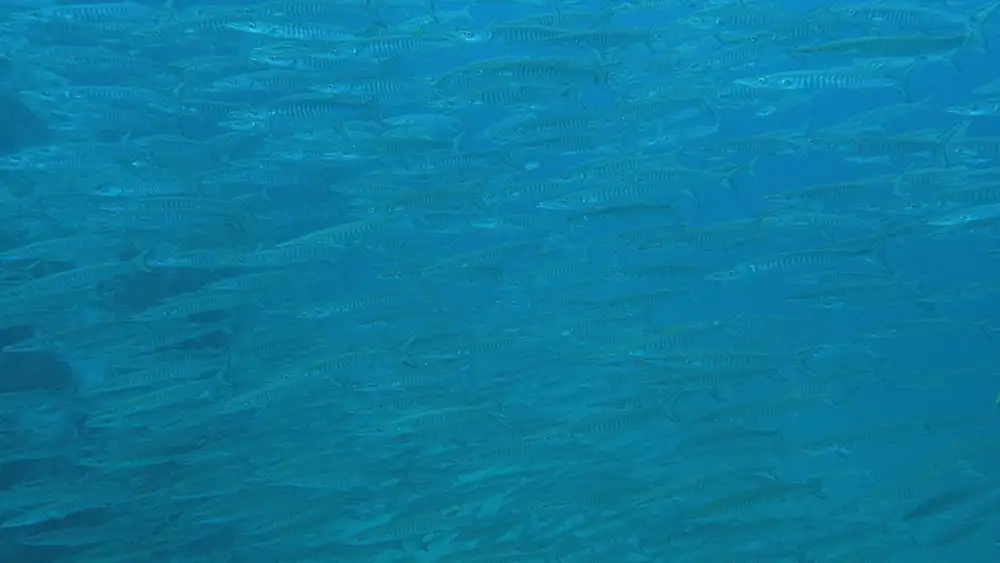
Chevron Barracudas are the medium-sized members of Koh Tao’s barracuda family, typically growing to 60–90 cm (2–3 feet) in length. Their name comes from the distinctive chevron-shaped or V-shaped marks running along their silvery sides, creating beautiful patterns that become especially visible when these fish form their characteristic schools.
Compared with Great Barracudas, Chevrons have a more slender build with a proportionally smaller head and less pronounced teeth. Their relatively large eyes give excellent vision for hunting in a range of lighting conditions, from bright surface waters to deeper, dimmer environments.
The most remarkable characteristic of Chevron Barracudas is their incredible schooling behaviour. Unlike their solitary Great Barracuda cousins, Chevrons form massive schools numbering in the hundreds or thousands, creating mesmerising tornado-like formations that spiral through the water column.
These schools typically form during daylight hours, particularly in the early morning and late afternoon. Their synchronised swimming creates dazzling visual effects as sunlight reflects off their silvery bodies, serving both as protection against larger predators and as coordination for hunting.
The Pickhandle Barracuda is the smallest of Koh Tao’s three species, typically reaching lengths of 40–60 cm (16–24 inches). Despite its smaller size, it has highly distinctive features that make identification straightforward for observant divers.
Its predominantly silver colouration has a bluish tint on the upper body and dark bars or blotches along the sides. Its most distinctive feature, however, is the yellowish tail fin combined with black tips on various fins, creating a unique look that sets it apart from its larger relatives.
Pickhandle Barracudas typically form small to medium-sized schools that rarely reach the massive numbers characteristic of Chevron Barracudas. These schools keep looser formations and are more active, constantly moving rather than forming stable, tornado-like structures.
They commonly inhabit reef areas, rubble zones and sandy patches between coral formations, which makes them accessible to both scuba divers and snorkellers at various depths around Koh Tao.
The peak season for witnessing spectacular barracuda schools — particularly the famous “barracuda tornadoes” formed by Chevron Barracudas — runs from March through September. The largest and most impressive formations typically appear between May and July, with Chumphon Pinnacle offering the most reliable sightings on early-morning dives. For comprehensive information about optimal diving conditions throughout the year, seasonal planning can significantly improve your barracuda viewing opportunities.
Great Barracudas can be encountered year-round at various sites, while Pickhandle Barracudas form their smaller schools most actively during the morning at shallower sites regardless of season. Understanding these patterns helps divers plan their underwater encounters for the best chance of seeing barracuda. Before visiting, it’s worth reviewing transport options to reach Koh Tao for your barracuda diving adventure.
Ready to witness the barracuda species that make Koh Tao a world-renowned diving destination? Join La Bombona Diving for encounters with Great, Chevron and Pickhandle Barracudas at the island’s premier dive sites — our guides know when and where to look for these silver predators. Our Sail Rock trip (2,800 ฿, every Friday, two dives) is one of the best chances to see a big Chevron school.
While barracuda populations around Koh Tao remain relatively healthy, they face challenges including overfishing in surrounding waters, habitat degradation from coastal development, climate change impacts on coral reef ecosystems and plastic pollution affecting their prey species. Learn more about ongoing conservation efforts protecting Koh Tao’s marine environment.
Local conservation efforts, including marine protected areas and sustainable fishing practices, help protect these magnificent predators. Dive centres and marine conservation organisations regularly monitor barracuda populations to track their health and numbers.
By choosing responsible dive operators and practising environmentally conscious diving, visitors help ensure future generations can enjoy encounters with all three remarkable barracuda species that make Koh Tao’s underwater world so special. These predators are just one highlight of the diverse marine life ecosystem that makes this destination truly exceptional.
Barracuda around Koh Tao rarely pose a threat to divers. While their prominent teeth may look intimidating, attacks on humans are extremely rare. These predators are generally more curious than aggressive and will typically keep their distance when approached respectfully. Following proper diving protocols and maintaining adequate distance ensures safe encounters.
Peak season for witnessing the spectacular "barracuda tornadoes" formed by Chevron Barracudas runs from March through September, with the largest formations typically occurring between May and July. These impressive schools are most reliably spotted at Chumphon Pinnacle during early-morning dives. Great Barracudas can be seen year-round, while Pickhandle Barracudas form smaller schools most actively during the morning regardless of season.
You can distinguish the species by observing: Size — Great Barracudas are significantly larger (up to 1.8 m) than Chevron (60–90 cm) and Pickhandle Barracudas (40–60 cm). Markings — Chevron Barracudas have distinctive V-shaped marks, Pickhandle Barracudas have black fin tips and yellowish tails, while Great Barracudas have faint bars that fade with age. Behaviour — Great Barracudas are typically solitary, Chevron Barracudas form massive tornado-like schools, and Pickhandle Barracudas gather in smaller, looser schools. Location — the different species also prefer different depth ranges and habitats around Koh Tao.
Barracuda is commonly eaten in Thailand, particularly Great Barracuda, and is considered perfectly safe and delicious when prepared properly. As a diver visiting Koh Tao, though, you'll probably be more interested in observing these magnificent predators underwater than on your dinner plate. Many local restaurants do serve barracuda dishes if you're curious to try this local delicacy.
When you meet a barracuda school while diving in Koh Tao: position yourself to the side of the school rather than directly in its path, hold neutral buoyancy at the same depth as the school, make slow deliberate movements to avoid startling them, avoid flash photography as it can disorient or scatter the school, keep a respectful distance of at least 3–4 metres, and for the best experience with Chevron Barracuda "tornadoes", stay relatively stationary and let the school circle around you rather than chasing it. If diving in a group, spread out for better viewing and less disturbance to the school.
More in Marine Life
 Marine Life
From barracuda and trevally to lionfish, cuttlefish, pufferfish, boxfish, moray eels, batfish and sea kraits — a species-by-species guide to the marine life you can meet on Koh Tao's reefs.
 Marine Life
The enigmatic scribbled filefish of Koh Tao — how to identify these living artworks, how they behave, where to find them on the island's dive sites, and the conservation challenges they face.
 Marine Life
Everything about Koh Tao's blacktip reef sharks — how to identify them, how they behave and hunt, the bays where you can reliably see them, the best time of day, and how to watch them responsibly.
Message us on WhatsApp — courses, fun dives and honest advice about Koh Tao.
Chat on WhatsApp