Age requirements, safety protocols, kid-friendly dive sites, the best season for families and how to prepare your child for a first dive on Koh Tao.
22 April 2025 · updated 7 August 2026 · by Bryan Roseman
Key takeaways
- Children can start scuba diving from age 8, with introductory Try Dive programs. From age 10, they can earn a Junior Open Water certification with age-appropriate depth limits.
- Safety is the top priority. Kids dive with specially trained instructors, child-sized equipment, small instructor-to-student ratios, and conservative depth limits designed for young divers.
- Koh Tao is one of the best places in Thailand for family diving thanks to its warm water, calm conditions, shallow dive sites, and abundant marine life.
- Most families visit between December and May, when calm seas and clear visibility create the most comfortable conditions for first-time and young divers.
Scuba diving for kids has become increasingly popular as families seek meaningful adventure experiences together. If you’re planning a family diving holiday, you’ll also need to know how to get to Koh Tao from anywhere in Thailand, as the island is easily reached by ferry, flight, train, and bus connections from major destinations. Once you arrive, Thailand’s diving capital offers ideal conditions for introducing children to the underwater world safely, with calm waters, abundant marine life, and dive centres specifically equipped for family programs.
This comprehensive guide covers everything parents need to know about scuba diving in Koh Tao for kids, from age requirements and safety protocols to choosing the right program for your child’s experience level.
Perfect introduction to scuba diving in controlled conditions. La Bombona Diving’s Try Dive program offers the safest way for children to experience underwater breathing.
First real certification with restricted depth limits. This comprehensive Open Water certification program is adapted specifically for young divers.
Advanced skills development with specialised activities.
Complete access to all diving courses and depths.
Answer these questions to determine if your child is ready for scuba diving for kids Koh Tao programs:
Important medical considerations. Children with asthma, ear problems, heart conditions, or other medical issues require doctor clearance before diving. Never overlook medical questionnaires or skip health assessments. Some conditions that are manageable on land can become serious underwater.
Year-round water temperatures of 26–30°C provide comfortable conditions for young divers without thick wetsuits.
Colourful fish, sea turtles, and coral reefs create exciting underwater experiences that captivate young minds.
Koh Tao’s dive centres employ instructors specifically trained in teaching children and family groups.
Multiple sites under 10 metres depth provide perfect training grounds for young divers.
Medical facilities, hyperbaric chamber access, and established emergency protocols ensure safety.
Many dive centres offer family packages and activities for non-diving family members.
Koh Tao’s warm tropical climate allows children to learn scuba diving throughout the year, with generally calm conditions.
Visibility often ranges from 10 to 30 metres, making it easier for children to see their instructor, marine life, and dive equipment underwater.
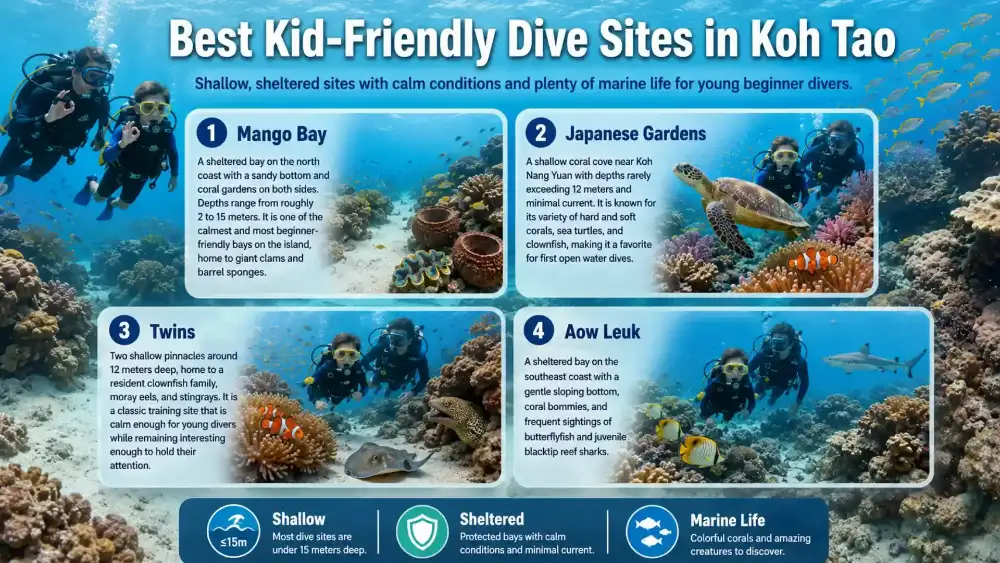
Koh Tao’s most popular training and family sites are shallow, sheltered, and rich with marine life, making them ideal conditions for young divers. Here are the best shallow dive sites in Koh Tao for beginners:
A sheltered bay on the north coast with a sandy bottom and coral gardens on both sides. Depths range from roughly 2 to 15 metres. It is one of the calmest and most beginner-friendly bays on the island, home to giant clams and barrel sponges.
A shallow coral cove near Koh Nang Yuan with depths rarely exceeding 12 metres and minimal current. It is known for its variety of hard and soft corals, sea turtles, and clownfish, making it a favourite for first open water dives.
Two shallow pinnacles around 12 metres deep, home to a resident clownfish (“Nemo”) family, moray eels, and stingrays. It is a classic training site that is calm enough for young divers while remaining interesting enough to hold their attention.
A sheltered bay on the southeast coast with a gentle sloping bottom, coral bommies, and frequent sightings of butterflyfish and juvenile blacktip reef sharks.
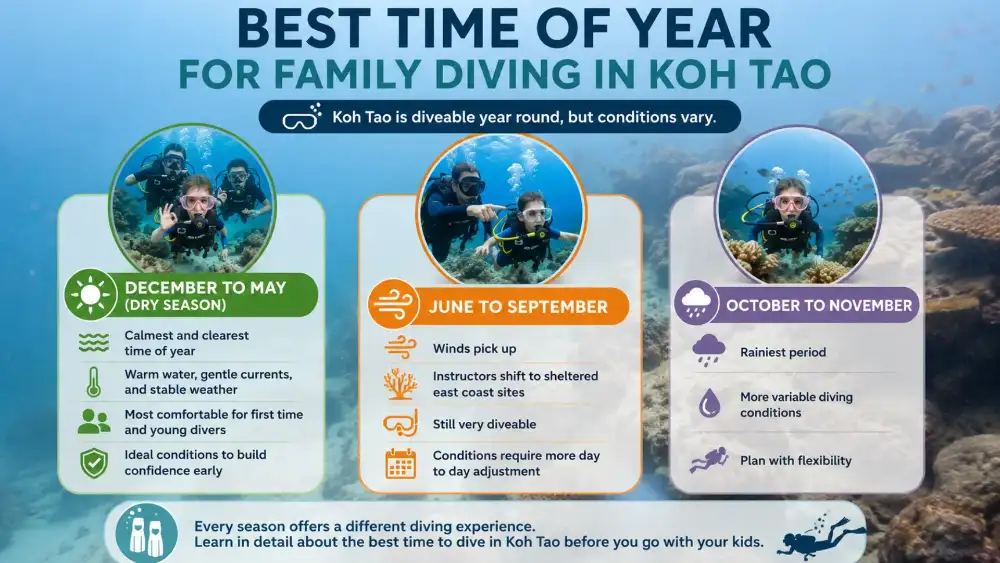
Koh Tao is diveable year-round, but conditions vary:
Every season offers a different diving experience; it is important to learn in detail about the best time to dive in Koh Tao before you go with your kids for diving.
| Agency | Minimum age | Program name | Maximum depth | Special features |
|---|---|---|---|---|
| PADI | 8 years | Bubblemaker / Junior Open Water | 2 m / 12 m | Most recognised globally |
| SSI | 8 years | Try Scuba / Junior Open Water | 2 m / 12 m | Digital learning platform |
| RAID | 10 years | Junior Open Water | 12 m | Modern teaching methods |
Ready to introduce your children to the magical underwater world of Koh Tao? La Bombona Diving specialises in family diving experiences with qualified instructors trained specifically for young divers.
Child-focused instruction with 1:2 maximum ratios
All equipment included and properly fitted
Flexible scheduling for family travel plans
Experienced instructors with kids’ diving specialties
Safe, gradual introduction to diving skills
Family-friendly boat facilities
Multiple certification agencies available
Emergency protocols specifically for young divers
Try Dive for Kids (ages 8+): 2,500 ฿ for 1 dive (optional 2nd dive 1,000 ฿)
Junior Open Water (ages 10+): 11,000 ฿ – full 4-day certification program
Full day experience | All equipment included | Professional child-certified instructors
Scuba diving for kids Koh Tao stands out due to consistently warm water temperatures (26–30°C), calm conditions, shallow training sites, and dive centres with extensive experience teaching children. The island's compact size and family-friendly infrastructure make it ideal for young divers.
Children can start with Try Dive experiences at age 8. These introductory programs are conducted in shallow, controlled environments with maximum depths of 2 metres, providing a safe first taste of underwater breathing and movement.
While advanced swimming skills aren't required for introductory programs, children should be comfortable in water and able to float or swim short distances without assistance. Basic water confidence is more important than swimming speed or technique.
La Bombona Diving maintains strict 1:2 instructor-to-student ratios for children, uses age-appropriate equipment, conducts thorough skill assessments before advancing, and follows conservative depth limits. All instructors receive specialised training for teaching young divers.
Parents with diving certification can often participate in family dives, but children's training dives are typically conducted with professional instructors to ensure proper skill development. Family fun dives can be arranged after course completion.
Instructors are trained to recognise signs of discomfort and will immediately surface with scared children. No pressure is applied to continue if a child feels uncomfortable. The goal is building confidence gradually through positive experiences.
Children with asthma, ear problems, heart conditions, or other significant health issues require medical clearance before diving. A standard medical questionnaire must be completed, and some conditions may require doctor approval before participation.
The "Rule of 120" isn't a children's diving guideline. It is an older general dive planning shortcut where depth in feet plus no-decompression time in minutes equals approximately 120, based on outdated US Navy dive tables. Modern dive computers and agency tables have replaced it. It has no direct application to kids' shallow, depth-limited programs like Bubblemaker or Junior Open Water, which use their own fixed depth limits.
Anyone with uncontrolled asthma, certain heart or lung conditions, or other significant unresolved health issues typically needs medical clearance before diving. For children specifically, this is why La Bombona Diving requires a completed medical questionnaire before any first dive.
The minimum age is 8 years old for introductory programs like Bubblemaker (pool or confined water only, maximum depth of 2 metres). Full Junior Open Water certification, which allows ocean diving to 12 metres, starts at age 10.
Yes. Koh Tao's calm, shallow bays and warm water (26–30°C year-round) make it one of the world's most popular places to learn as a family. Children as young as 8 can join introductory programs while parents or older siblings pursue Open Water certification alongside them. Many dive centres also offer family-friendly boat facilities for non-diving family members.
Kids' scuba diving programs follow strict safety standards, including:
For the diving day itself, children should bring a swimsuit (worn under the wetsuit), a towel, reef-safe sunscreen, a hat, water shoes or sandals, a change of dry clothes, and any completed medical clearance paperwork if required. For everything else you'll need for the wider trip, see our full Koh Tao packing checklist.
A Try Dive or Bubblemaker session is typically run as a full-day experience, though actual time breathing underwater is short and closely supervised. The Junior Open Water course runs over 4 days with 4 ocean dives, each dive typically lasting 30–45 minutes depending on air consumption and conditions.
Bubblemaker (age 8+) takes place in a pool or confined water only, with a 2-metre depth limit and no certification issued. Discover Scuba Diving (age 10+) can take place in open water, either in a sheltered bay or from a boat, and is also non-certifying. Many dive centres apply its cost toward a full Open Water course if a child continues.
Family and private group sessions can typically be arranged on request. It's worth confirming directly with your dive centre whether a fully private (just your family) booking is available or whether you'll join a small mixed group, as this varies by season and availability.
More in Diving Tips
 Diving Tips
Depth, breathing, training, safety, equipment and cost compared side by side, so you can decide whether a snorkel afternoon, a Try Dive or a full Open Water course is the right fit for your Koh Tao trip.
 Diving Tips
An Open Water course in Koh Tao usually takes three to four days — but the advertised number of days tells only part of the story. Here is what actually fills those days, why schedules differ between dive schools, and how to plan your stay around the course.
 Diving Tips
PADI, RAID and SSI compared across the whole training pathway — Open Water, advanced, rescue, specialities, Divemaster, instructor and technical — plus what actually decides the quality of your course in Koh Tao.
Message us on WhatsApp — courses, fun dives and honest advice about Koh Tao.
Chat on WhatsApp