Every scuba diving cost on Koh Tao explained — Try Dive, Open Water and Advanced certification, fun dive packages, night dives, extras to budget for, and how the island compares with Phuket, Khao Lak and Krabi.
21 May 2026 · updated 1 June 2026 · by Bryan Roseman
In short. Koh Tao is widely regarded as one of the most affordable scuba diving destinations in the world. This guide breaks down every cost you need to know, from your first Try Dive to full certification courses and fun dive packages, so you can plan your underwater adventure with complete confidence.
Most people imagine expensive trips to Australia, the Maldives or the Caribbean. Koh Tao offers a very different reality. This small island in Thailand, also called “Turtle Island”, has become one of the world’s most popular diving destinations because it delivers high-quality diving at surprisingly affordable prices.
Open Water certification courses, which often cost £550 to £750 in the UK or Australia, typically range from £200 to £265 here without compromising international safety standards. With over 30 million PADI certifications issued globally, Koh Tao continues to attract first-time divers thanks to its warm waters, beginner-friendly dive sites and transparent pricing.
This guide breaks down every major scuba diving cost so you know exactly what to expect before arriving.
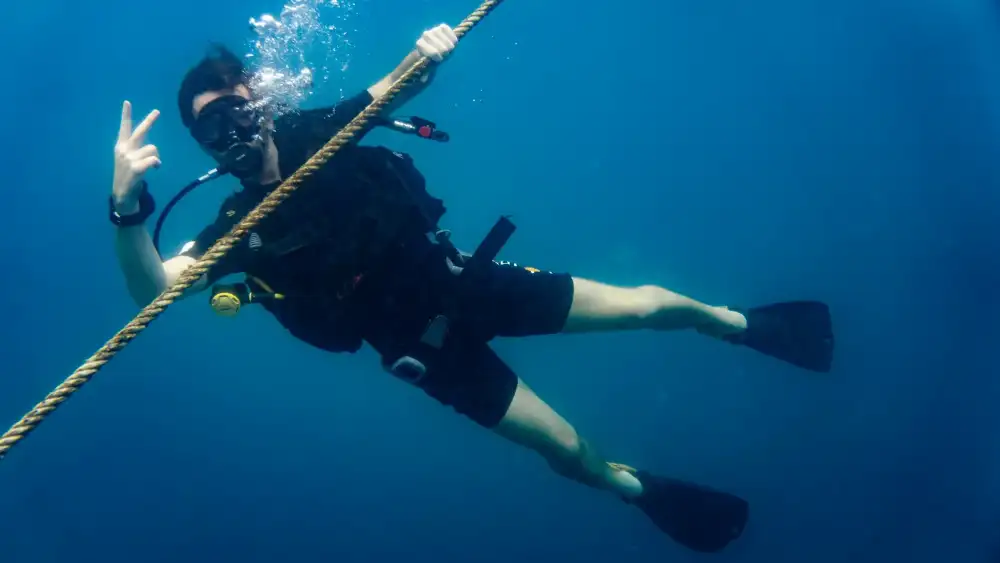
Understanding the baseline costs helps you compare value across different dive options and plan your trip budget accurately.
| Experience type | Duration | Cost (THB) | Cost (GBP approx.) | Best for | What is included |
|---|---|---|---|---|---|
| Try Dive / Discover Scuba | Half to full day | 2,500 to 3,500 | £55 to £78 | First-timers with no certification | Instructor, equipment, 1 to 2 dives |
| Open Water certification | 3 to 4 days | 9,000 to 12,000 | £200 to £265 | Becoming a fully certified diver | Theory, confined water, 4 open water dives, certification card |
| Advanced Open Water | 2 days | 9,000 to 11,000 | £190 to £235 | Already certified Open Water divers | 5 adventure dives, certification |
| Fun dive (single) | 2 to 3 hours | 1,000 to 1,200 | £22 to £27 | Certified divers exploring sites | Guide, boat, equipment |
| Fun dives (2 dives) | Full day | 1,800 to 2,000 | £40 to £45 | Certified divers wanting more | Guide, boat, equipment, 2 dives |
| Night dive | 2 to 3 hours | 1,200 to 1,800 | £27 to £40 | Unique after-dark experience | Specialist guide, dive lights, equipment |
| Specialty courses | 1 to 2 days | 3,000 to 5,000 | £67 to £112 | Skill advancement | Course-specific instruction and materials |
| Divemaster internship | 4 to 8 weeks | 40,000 to 92,500 | £890 to £2,055 | Professional career training | Full internship programme |
The biggest investment for most visitors is certification, and it is well worth understanding what each level involves before you commit.
A Try Dive is the ideal starting point if you are curious about diving but not ready to commit to a full course. You will spend roughly half a day with a qualified instructor who guides you through every step, from putting on the equipment to your first breaths underwater. No prior experience or training is required whatsoever.
Cost: 2,500 to 3,500 THB (approximately £55 to £78). At La Bombona Diving the Try Dive is 2,500 ฿, with an optional second dive for 1,000 ฿.
This price typically includes all equipment, your instructor’s time, a safety briefing and one to two shallow dives. What is not included is any form of certification, which means you cannot dive independently after this experience.
If you enjoy your Try Dive and want to continue, the smart financial move is to put that cost towards an Open Water certification course, rather than booking multiple Try Dives separately.
The Open Water course is the world’s most recognised entry-level scuba certification and the most popular choice. It qualifies you to dive independently anywhere in the world, to a depth of 18 metres, for the rest of your life.
Cost: 9,500 to 12,500 THB (approximately £200 to £265) for 3 to 4 days. At La Bombona Diving the Open Water course is 11,000 ฿ for 4 days and 4 ocean dives.
This price includes everything you need: theory and online learning materials, confined-water training sessions, four open-water dives, all equipment throughout, and your internationally recognised certification card. There are no hidden extras.
As we explain in our guide to scuba certification levels, the Open Water qualification is a permanent investment. You will never need to pay for it again, and it opens up dive sites across every ocean.
Once you hold your Open Water certification, the Advanced course builds on your skills and increases your maximum depth from 18 metres to 30 metres.
Cost: 9,000 to 11,000 THB (approximately £190 to £235) over 2 days. At La Bombona Diving the Explorer 30 / Advanced course is 10,000 ฿.
The course involves five adventure dives covering navigation and deep diving, plus three additional specialities of your choice. Completing it gives you access to premium Koh Tao sites that are closed to Open Water divers alone.
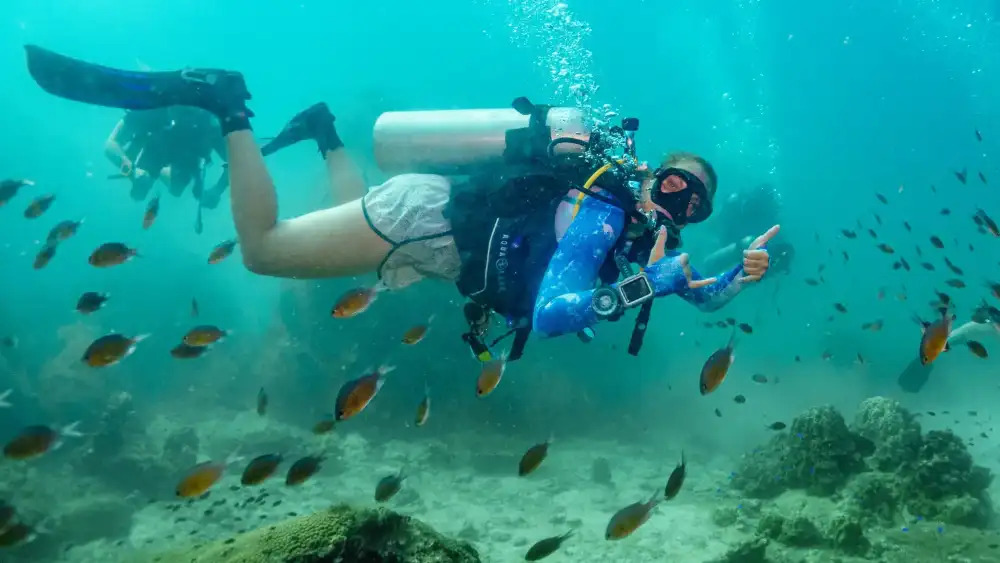
Once you hold a certification, the cost of each dive drops significantly. Fun dives are straightforward: you join a small group with a professional guide, board the boat, and explore.
| Package | Cost (THB) | Cost (GBP approx.) |
|---|---|---|
| Single dive | 1,000 to 1,200 | £22 to £27 |
| 2 dives (same day) | 1,800 to 2,000 | £40 to £45 |
| 5-dive package | 4,500 to 5,000 | £100 to £112 |
| 10-dive package | 7,000 to 8,000 | £155 to £178 |
| Sail Rock day trip | approx. 2,800 | £62 |
All fun dive prices include a professional guide, boat transport to and from the site, and full equipment rental. You will not be charged separately for tanks, weights or a BCD.
Night diving is one of the most memorable experiences Koh Tao offers, and it costs between 1,200 and 1,800 THB (approximately £27 to £40). The marine life that emerges after dark, from bioluminescent plankton to sleeping reef fish and hunting cephalopods, is completely different to a daytime dive.
Wreck diving and Sail Rock day trips are available at varying prices depending on the site, boat travel time and the number of dives included.
Smart budgeting means knowing the total cost of your trip, not just the headline course price.
Bringing your own mask and fins can save you 200 to 500 THB per day and ensure equipment that fits you properly, which always makes a difference to your comfort underwater.
All scuba equipment during your course or fun dives, qualified instruction, safety briefings, boat transport and all post-dive logistics are typically included in the price you are quoted. Always confirm this when booking, but at La Bombona Diving, what we quote is what you pay — the only extra is the mandatory dive insurance (100 THB).
Note. A note on dive insurance: standard travel insurance policies do not cover scuba diving. Specialist dive insurance through organisations such as DAN (Divers Alert Network) costs approximately £35 to £85 per year and is strongly recommended before you dive anywhere in the world. Visit DAN for current membership options.
Pricing across Thailand’s dive destinations varies considerably, and the difference is not arbitrary.
| Destination | Try Dive (THB) | Open Water course (THB) | 2 fun dives (THB) | Why prices differ |
|---|---|---|---|---|
| Koh Tao | 2,500 to 3,500 | 9,000 to 12,000 | 1,800 to 2,000 | Short boat rides, high competition, beginner-focused infrastructure |
| Phuket | 4,500 to 5,000 | 12,900 | 3,200 to 3,900 | Longer travel times, higher venue and operational costs |
| Khao Lak | 4,500 to 5,500 | 13,000 | 3,500 to 4,500 | Premium Similan Islands access, higher overhead |
| Krabi | 3,500 to 4,500 | 12,000 | 2,800 to 3,500 | Mid-range pricing, mixed site quality |
| Koh Phi Phi | 4,000 to 4,500 | 12,500 | 3,000 to 3,500 | Tourist destination premium pricing |
Koh Tao is cheaper for structural reasons, not a compromise in quality. More importantly, Koh Tao is physically surrounded by more than 30 dive sites, most of which are within a 10- to 30-minute boat ride. Operators in Phuket or Khao Lak spend far more on fuel and time reaching comparable sites, and those costs are passed on to divers.
As our guide to choosing a dive provider explains, a lower price does not mean lower quality when the geography and infrastructure genuinely support it.
Book Open Water instead of multiple Try Dives: three Try Dives cost between 7,500 and 10,500 THB with no certification to show for it. The Open Water course costs only marginally more and qualifies you to dive independently for life. The maths is straightforward.
Travel in shoulder season: October through November and late January through February offer excellent diving conditions alongside lower accommodation prices. As we outline in our Koh Tao budget diving guide, these months are ideal for those who want to stretch their budget.
Buy multi-dive packages: the per-dive cost of a 10-dive package is significantly lower than booking individual dives each day. If you are staying for a week or more, a package almost always represents better value.
Bring personal gear: a well-fitting mask is worth the space in your bag. Arriving with your own mask, fins and perhaps a rash guard will reduce daily rental costs and improve your comfort underwater.
| Item | Cost (THB) |
|---|---|
| Accommodation (5 nights, budget) | 7,500 to 12,500 |
| Ferry to Koh Tao | 600 to 800 |
| Open Water course (all inclusive) | 9,000 to 12,000 |
| Food and daily expenses | 1,500 to 2,500 |
| Estimated total | 18,600 to 27,800 THB (approximately £420 to £630) |
| Item | Cost (THB) |
|---|---|
| Accommodation (4 nights, mid-range) | 6,000 to 10,000 |
| Ferry to Koh Tao | 600 to 800 |
| 6 fun dives (discounted package) | 6,000 to 7,000 |
| Food and daily expenses | 2,000 |
| Estimated total | 14,600 to 19,800 THB (approximately £330 to £450) |
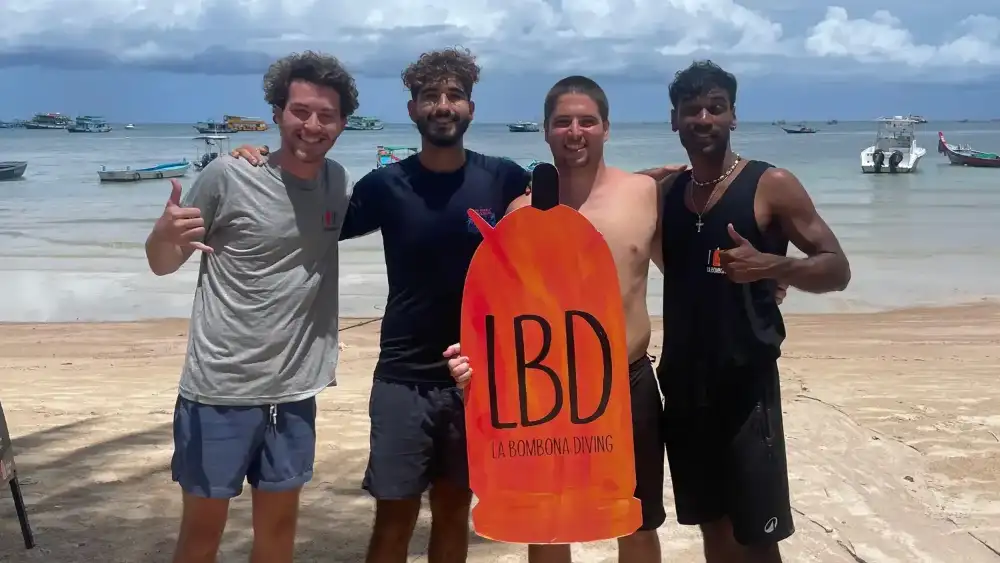
Price alone does not tell the full story. What matters is what you receive for your money.
According to NOAA, coral reefs support nearly 25 percent of all marine species despite covering less than 1 percent of the ocean floor. Koh Tao’s reef systems reflect that extraordinary biodiversity, with divers regularly encountering whale sharks, sea turtles, reef sharks, octopus and vibrant tropical fish across its dive sites.
What makes Koh Tao stand out is not simply affordability, but the overall value of the experience. From warm year-round waters and diverse marine life to accessible training and world-class dive conditions, the island consistently delivers far more than many divers expect for the price. That is why so many visitors return after their first trip.
Ready to experience Koh Tao diving the right way? At La Bombona Diving, every dive is built around safety, small-group learning and unforgettable underwater experiences, with RAID-certified instructors, well-maintained equipment and access to more than 30 dive sites. Take a look at our courses and discover why Koh Tao remains one of the world’s most loved diving destinations.
Koh Tao dive sites are only 10 to 30 minutes from shore, significantly reducing fuel and operational costs. Combined with over 70 dive schools competing on a small island, divers benefit from much lower prices without sacrificing quality.
No. Reputable dive schools follow the same international PADI, SSI and RAID standards used worldwide. Koh Tao's lower prices come from operational efficiency, shorter boat trips and high diving volume rather than reduced safety or poor instruction.
No. Multiple Try Dives can cost nearly as much as an Open Water certification, but do not provide a recognised qualification. The Open Water course offers lifetime certification and far better long-term value for anyone planning to dive again.
Dive insurance is not legally required but is highly recommended. Standard travel insurance often excludes scuba diving. Specialist dive insurance helps cover emergency evacuations and hyperbaric treatment costs, which can otherwise become extremely expensive.
Certification courses require a larger upfront payment, but they are a one-time investment. Once certified, fun dives become much cheaper per dive, making certification far more cost-effective for anyone planning to dive regularly.
More in Diving Tips
 Diving Tips
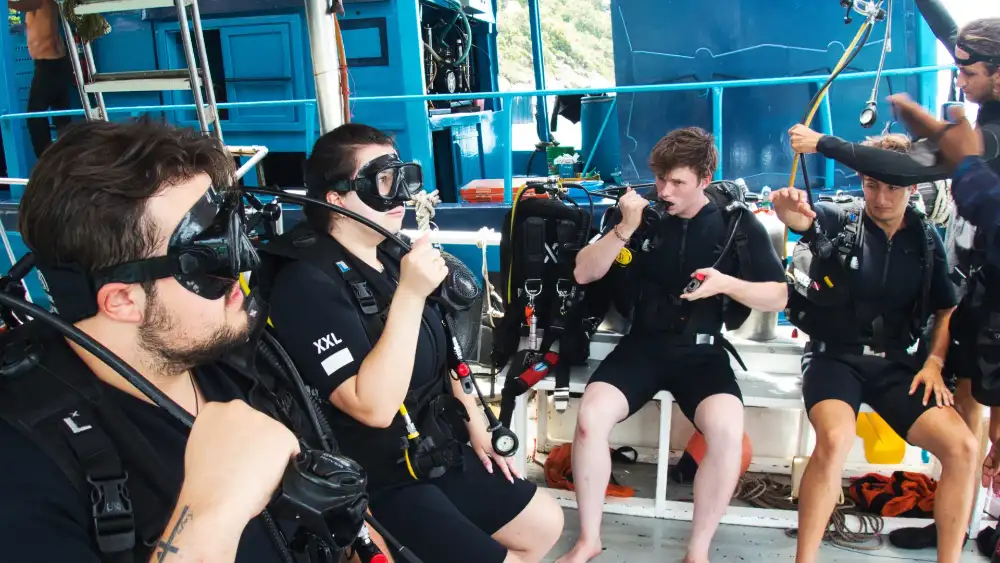
Depth, breathing, training, safety, equipment and cost compared side by side, so you can decide whether a snorkel afternoon, a Try Dive or a full Open Water course is the right fit for your Koh Tao trip.
 Diving Tips
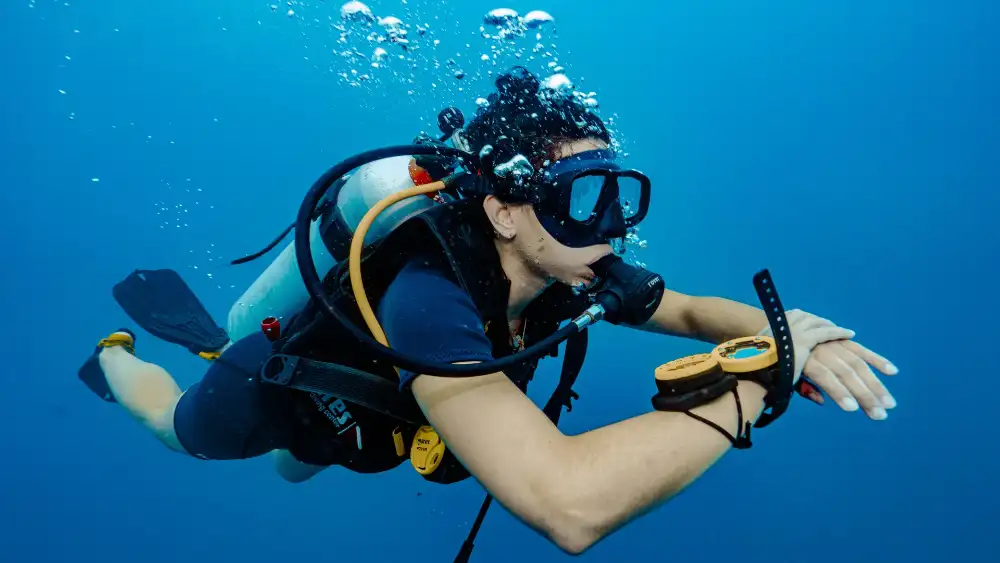
An Open Water course in Koh Tao usually takes three to four days — but the advertised number of days tells only part of the story. Here is what actually fills those days, why schedules differ between dive schools, and how to plan your stay around the course.
 Diving Tips
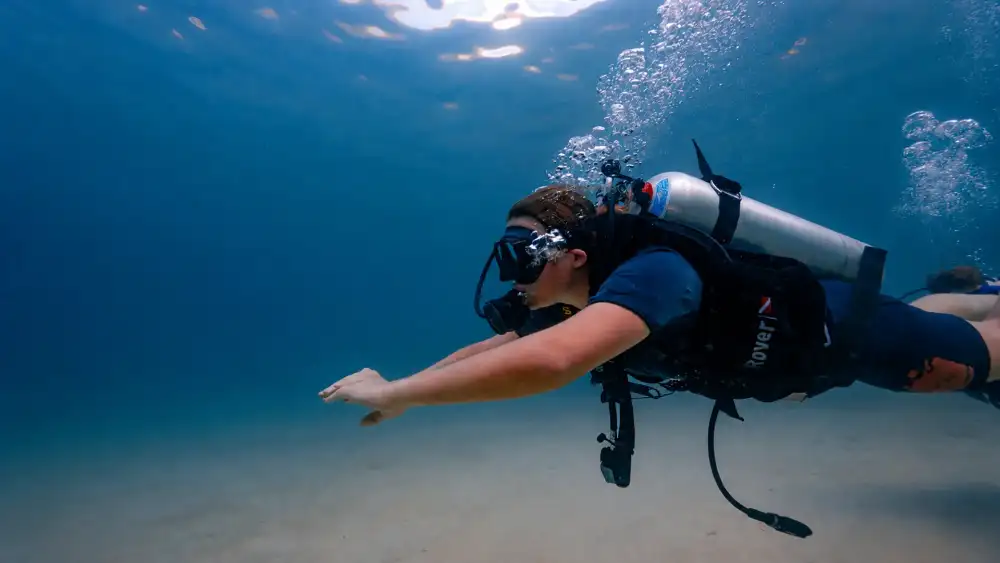
PADI, RAID and SSI compared across the whole training pathway — Open Water, advanced, rescue, specialities, Divemaster, instructor and technical — plus what actually decides the quality of your course in Koh Tao.
Message us on WhatsApp — courses, fun dives and honest advice about Koh Tao.
Chat on WhatsApp