The accepted behaviours every diver should follow before, during and after a dive — buddy rules, boat manners, buoyancy, hand signals, marine life and photography etiquette, plus the most common mistakes to avoid.
21 January 2026 · updated 24 August 2026 · by Bryan Roseman
Key takeaways
- Scuba diving etiquette is based on four core principles: safety, communication, courtesy and conservation. Following these principles helps create safer dives, improves teamwork and protects the underwater environment.
- Good dive etiquette begins before entering the water. Arriving on time, listening to the dive briefing, completing a buddy check and communicating honestly about your experience help prevent avoidable problems before the dive starts.
- Buddy awareness is one of the most important parts of safe diving. Stay close enough to communicate, monitor your buddy’s condition and gas supply, and always respect a diver’s decision to end the dive if they feel uncomfortable or unsafe.
- Responsible divers observe marine life without interfering. Avoid touching, chasing or feeding animals, never collect coral or shells, and leave every dive site in the same condition you found it.
- Underwater photography should only be attempted when you can comfortably control your buoyancy, monitor your depth and gas supply, and maintain awareness of your buddy and surroundings. No photograph is worth compromising safety or harming marine life.
Learning to scuba dive involves much more than mastering your equipment or earning a certification. Every dive also depends on how responsibly you behave around your buddy, other divers and the marine environment. Good dive etiquette helps dives run smoothly, reduces unnecessary risks and makes the experience safer and more enjoyable for everyone involved.
Dive etiquette refers to the accepted behaviours and best practices divers should follow before, during and after every dive. From listening carefully to the dive briefing and completing a buddy check to maintaining good buoyancy, communicating effectively underwater and respecting marine life, these simple habits help create a safer diving environment while protecting fragile underwater ecosystems.
Whether you’re preparing for your first Open Water course or simply want to become a more considerate diver, understanding proper dive etiquette is an essential part of becoming a confident scuba diver. In this guide, you’ll learn the key etiquette rules to follow before, during and after a dive, common mistakes to avoid and practical tips that will help you become a safer, more responsible dive buddy.
Important. Dive etiquette complements your formal scuba training; it does not replace it. Always dive within your certification limits, follow local regulations, stick to the agreed dive plan and follow the instructions of your instructor, divemaster, guide or boat crew.
Good dive etiquette is built on four key principles that help keep every dive safe, organised and enjoyable. Whether you’re diving with a buddy, joining a guided group or exploring from a liveaboard, these principles encourage responsible behaviour both underwater and on the surface.
Together, they provide a simple framework for making better decisions before entering the water, during the dive and after surfacing.
| Priority | Proper diver behaviour | Why it matters |
|---|---|---|
| Safety | Following training, dive briefings, buddy checks and certification limits | Reduces avoidable risks and helps dives run according to plan. |
| Communication | Using standard hand signals, staying with your buddy and communicating concerns early | Prevents misunderstandings and allows problems to be addressed quickly. |
| Courtesy | Respecting other divers’ space, equipment and pace | Creates a more organised and enjoyable experience for everyone. |
| Conservation | Maintaining good buoyancy and avoiding unnecessary contact with marine life | Helps protect coral reefs, marine animals and dive sites for future visitors. |
Some aspects of dive etiquette are mandatory, such as following local regulations, marine park rules and the instructions of your instructor or dive guide. Others are widely accepted practices followed throughout the global diving community. Whether they are formal rules or established customs, they all contribute to safer, smoother and more enjoyable dives.
Ultimately, proper dive etiquette is not about appearing experienced. It is about being prepared, predictable and aware of how your actions affect your buddy, the rest of the dive group and the underwater environment.
Understanding these principles is only the first step. The real value of dive etiquette lies in how it improves safety, communication and the overall diving experience.
Scuba diving takes place in an environment where communication is limited and even small actions can have significant consequences. A missed buddy check, poor buoyancy control or failure to follow the dive plan can affect not only your own safety but also the experience of everyone else in the water.
By following good dive etiquette, divers can:
These practices are reinforced during scuba training and are also recommended by organisations such as Divers Alert Network (DAN). Simple habits such as arriving prepared, paying attention during the dive briefing, completing a buddy check and agreeing on underwater signals before entering the water help create safer dives for everyone.
Understanding dive etiquette becomes much easier when you look at each stage of a dive. The following overview summarises the key behaviours divers should follow before entering the water, during the dive and after surfacing.
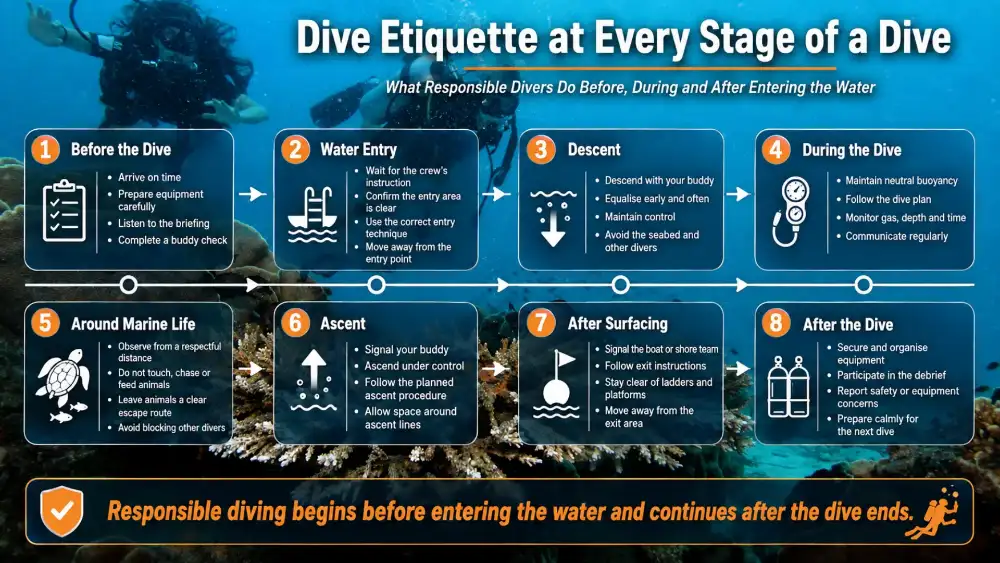
Although every dive is different, the same principles of good etiquette apply throughout the experience. Following these simple practices helps create a safer, smoother and more enjoyable dive for everyone involved.
| Stage | What a respectful diver does |
|---|---|
| Before the dive | Arrives on time, assembles equipment carefully, listens to the dive briefing and completes a buddy check. |
| Water entry | Waits for instructions, confirms the entry area is clear and moves away from the entry point after entering the water. |
| Descent | Descends with the buddy, equalises early and avoids contacting the seabed. |
| During the dive | Maintains good buoyancy, follows the dive plan, monitors gas supply and communicates clearly. |
| Around marine life | Observes wildlife from a respectful distance without touching, feeding, chasing or blocking animals. |
| Ascent | Ascends with the buddy, follows the planned ascent procedure and allows space for other divers. |
| After surfacing | Signals the boat or shore team, follows exit instructions and clears the exit area promptly. |
| After the dive | Secures equipment, participates in the dive debrief and reports any equipment or safety concerns. |
Good scuba diving etiquette starts before anyone enters the water. Most preventable diving problems occur during preparation rather than underwater. Arriving prepared, listening to the briefing, checking your equipment and respecting dive boat procedures help create a safer and more enjoyable experience for everyone.
Arrive at the dive centre or meeting point at the time requested by the dive operator. Rushing through pre-dive preparations increases the risk of forgotten equipment, missed safety checks and unnecessary stress.
Before the dive, allow enough time to:
Taking your time before entering the water helps you start the dive calmly and safely.
Always tell your dive professional if your experience or comfort level does not match the planned dive.
You should speak up if:
Being honest allows the instructor or divemaster to choose an appropriate dive site, group and level of supervision. It is always better to ask for help than pretend to have more experience than you do.
Every diver should listen to the entire dive briefing, even if they have visited the site before.
A dive briefing usually explains:
Avoid talking to other divers, checking your phone or assembling noisy equipment while the briefing is taking place. Important details may change from one dive to the next.
A complete buddy check confirms that both divers are ready before entering the water. Even experienced divers can overlook simple mistakes.
Confirm that:
Skipping a buddy check because you are experienced is poor dive etiquette. A few minutes of checking can prevent avoidable problems during the dive.
Good dive boat etiquette helps keep the boat organised, protects equipment and allows every diver to enter the water safely.
Store your scuba equipment only where the crew instructs.
Good practice includes:
Properly storing equipment reduces trip hazards and prevents accidental damage to regulators, masks and cameras.
The boat crew controls the timing of entries for safety reasons. Do not put on heavy equipment or move towards the entry point until instructed.
Wait for permission before:
Following the crew’s instructions keeps the entry organised and prevents congestion around the dive platform.
Before entering the water:
Never jump into the water without first checking that the entry area is clear.
Many dive boats have designated areas for underwater cameras, electronics and personal belongings.
To protect everyone’s equipment:
Respecting shared spaces helps protect expensive equipment and keeps the boat organised throughout the trip.
A good buddy is more than someone assigned to dive beside you. Buddy diving is based on communication, awareness and teamwork. Before, during and after the dive, both divers should understand the plan, remain within a useful distance of one another and communicate any concerns early.
Following proper buddy diving etiquette helps improve safety, reduces misunderstandings and allows both divers to enjoy the dive with greater confidence.
Every buddy team should agree on a dive plan before entering the water. Even if a guide leads the dive, buddies should understand what to expect and how they will respond if conditions change.
Before the dive, discuss:
The dive should always be planned around the less experienced or less confident diver. Good buddy etiquette means respecting each other’s limits rather than encouraging unnecessary risks.
There is no single distance that suits every dive. The ideal buddy distance depends on visibility, current, depth, underwater terrain and experience.
In general, buddies should stay:
Simply looking back every few minutes is not enough. Good buddy awareness means regularly checking your partner’s position, breathing, comfort level and overall condition throughout the dive.
Yes. Small problems are much easier to manage when they are reported early.
Tell your buddy or dive guide immediately if:
Never hide a problem because you do not want to inconvenience someone else. Early communication is an important part of responsible diving.
Either diver can decide to end the dive at any time.
When your buddy signals that they want to ascend or finish the dive, acknowledge the signal and follow the agreed dive plan together.
Good dive etiquette means respecting your buddy’s decision without criticism. Completing the planned route or reaching a certain depth is never more important than returning safely.
Group diving requires cooperation between every diver in the water. Staying organised helps the guide manage the group safely while reducing confusion and unnecessary risks.
Dive guides often organise divers according to experience, buddy teams, air consumption or the conditions expected at the site.
Avoid swimming ahead of the guide or overtaking other buddy teams unless specifically instructed.
Following the planned order allows the guide to monitor everyone more effectively and keeps the group together.
Maintain enough distance to avoid interfering with other divers while still remaining part of the group.
Swimming too closely can cause:
Giving everyone adequate space creates a calmer and safer dive.
Yes.
Even when diving in a guided group, your assigned buddy remains your primary point of contact throughout the dive.
Continue monitoring your buddy, communicate regularly and avoid assuming that the guide will act as everyone’s buddy underwater.
Good group etiquette means diving at a pace that suits the entire group.
Avoid racing ahead, but also avoid stopping unexpectedly without signalling your buddy or guide.
If you want to photograph marine life or spend extra time observing something, communicate first and remain aware of the group’s movement.
The dive professional needs room to:
Crowding the guide makes it harder for them to supervise the group effectively.
Good underwater behaviour can be summarised in three principles:
A controlled descent sets the tone for the rest of the dive.
During descent:
Most underwater etiquette focuses on maintaining control and protecting both the environment and other divers.
Good practice includes:
These habits improve safety while helping protect fragile underwater ecosystems.
A safe ascent requires the same level of attention as the descent.
Before surfacing:
The exact ascent procedure depends on the dive site, conditions, equipment and instructions provided during the briefing.
Good buoyancy is more than a diving skill; it is one of the most important aspects of underwater etiquette. A diver who maintains neutral buoyancy protects marine life, avoids disturbing other divers and moves through the water with greater control and efficiency.
Poor buoyancy can damage fragile reef ecosystems, increase air consumption and create unnecessary risks for both the diver and the group.
Maintaining good buoyancy helps you stay in control without making unnecessary contact with the underwater environment.
Poor buoyancy may cause a diver to:
Developing good buoyancy improves both diving safety and environmental protection.
Buoyancy improves with practice, proper weighting and good body position.
To maintain better underwater control:
Good buoyancy allows you to observe marine life without disturbing the surrounding environment.
Clouds of sand or silt affect everyone on the dive.
Disturbed sediment can:
When diving close to the bottom, maintain a horizontal trim, move slowly and use finning techniques that minimise disturbance.
Responsible divers observe marine life without interfering with its natural behaviour. The goal is to experience the underwater world while leaving no lasting impact.
Good diving etiquette means allowing animals to behave naturally rather than trying to create interactions for photographs or entertainment.
No.
Wild marine animals should never be touched, chased or handled.
Avoid:
Observing animals from a respectful distance reduces stress and allows them to continue their natural behaviour.
If you encounter marine life underwater:
The best wildlife encounters happen when the diver remains calm and unobtrusive.
During a recreational scuba dive, avoid touching any natural underwater feature unless it is necessary for your immediate safety.
This includes:
Even accidental contact from a hand, fin, gauge or camera can damage delicate marine organisms.
Healthy coral reefs depend on careful diving practices. Maintaining distance and good buoyancy is usually enough to prevent accidental damage.
Only approach coral when you can confidently:
If you are still practising buoyancy, remain farther away from fragile reef areas.
When diving close to a reef:
Good buoyancy is the best way to protect coral reefs.
No.
Leave coral, shells, stones, sand and underwater artefacts exactly where you find them.
An apparently empty shell may still provide shelter for marine life, while removing natural objects gradually changes the dive site over time.
Photographs and memories are the only souvenirs responsible divers should take home.
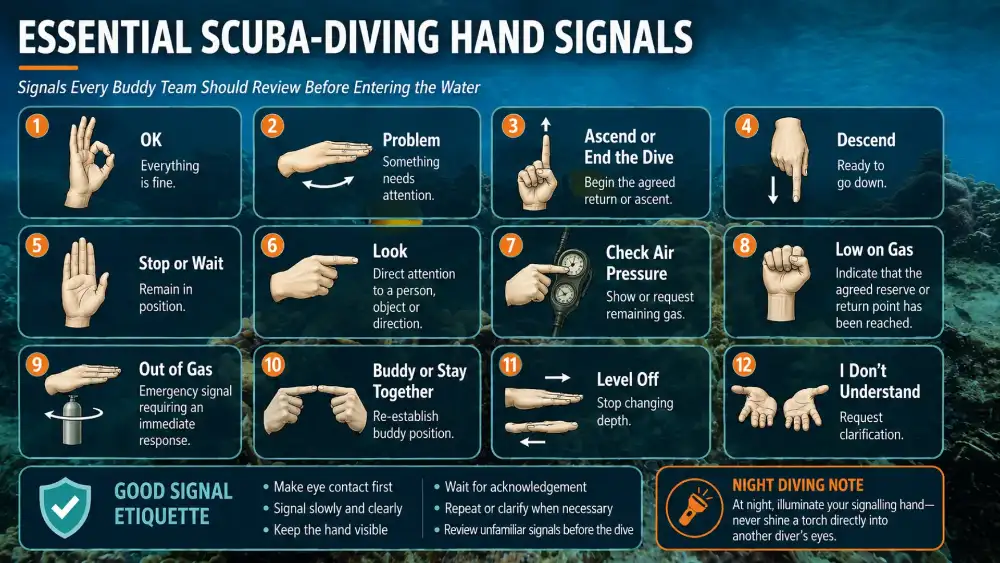
Clear communication underwater depends on hand signals that every diver understands before the dive begins.
Although most basic scuba signals are widely recognised, some organisations and instructors teach slight variations. Reviewing signals during the briefing helps prevent confusion underwater.
Before entering the water, confirm signals for:
| Hand signal | Purpose |
|---|---|
| OK | Confirms everything is fine. |
| Problem | Indicates something needs attention. |
| Ascend / End the dive | Begins a safe return. |
| Descend | Confirms readiness to go down. |
| Stop / Wait | Prevents the team from moving ahead. |
| Look | Directs attention to something important. |
| Air pressure | Shares remaining gas. |
| Low on gas | Indicates it is time to return or ascend. |
| Out of gas | Signals an immediate emergency. |
| Buddy / Stay together | Re-establishes team position. |
| Level off | Stops an unintended depth change. |
| I don’t understand | Requests clarification. |
Good underwater communication involves more than making the correct signal.
Always:
During night dives, illuminate your hand rather than shining your torch directly into another diver’s face.
Underwater photography should never take priority over safety, buoyancy or marine life protection.
Using a camera increases task loading and can distract divers from their buddy, gas supply, depth and surroundings. Responsible underwater photographers remain aware of the entire dive, not just the subject in front of the lens.
Carrying an underwater camera adds task loading and requires good buoyancy, situational awareness and dive skills. Before taking a camera on a dive, you should be able to:
If using a camera begins to affect your buoyancy, awareness or ability to follow the dive plan, put the camera away and focus on the dive. A good underwater photograph is never more important than your safety, your buddy or the protection of the marine environment.
Respectful underwater photographers always place safety and marine life ahead of getting the perfect image.
Good practice includes:
Scuba diving etiquette does not end when you leave the water. How you behave after the dive helps keep the boat organised, protects equipment and supports a positive experience for everyone.
After completing the dive:
Every dive boat operates differently, so always follow the procedures explained by the crew.
Once back on board:
Keeping equipment organised helps prevent damage and reduces trip hazards.
A dive debrief allows divers to learn from the experience and identify any issues before the next dive.
Discuss topics such as:
If you notice a safety concern or equipment issue, discuss it respectfully with the dive professional. Constructive feedback is far more valuable than criticising or embarrassing another diver.
Most dive boats provide separate rinse tanks for different types of equipment.
Good etiquette includes:
Newly certified divers are not expected to know everything. Good beginner etiquette is about communicating honestly, listening carefully and diving conservatively.
If you are new to scuba diving:
The best beginner divers are not those who try to impress others. They are the ones who communicate honestly, follow instructions and make safe decisions.
Protecting the underwater environment is an important part of responsible scuba diving. Small choices made before, during and after the dive can reduce your environmental impact.
Simple habits include:
Responsible diving means leaving the dive site in the same condition — or better — than you found it.
Protecting your skin is important, but divers can also reduce the amount of sunscreen entering the water.
Consider:
No sunscreen is completely impact-free, so combining protective clothing with responsible sun protection practices is often the most environmentally friendly approach.
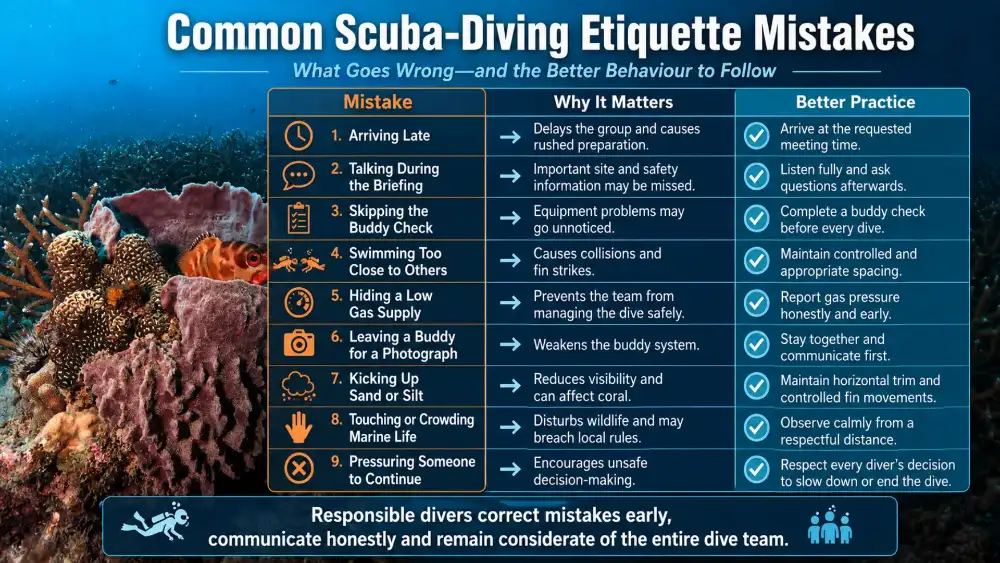
Even experienced divers occasionally develop habits that affect safety, marine life or the experience of other divers. Most etiquette mistakes are easy to avoid with good preparation, communication and environmental awareness.
The table below summarises some of the most common scuba diving etiquette mistakes and the recommended alternative.
| Common mistake | Why it causes problems | Better practice |
|---|---|---|
| Arriving late | Delays the group and encourages rushed preparation. | Arrive at the requested meeting time. |
| Talking during the briefing | Important safety information may be missed. | Listen carefully and ask questions afterwards. |
| Skipping the buddy check | Equipment problems may go unnoticed. | Complete a buddy check before every dive. |
| Leaving equipment across the boat | Creates trip hazards and blocks shared areas. | Store equipment in your assigned space. |
| Entering the water before instructed | Can interfere with boat operations and other divers. | Wait for the crew’s signal. |
| Swimming too close to others | Increases the risk of collisions and fin strikes. | Maintain a comfortable buddy distance. |
| Overtaking the dive guide | Makes group supervision more difficult. | Follow the planned dive order. |
| Hiding low gas | Prevents the team from managing the dive safely. | Report your gas pressure honestly and early. |
| Leaving your buddy for a photograph | Weakens the buddy system. | Stay together and communicate first. |
| Kicking up sand or silt | Reduces visibility and may damage nearby coral. | Maintain good buoyancy and fin control. |
| Touching marine life | Can harm wildlife and breach local regulations. | Observe animals without touching them. |
| Crowding marine animals | Alters natural behaviour and affects other divers. | Wait your turn and keep a respectful distance. |
| Using a camera before mastering buoyancy | Increases distraction and reef-contact risk. | Develop buoyancy skills before adding a camera. |
| Shining a torch into another diver’s eyes | Affects vision and underwater communication. | Keep your torch beam controlled and directed away from faces. |
| Pressuring another diver to continue | Encourages unsafe decision-making. | Respect any decision to slow down or end the dive. |
Good scuba diving etiquette is about more than following rules. It reflects respect for your buddy, the dive guide, other divers and the underwater environment. Simple habits such as arriving prepared, communicating clearly, maintaining good buoyancy and observing marine life responsibly help make every dive safer and more enjoyable.
Whether you are completing your first Open Water course or logging your hundredth dive, practising good diving etiquette protects fragile marine ecosystems and contributes to a positive experience for everyone in the water.
At La Bombona Diving, we believe that becoming a good diver means more than learning diving skills. Our experienced instructors emphasise safe diving practices, responsible marine-life interactions, excellent buoyancy control and respectful buddy communication from your very first dive.
Whether you’re trying scuba diving for the first time, earning your Open Water certification or continuing your diving education, we’ll help you build the confidence and habits needed to enjoy the underwater world responsibly.
Ready to explore Koh Tao’s reefs the right way?
Contact La Bombona Diving to book your next dive or scuba course and experience small-group diving with a strong focus on safety, conservation and personalised instruction.
The best way to prevent seasickness while scuba diving is to prepare before the boat trip, stay hydrated, avoid heavy meals and follow your dive operator's guidance. If you are prone to motion sickness, speak with a healthcare professional about suitable medication before your trip.
To reduce the likelihood of seasickness:
If you begin to feel nauseous, tell the dive crew immediately. They can suggest practical measures or advise whether it is safer to delay or skip the dive. Never force yourself to dive if you feel unwell, as discomfort can affect your concentration and increase task loading underwater.
Preventing seasickness starts with good preparation, but the safest decision is always to postpone a dive if your symptoms are severe or you are unable to dive comfortably.
Proper scuba diving etiquette means diving safely, respectfully and responsibly. It involves preparing thoroughly before the dive, communicating effectively with your buddy and dive guide, maintaining good buoyancy, following the agreed dive plan and protecting the underwater environment.
Good scuba diving etiquette includes:
Following proper scuba diving etiquette helps prevent accidents, protects fragile marine ecosystems and creates a safer, more enjoyable diving experience for everyone in the water.
During recreational scuba diving, you should avoid touching coral, reef structures, sponges, anemones, fish, turtles, rays, sharks, octopuses, nudibranchs, shells, eggs, nests, wreck artefacts and any unidentified marine organisms. Even light contact from your hands, fins, gauges or camera can damage fragile marine life or disturb natural habitats.
The best practice is to observe without touching. Leaving the underwater environment undisturbed helps protect marine ecosystems, reduces stress on wildlife and preserves dive sites for future divers. Personal safety always comes first, so in a genuine emergency, follow your training and the instructions of the supervising dive professional.
If another diver behaves irresponsibly, avoid confronting them underwater unless there is an immediate safety risk. Instead, maintain your own safety, alert the dive guide using the agreed hand signal if necessary and allow the dive professional to manage the situation.
After the dive, discuss the issue calmly and respectfully with the guide or instructor. They can explain the relevant safety, environmental or local diving rules and address the behaviour appropriately. Underwater, the priority should always be maintaining safety and avoiding unnecessary distractions or conflict.
Yes. Any diver can choose to end a dive at any time, and that decision should be respected by their buddy and the dive team. There is no requirement to continue a dive if you feel uncomfortable or believe it is no longer safe to do so.
Valid reasons to end a dive include:
When a diver signals that they want to end the dive, the buddy team should acknowledge the signal, stay together and follow the agreed ascent procedure. Respecting a decision to end a dive is an important part of safe scuba diving etiquette and responsible buddy diving.
No. It is best to avoid touching dead coral as well as living coral. Underwater, it is often difficult to distinguish between dead coral, living coral and reef structures that support small marine organisms. Even apparently dead coral can provide habitat for marine life or form part of a fragile reef ecosystem.
Avoiding contact also helps you maintain good buoyancy and prevents accidental damage to nearby coral. As a general rule, responsible divers should leave reefs and other underwater features untouched unless contact is necessary for an emergency or required during a supervised training exercise.
More in Diving Tips
 Diving Tips
Depth, breathing, training, safety, equipment and cost compared side by side, so you can decide whether a snorkel afternoon, a Try Dive or a full Open Water course is the right fit for your Koh Tao trip.
 Diving Tips
An Open Water course in Koh Tao usually takes three to four days — but the advertised number of days tells only part of the story. Here is what actually fills those days, why schedules differ between dive schools, and how to plan your stay around the course.
 Diving Tips
PADI, RAID and SSI compared across the whole training pathway — Open Water, advanced, rescue, specialities, Divemaster, instructor and technical — plus what actually decides the quality of your course in Koh Tao.
Message us on WhatsApp — courses, fun dives and honest advice about Koh Tao.
Chat on WhatsApp