What a Koh Tao Open Water course really costs, how the four days are structured, how many nights to book, where to sleep, how to pick a backpacker-friendly dive school and the health, packing and no-fly rules you need to plan around.
10 June 2024 · updated 21 August 2026 · by Bryan Roseman
Key takeaways
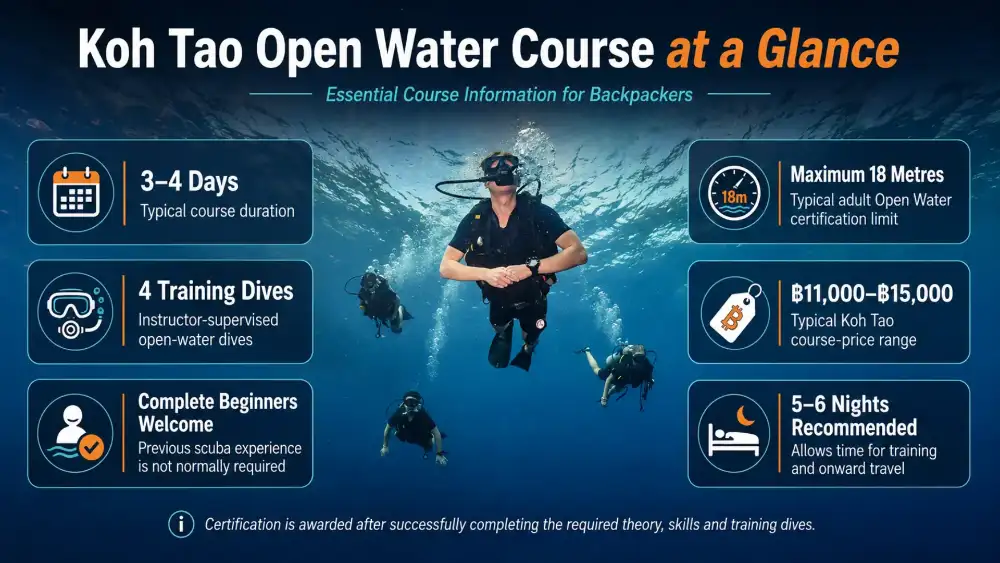
- Most Open Water courses in Koh Tao take three to four days and include scuba theory, confined-water training and four supervised open-water dives, leading to an internationally recognised certification on successful completion.
- Planning to stay at least five to six nights in Koh Tao gives you flexibility for ferry schedules, weather changes, extra training if needed and the recommended no-fly interval after the final dive.
- Choosing the right dive school involves more than comparing prices. Backpackers should confirm group size, instructor continuity, equipment inclusions, accommodation options, medical policies and cancellation terms before booking.
Backpacking through Thailand is all about making the most of your time and budget while collecting experiences you’ll remember long after the trip ends. For many travellers, earning an Open Water scuba certification in Koh Tao becomes one of those unforgettable milestones. Instead of simply visiting the island, you leave with a lifelong skill and an internationally recognised diving certification.
Koh Tao has earned its reputation as one of the world’s most popular places to learn scuba diving. Its calm, beginner-friendly dive sites, experienced instructors and competitive course prices make it especially appealing to backpackers looking for a high-quality certification without stretching their travel budget.
That said, booking the cheapest course isn’t always the best decision. The total cost of your trip can also include accommodation, ferry transfers, meals, equipment rental, certification fees and a few extra nights on the island, depending on your schedule. Planning these details in advance can help you avoid unexpected expenses and enjoy the course at a comfortable pace rather than rushing through it.
This guide explains everything backpackers need to know before booking a Koh Tao Open Water course, including typical costs, course schedules, accommodation options, transport, budgeting tips and practical advice to help you fit scuba diving into your Thailand itinerary.
| Question | Answer |
|---|---|
| Is the Koh Tao Open Water course suitable for complete beginners? | Yes. The Open Water course is specifically designed for beginners, and no previous scuba diving experience is normally required. Students learn diving theory, confined-water skills and complete supervised open-water dives before earning certification. |
| How long does a Koh Tao Open Water course take? | Most Open Water courses in Koh Tao take three to four days, depending on the dive centre and training schedule. |
| How many dives are included in an Open Water course? | A standard Open Water certification includes four supervised open-water training dives, along with confined-water skill sessions and classroom or online learning. |
| What is the maximum depth for an Open Water diver? | After certification, adult Open Water divers certified through RAID, PADI or SSI are generally qualified to dive to a maximum depth of 18 metres (60 feet) under recommended recreational diving guidelines. |
| Is scuba equipment included in the course fee? | Most Koh Tao Open Water course packages include the required scuba equipment, including the mask, fins, BCD, regulator, cylinder and weights. Always confirm exactly what is included before booking. |
| How many nights should backpackers stay in Koh Tao for the course? | Backpackers should plan to stay at least five nights for a four-day Open Water course. Staying six nights provides extra flexibility for weather, ferry schedules and the recommended no-fly interval after diving. |
| Can solo travellers join an Open Water course? | Yes. Solo travellers regularly join Open Water courses in Koh Tao. Dive centres organise students into small training groups and buddy teams, making it easy to meet other travellers while learning. |
| Can you fly immediately after completing the course? | No. Divers should wait for the recommended surface interval before flying after their final dive to reduce the risk of decompression sickness. The exact waiting time depends on the diving completed and current dive safety recommendations. |
| Do you automatically receive certification after the course? | No. Students receive their Open Water certification only after successfully completing all required theory assessments, confined-water skills and open-water training dives to the required standard. |
Every internationally recognised Open Water course follows the same objective: teaching beginners how to dive safely and confidently. Although the daily schedule may vary between dive centres and certification agencies, the training follows a similar progression. Students first learn the knowledge needed to understand scuba diving, then practise essential skills in a controlled environment before completing supervised training dives in the ocean.
The course begins with the theory behind safe scuba diving. Students learn how diving equipment works, how the underwater environment affects the body and the procedures used to plan and complete dives safely.
Topics typically include:
Many dive centres allow students to complete part of the theory online before arriving in Koh Tao. The remaining material is reviewed with an instructor before progressing to the practical training.
Once the theory is complete, students move to confined-water training, which usually takes place in a swimming pool or another controlled environment.
This stage is designed to help beginners become comfortable using scuba equipment while practising the essential skills needed for open-water diving.
Students typically learn how to:
Everyone learns at a different pace. Some students become comfortable with the skills quickly, while others need additional practice with buoyancy, equalisation or mask clearing. Taking extra time to build confidence is a normal part of learning to dive.
The final stage of the course is completing four supervised training dives in the ocean.
These dives allow students to apply the knowledge and skills learned during confined-water training in real diving conditions. Each dive includes specific exercises and performance requirements that must be completed under instructor supervision, so the focus is on developing safe diving habits rather than simply exploring the reef.
Entry-level Open Water certifications from RAID, PADI and SSI generally include four open-water training dives. After successfully completing all required theory assessments and practical skills, adult Open Water divers are typically certified to dive to a maximum depth of 18 metres (60 feet) with a certified dive buddy in conditions similar to those experienced during training.
While some dive centres complete the programme in around three days, others spread the training over four days to give students more time to absorb the theory, practise their skills and complete the required dives without feeling rushed.
Example four-day Open Water course schedule
Although the exact timetable varies depending on the dive centre, weather conditions and boat schedules, a typical four-day programme may follow this structure:
| Day | Typical activities |
|---|---|
| Day 1 | Course registration, orientation, equipment fitting and theory introduction |
| Day 2 | Knowledge review, confined-water training and scuba skills practice |
| Day 3 | First two supervised open-water training dives |
| Day 4 | Final two training dives, course review and certification processing |
Sea conditions, weather and individual student progress can occasionally affect the schedule. For that reason, backpackers should avoid booking ferries, buses or flights immediately after the expected course completion time and allow a little flexibility in their itinerary.
If your Open Water course takes four days, booking only four nights can make the trip unnecessarily rushed. Ferry delays, travel fatigue, weather conditions or extra training time may affect the schedule, leaving little room before departure.
A more practical itinerary looks like this:
| Travel stage | Suggested plan |
|---|---|
| Arrival day | Reach Koh Tao, check in, rest and attend the course orientation if scheduled |
| Course days | Complete the knowledge sessions, confined-water training and four open-water dives |
| Final night | Stay on Koh Tao after completing the final training dives |
| Departure day | Take the ferry only after observing the required post-diving interval before onward travel, especially if you will be flying |
Booking an extra night or two can be useful when:
Backpackers should therefore plan an Open Water course as a multi-day travel commitment rather than trying to fit it tightly between an arrival ferry and a fixed departure connection.
Backpackers can generally expect an Open Water course in Koh Tao to cost approximately 11,000 to 15,000 ฿, depending on the dive school, certification agency, course duration and package inclusions.
However, the advertised course fee is only one part of the total travel budget. Accommodation, transport, food and additional nights can increase the final cost, so it is important to compare the complete package rather than choosing a course based only on the lowest advertised price.
| Expense | What to confirm |
|---|---|
| Course fee | Whether theory sessions, confined-water training, four open-water dives and instructor supervision are included |
| Learning materials | Whether online learning, manuals or digital study materials are included |
| Certification | Whether certification registration and processing fees are included |
| Equipment | Whether all required scuba equipment, including a dive computer, is provided |
| Accommodation | Number of nights, room type, shared or private facilities and distance from the dive centre |
| Transport | Ferry tickets, bus or train connections and local transfers |
| Food | Meals, snacks and drinking water before and after training sessions |
| Insurance | Whether the policy covers scuba training and recreational diving |
| Medical assessment | An additional cost that may apply when the medical questionnaire requires clearance from a doctor |
| Additional nights | Extra accommodation for ferry delays, course rescheduling or post-diving travel planning |
| Personal expenses | Laundry, toiletries, SIM cards and non-diving activities |
A course at the lower end of the price range may offer good value, but backpackers should always check exactly what is included before booking.
For example, La Bombona Diving in Koh Tao offers its four-day RAID Open Water course for 11,000 ฿, placing it at the affordable end of the typical Koh Tao price range. Backpackers planning to get certified can check the latest course inclusions, available dates and booking details on the La Bombona Diving Koh Tao Open Water course page.
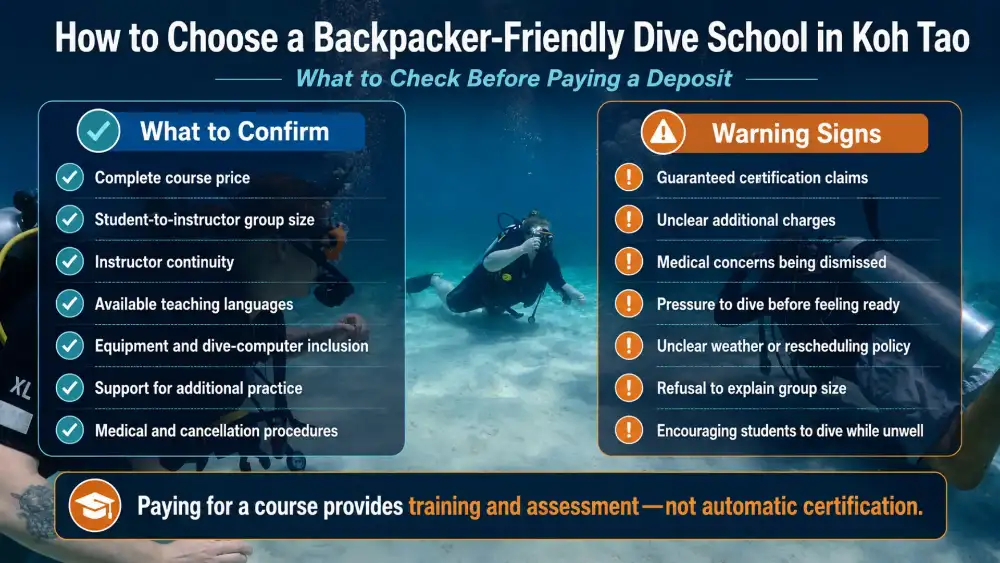
The cheapest dive school is not always the best choice, and the right option can vary according to your budget, schedule, experience level, preferred language and learning needs.
Before paying a deposit, ask the dive centre the following questions:
| Questions to ask | Why it matters |
|---|---|
| What is the complete course price? | Confirms whether certification fees, learning materials, equipment rental or other charges are added separately |
| How many students will be in the group? | Smaller groups can provide more opportunities for individual feedback and instructor attention |
| Will I usually have the same instructor throughout the course? | Instructor continuity can make communication and skill development more consistent |
| Which languages are available? | You must be able to understand safety briefings, theory and underwater instructions clearly |
| What equipment is included? | Prevents unexpected rental charges and confirms whether essential items, such as a dive computer, are provided |
| Where does confined-water training take place? | Helps you understand whether initial skills are taught in a swimming pool or another controlled training environment |
| What happens if I need additional practice? | Shows whether the schedule can be adjusted when a student needs more time to complete a skill comfortably |
| When does the final course day normally finish? | Helps you avoid booking a ferry, transfer or hotel checkout too close to the final dives |
| What happens when weather or sea conditions change? | Clarifies whether dives may be delayed, moved to another site or rescheduled |
| What is the cancellation or refund policy? | Important for backpackers whose transport, health or travel plans may change unexpectedly |
| How are medical concerns handled? | Confirms that the dive centre follows an appropriate screening and medical-clearance process |
Be cautious when a dive centre:
Paying for an Open Water course gives you access to professional instruction, supervised practice and assessment. It does not automatically guarantee certification. Students must demonstrate the required knowledge, confined-water skills and open-water performance before they can qualify.
Backpackers completing an Open Water course in Koh Tao usually choose between a hostel dormitory, a private room or a dive-and-stay package. The best option depends on your budget, sleep preferences and how much convenience you want during the course.
Because training may include early starts, theory sessions and physically demanding dives, accommodation should be chosen for more than price alone.
A hostel dormitory is often the cheapest and most social option. However, shared rooms, late-night arrivals and nearby nightlife can make it harder to sleep before morning training sessions.
Before booking, check:
A dormitory may suit travellers who sleep easily in shared accommodation, but it may be less practical for anyone who needs quiet study time or reliable rest.
A private room usually costs more than a dorm bed but can provide better sleep, privacy and space to study during an intensive course.
This option may be especially useful for backpackers who:
Check whether the room includes air-conditioning, a private bathroom, Wi-Fi and easy access to food and the dive centre.
A dive-and-stay package can simplify planning by combining training and accommodation in one booking. It may also reduce the need for daily transport between your room and the dive centre.
Before choosing a package, confirm:
| What to check | Why it matters |
|---|---|
| Number of included nights | The course may last four days, but you may need an arrival night and a final night after diving |
| Room type | Confirm whether the accommodation is a dormitory, shared room or private room |
| Fan or air-conditioning | Room comfort can affect sleep and recovery between training days |
| Check-in and check-out times | Early checkout may be inconvenient if the course finishes later in the day |
| Distance from the dive centre | A nearby room can make early starts and equipment preparation easier |
| Availability of extra nights | Useful when extending your trip or allowing flexibility for delays |
| Schedule-change policy | Clarifies what happens if weather, illness or training progress affects the course timeline |
| What the package price includes | Confirms whether towels, breakfast, transfers or other services are included |
The cheapest room is not always the most practical choice during a diving course. A quiet, clean and conveniently located room can make it easier to rest, study and arrive prepared for each training session.
An Open Water course is designed for beginners, but it still requires concentration, physical coordination, adequate rest and honest communication with your instructor. Backpackers should plan their sleep, meals, alcohol consumption, medication and onward travel as carefully as the course itself.
Scuba training requires clear judgment, good coordination, hydration and the ability to follow instructions both above and below the water.
Do not dive when you are:
Koh Tao’s nightlife can still be part of the backpacking experience, but late nights and major parties are better planned after completing the final training dive. Drinking heavily during the course can interfere with sleep, hydration, learning and physical performance.
Tell your instructor if you feel unwell, unusually tired or unable to participate safely. Missing or rescheduling a dive is preferable to entering the water when you are not fit to dive.
Even travellers who feel comfortable on ferries can experience motion sickness on smaller dive boats. Boat movement, heat, dehydration, strong smells and an empty stomach can all contribute to nausea.
Before a boat session:
Do not take an unfamiliar medicine immediately before diving without understanding how it may affect alertness, balance or coordination.
Most beginner divers do not need to purchase or carry a complete set of scuba equipment. Rental equipment is usually included or available through the dive centre and is more practical than carrying regulators, fins or buoyancy equipment through Southeast Asia.
Useful items to bring include:
| Item | Why it is useful |
|---|---|
| Swimwear | Needed for confined-water sessions and boat dives |
| Towel | Useful after training sessions and boat trips |
| Reusable water bottle | Helps you remain hydrated throughout the course |
| Dry clothes | Useful after dives and during theory sessions |
| Sun protection | Bring suitable clothing, a hat and sunscreen for time on the boat |
| Light rain protection | Tropical weather can change quickly |
| Smartphone or tablet | May be needed for digital learning and certification records |
| Passport details | Commonly required for registration and certification |
| Travel-insurance information | Useful if medical assistance or a claim becomes necessary |
| Required medication | Bring enough for the full stay and disclose relevant medical information |
| Contact lenses or prescription details | Useful when arranging an appropriate mask |
| Small water-resistant bag | Helps protect personal items on the boat |
Confirm with the dive centre which equipment is included before packing or buying additional gear.
Do not assume that every travel-insurance policy automatically covers scuba diving. Some policies exclude diving completely, cover it only to a specified depth or apply different conditions to certified divers and students.
Before travelling, check whether the policy covers:
General travel insurance and specialist diving-accident cover may provide different benefits. Read the policy wording rather than relying only on a summary or sales page.
A four-day course should not be squeezed between tightly scheduled ferry connections. Allowing an additional night can provide flexibility for travel delays, illness, weather changes or extra training time.
The lowest advertised price may not include equipment, learning materials, certification fees or accommodation. Compare the complete package and the quality of training rather than only the headline cost.
Beginning the course immediately after an overnight bus, train or ferry journey can make academic learning and practical training more difficult. Arriving at least one night before the course gives you time to rest and settle in.
Poor sleep, dehydration and alcohol consumption can affect concentration, decision-making and physical coordination. Save late nights and heavy drinking until all training dives are complete.
An Open Water course includes knowledge development as well as underwater skills. Complete assigned digital learning on time and ask the instructor about anything you do not understand.
Medical screening is intended to identify conditions that may require evaluation before diving. Answer the questionnaire honestly and do not conceal medication, previous illness or current symptoms to avoid delaying the course.
The recommended preflight interval must be calculated from the time you surface after the final dive, not from the time the course officially ends or the certification is issued.
Paying for a course provides training, supervised practice and assessment. Certification is awarded only after the student completes the required knowledge development, demonstrates the necessary water skills and safely completes the training dives.
A Koh Tao Open Water course can be one of the most rewarding experiences during a Thailand backpacking trip, giving you an internationally recognised scuba certification and the skills to explore dive sites around the world. However, choosing the right course involves more than comparing advertised prices. Your budget, accommodation, ferry schedules, travel plans, health requirements and the quality of instruction all play an important role in your overall experience.
Planning enough time on the island, understanding what is included in the course fee and selecting a reputable dive centre can help you avoid unnecessary stress and focus on learning safely and confidently. Whether you are travelling solo or with friends, taking the time to prepare your itinerary properly can make your Open Water course far more enjoyable.
If you’re looking for a beginner-friendly Open Water course in Koh Tao, La Bombona Diving offers a four-day RAID Open Water programme with experienced instructors, small groups and optional accommodation packages to help backpackers plan their stay more easily. Before booking, compare course inclusions, confirm your travel schedule and allow enough flexibility to enjoy both the training and everything Koh Tao has to offer.
You should wait at least 18 hours after surfacing from your final Open Water training dive before boarding a commercial flight. An Open Water course normally includes several dives over multiple days, so DAN's recommendation for multiple dives in one day or diving over multiple days is the most relevant guidance:
Open Water training dives should remain within no-decompression limits, but the course still involves repetitive diving. For this reason, backpackers should plan their flight around the 18-hour minimum rather than the 12-hour interval. Waiting longer provides an additional safety margin.
The interval begins when you surface after your final dive, not when the course ends, your paperwork is completed or your certification is issued. For example, if your last dive finishes at 2:00 p.m. on Monday, the 18-hour interval ends at 8:00 a.m. on Tuesday. A later flight would provide more flexibility.
Anyone experiencing unusual fatigue, joint pain, dizziness, numbness, breathing difficulty or other possible symptoms of decompression illness should not fly and should seek medical advice immediately.
Koh Tao has become one of the world's most popular destinations for beginner scuba divers, particularly backpackers travelling through Thailand. The island offers a combination of beginner-friendly dive sites, affordable accommodation, convenient ferry connections and a well-established diving community, making it easy to include an Open Water course in a backpacking itinerary. Many backpackers choose Koh Tao because it offers:
Many travellers also combine Koh Tao with nearby islands such as Koh Phangan and Koh Samui. Ferry operators, including Lomprayah, connect these destinations with Chumphon on the mainland, where onward bus services are available to and from Bangkok. Because ferry schedules can change throughout the year, it is always worth checking the latest timetable before confirming your accommodation and course dates.
A standard Open Water course includes four supervised open-water training dives. Before completing these dives, students also take part in knowledge development and confined-water training, where they learn essential scuba skills in a controlled environment. The four training dives are designed to help students safely apply those skills in real diving conditions. After successfully completing all required theory, practical skills and training dives, students become eligible for Open Water certification.
A Koh Tao Open Water diving course is a structured training programme designed to teach complete beginners how to scuba dive safely and confidently. Most courses take three to four days and combine classroom or online learning, confined-water skills training and four supervised open-water training dives. By the end of the course, students who successfully meet all theory and practical requirements earn an internationally recognised Open Water certification that allows them to dive with a certified buddy within the limits of their certification. The course is usually divided into three stages:
Throughout the course, instructors assess both knowledge and practical skills rather than simply counting completed dives. Students progress at their own pace, and anyone who needs additional guidance or practice can discuss this with their instructor before moving on to the next stage. After successfully completing all required assessments and training dives, students receive an Open Water certification recognised by major scuba diving agencies, allowing them to dive independently with a qualified buddy in conditions similar to those experienced during training.
Koh Tao is one of the most affordable and popular destinations in the world to earn an Open Water scuba certification, but it is not always the absolute cheapest. Course prices vary between dive centres, certification agencies, seasonal demand and what is included in the package, such as learning materials, equipment, accommodation or certification fees. Many backpackers choose Koh Tao because it offers an excellent balance of competitive course prices, beginner-friendly dive sites, experienced instructors and a wide choice of dive schools. Rather than comparing the advertised course fee alone, it is better to consider the overall value of the package, including group size, equipment, training quality, accommodation options and any additional costs. If you're travelling through Thailand, Koh Tao remains one of the best-value places to earn an internationally recognised Open Water certification while enjoying a well-established diving community and convenient connections to nearby islands such as Koh Samui and Koh Phangan.
Yes. The Open Water course in Koh Tao is specifically designed for complete beginners, and no previous scuba diving experience is required. Students receive step-by-step instruction, starting with scuba theory and safety principles before practising essential skills in a controlled environment and progressing to supervised open-water training dives. To enrol, you do not need to own scuba equipment, have completed a Try Dive or already understand dive theory. Most dive centres provide the required equipment and guide students through every stage of the course. However, participants must be comfortable in the water, complete the required swimming assessment, meet the medical screening requirements and successfully demonstrate the knowledge and practical skills needed for certification. Because Koh Tao offers calm, beginner-friendly dive sites, experienced instructors and a wide choice of internationally recognised training agencies such as RAID, PADI and SSI, it is considered one of the world's most popular destinations for first-time divers to earn an Open Water certification.
The cheapest way to travel from Bangkok to Koh Tao is by taking an overnight bus to Chumphon followed by a ferry to Koh Tao. Combined bus-and-ferry tickets typically cost around 600–1,800 ฿ and take approximately 8–12 hours, depending on the operator and ferry schedule. This option is popular with backpackers because it is the most budget-friendly route, includes coordinated transfers and allows travellers to save on a night's accommodation by travelling overnight.
More in Diving Tips
 Diving Tips
Depth, breathing, training, safety, equipment and cost compared side by side, so you can decide whether a snorkel afternoon, a Try Dive or a full Open Water course is the right fit for your Koh Tao trip.
 Diving Tips
An Open Water course in Koh Tao usually takes three to four days — but the advertised number of days tells only part of the story. Here is what actually fills those days, why schedules differ between dive schools, and how to plan your stay around the course.
 Diving Tips
PADI, RAID and SSI compared across the whole training pathway — Open Water, advanced, rescue, specialities, Divemaster, instructor and technical — plus what actually decides the quality of your course in Koh Tao.
Message us on WhatsApp — courses, fun dives and honest advice about Koh Tao.
Chat on WhatsApp