Ten reasons Koh Tao works for every level of diver — a complete pathway from Try Dive to Divemaster, dive sites for every level, wrecks and night dives, warm water for much of the year and easy logistics.
8 July 2026 · by Bryan Roseman
Key takeaways
- Koh Tao is not only a beginner scuba destination; it works as a complete diving pathway where someone can start with a Try Dive, continue to Open Water certification, build confidence through fun dives, progress into Advanced or Rescue training, and eventually move toward Divemaster-level development.
- One of Koh Tao’s biggest strengths is its wide range of dive sites within easy reach, from shallow beginner-friendly reefs like Japanese Gardens, Mango Bay, Aow Leuk, Twins, and White Rock to more advanced locations such as Chumphon Pinnacle, Southwest Pinnacle, HTMS Sattakut, Shark Island, and Sail Rock.
- Diving in Koh Tao is possible for much of the year, with warm tropical water generally around 26°C to 30°C, while March to May and June to September are often highlighted as strong periods for training, fun dives, visibility, photography, and advanced dive-site access.
Koh Tao has earned its reputation as one of the world’s most popular scuba diving destinations because it combines excellent training conditions with a remarkable variety of dive experiences. Calm beginner reefs, offshore pinnacles, wrecks, night dives, and thriving coral ecosystems are all located within easy reach of the island.
Unlike destinations that appeal mainly to one type of diver, Koh Tao offers opportunities throughout a diver’s journey. First-time visitors can learn in shallow, protected bays, while certified divers can continue exploring deeper sites, specialty dives, and advanced training without needing to change destinations.
Other factors also contribute to the island’s popularity, including warm tropical water, short boat journeys, year-round diving opportunities, affordable courses, experienced instructors, and a welcoming dive community that encourages divers to keep progressing.
Koh Tao combines beginner-friendly training sites, advanced dive locations, wrecks, night dives, abundant marine life, affordable certification courses, and a well-developed diving infrastructure on one small island. Whether you’re taking your first breath underwater or planning advanced dives at Chumphon Pinnacle, Southwest Pinnacle, HTMS Sattakut, or Sail Rock, the island offers options for almost every experience level.
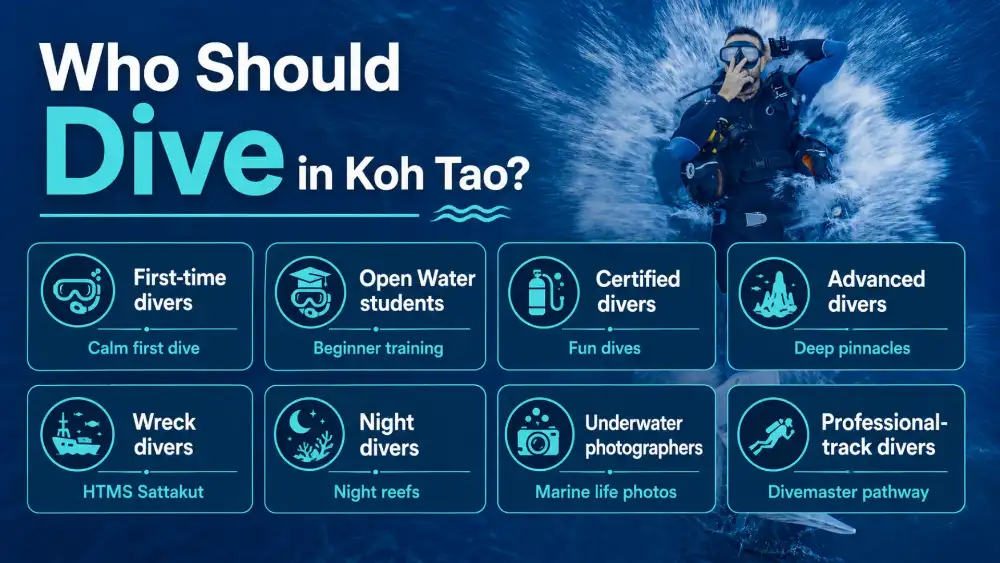
Koh Tao is suitable for almost every type of scuba diver, from first-time visitors who want a calm introduction to diving to certified divers looking for fun dives, advanced sites, wrecks, night diving, underwater photography, or long-term professional training. Its biggest strength is that different divers can find suitable courses, dive sites, and experiences without needing to travel to another destination.
| Diver Type | Why Koh Tao Works Well | Recommended Experiences |
|---|---|---|
| First-time divers | Calm water, shallow reefs, and patient instruction | Try Dive, Japanese Gardens, Mango Bay |
| Open Water students | Training-friendly reefs with gentle conditions | Open Water Course, Twins, White Rock, Aow Leuk |
| Certified divers | Large choice of reef dives and marine life | Fun Dives, White Rock, Green Rock, Shark Island |
| Advanced divers | Deeper pinnacles, stronger currents, and more challenging dives | Chumphon Pinnacle, Southwest Pinnacle, Sail Rock |
| Wreck divers | Artificial reefs and purpose-sunk wrecks | HTMS Sattakut, Junkyard Reef |
| Night divers | Shallow reefs with nocturnal marine life | White Rock, Twins, Sairee Reef |
| Underwater photographers | Coral gardens, macro life, and colourful reef fish | Japanese Gardens, Aow Leuk, Southwest Pinnacle |
| Marine-life enthusiasts | Excellent opportunities to see turtles, rays, barracuda, and seasonal whale sharks | Chumphon Pinnacle, Southwest Pinnacle, Shark Island |
| Returning divers | Easy refresher programmes before fun diving | Refresher Course |
| Professional-track divers | High dive volume and structured professional training | Rescue Course, Divemaster Programme |
This is why Koh Tao should not be described only as a beginner island. It is better understood as a complete scuba ecosystem, where divers can start at the best shallow dive sites in Koh Tao before progressing to deeper and more challenging locations.
Many destinations are good for one thing: beginner courses, advanced diving, liveaboards, wrecks, or photography. Koh Tao is different because it gives divers a pathway.
A traveller can arrive with no experience, try scuba for the first time, complete a Koh Tao scuba certification, continue with fun dives, refresh after a long break, explore deeper sites, take advanced training, and even move towards Divemaster-level development.
| Diver Stage | Best Koh Tao Option | What It Helps With |
|---|---|---|
| Never dived before | Try Dive | Experience scuba with instructor support without committing to certification |
| Beginner ready to get certified | Open Water course | Learn core theory, safety skills, buoyancy, and ocean diving |
| Certified but rusty | Refresh course | Rebuild comfort before joining fun dives |
| Newly certified | Guided fun dives | Gain more ocean experience after certification |
| Confident Open Water diver | Advanced / continuing training | Explore deeper sites, navigation, night diving, and better buoyancy |
| Safety-focused diver | Rescue course | Build awareness, prevention, and emergency-response confidence |
| Long-stay or career-focused diver | Divemaster training | Learn guiding, assisting, dive planning, leadership, and real dive operations |
| Certified diver wanting a special trip | Sail Rock | Experience one of the Gulf of Thailand’s most famous offshore dive sites |
A major reason Koh Tao stands out is the variety of dive sites around the small island. Divers do not need complicated transfers or liveaboard schedules to experience different underwater environments. Depending on the weather and boat plan, Koh Tao can offer shallow coral gardens, sandy training areas, reefs, boulder formations, swim-throughs, wrecks, pinnacles, and offshore sites.
This makes Koh Tao practical for mixed groups too. One person may be learning, another may already be certified, and another may want more advanced diving. The same destination can support all of them.
| Dive Site | Suitable For | Typical Level | What Makes It Valuable |
|---|---|---|---|
| Japanese Gardens | Try Dive, snorkelling, Open Water training | Beginner | Shallow coral areas, gentle reef sections, relaxed first-dive environment |
| Mango Bay | First dives, training, relaxed reef dives | Beginner | Sheltered bay feel and manageable conditions when suitable |
| Aow Leuk | Beginners, snorkellers, certified divers | Beginner to certified | Sandy patches, coral formations, and reef fish |
| Twins | Open Water training, fun dives | Beginner to certified | Training-friendly layout, reef life, and buoyancy-practice areas |
| White Rock | Fun dives, night dives, training dives | Beginner to certified | Large varied reef site with good day and night dive potential |
| Green Rock | Swim-throughs, boulders, topography | Intermediate | More adventurous layout with boulders and possible current |
| Shark Island | Marine life, reef structure, current practice | Intermediate to advanced | Stronger topography and conditions that can be more challenging |
| Hin Wong Pinnacle | Coral, boulders, rays, and less crowded diving | Intermediate | Granite formations and varied underwater scenery |
| HTMS Sattakut | Wreck diving, Advanced training | Advanced / specialty | Purpose-sunk wreck, depth, and artificial reef life |
| Chumphon Pinnacle | Big schools, deep diving, whale shark possibility | Advanced | One of Koh Tao’s most iconic deeper pinnacle sites |
| Southwest Pinnacle | Offshore pinnacle diving, fish schools | Intermediate to advanced | Soft corals, schooling fish, and deeper profiles |
| Sail Rock | Bucket-list Gulf dive, chimney swim-through | Certified / Advanced depending on conditions | Famous offshore pinnacle between Koh Tao and Koh Phangan |
Some islands are good for easy reef diving but lack exciting advanced options. Others have dramatically advanced sites but are less suitable for training. Koh Tao has both.
This is one of the most important reasons it works for different levels of divers.
Beginner and certified divers can enjoy reef sites such as Japanese Gardens, Aow Leuk, Twins, and White Rock. These sites can offer coral areas, sandy patches, reef fish, and manageable profiles when conditions are suitable.
These dives are useful for:
More experienced divers can look towards deeper and more dynamic sites such as Chumphon Pinnacle, Southwest Pinnacle, Shark Island, Green Rock, HTMS Sattakut, and Sail Rock.
These dives can offer:
| Site | Why It Supports Koh Tao’s Reputation | Best For |
|---|---|---|
| Chumphon Pinnacle | One of Koh Tao’s signature deeper pinnacle dives, known for schooling fish, depth, and occasional whale shark sightings | Advanced divers, confident certified divers, marine-life seekers |
| Southwest Pinnacle | Offshore pinnacle system with soft corals, glassfish, barracuda, groupers, and varied topography | Intermediate to advanced divers |
| Sail Rock | One of the Gulf of Thailand’s most famous dive sites, known for its vertical pinnacle, chimney swim-through, and large fish schools | Certified divers, Advanced divers, bucket-list dive trips |
For certified divers visiting Koh Tao, these sites add serious value. They create a reason to stay longer, do more dives, or continue training beyond Open Water.
Many travellers coming to Koh Tao are already certified. They may not want a course. They want good fun dives, relaxed logistics, and enough variety to fill several dive days.
Koh Tao works well for certified fun divers because it offers regular boat schedules, varied local sites, and dive options that can be adjusted based on conditions and experience level.
| Dive Day | Suggested Focus | Possible Site Type |
|---|---|---|
| Day 1 | Easy orientation dives | White Rock, Twins, Aow Leuk |
| Day 2 | Reef and boulder sites | Green Rock, Shark Island, Hin Wong |
| Day 3 | Deeper pinnacle experience | Chumphon Pinnacle or Southwest Pinnacle |
| Day 4 | Specialty-style experience | Night dive, wreck dive, or Sail Rock |
| Day 5 | Skill progression | Advanced, Nitrox, buoyancy, Rescue preparation |
This makes Koh Tao especially useful for divers who want more than one dive day. They can start with easier reefs, then progress into deeper or more interesting sites once the guide understands their comfort, air consumption, buoyancy, and experience level.
Certified divers often return to Koh Tao because it offers:
This is why Koh Tao should be presented as a multi-level scuba destination, not only a certification factory.
Another reason Koh Tao is one of the best places for scuba diving is that divers can add specialty-style experiences without needing a complicated itinerary. Two strong examples are night diving and wreck diving.
Night diving gives certified divers a completely different view of Koh Tao’s reefs. A site that feels familiar in daylight can feel new after sunset. Divers may see nocturnal reef behaviour, hunting fish, crabs, shrimps, moray eels, stingrays, sleeping parrotfish, and sometimes bioluminescence when conditions are right.
Night dives are usually planned at sites with:
White Rock, Twins, and Sairee-area reefs are commonly associated with night diving because they can offer manageable profiles and active reef life. Night diving is best for certified divers who are already comfortable with buoyancy, communication, and staying close to the group.
Koh Tao also offers wreck diving opportunities, with HTMS Sattakut being the best-known wreck site. Wreck diving adds a different type of challenge because divers must think more carefully about depth, orientation, buoyancy, visibility, and safety limits.
HTMS Sattakut is especially useful for:
Wreck diving should always be done within certification limits. Divers should not enter overhead environments unless they have the right training, supervision, and conditions.
Koh Tao is attractive because it is not limited to a very short dive season. Conditions are not identical every month, but the island is diveable for much of the year. Warm tropical water makes both training and fun diving more comfortable.
Water temperature is generally warm year-round, often around 26°C to 30°C depending on the month. This is helpful for:
This month-by-month overview shows why Koh Tao is practical for very different travel dates.
| Month | Typical Diving Conditions | Water Temperature | Visibility Tendency | Best For |
|---|---|---|---|---|
| January | Variable but improving after wetter periods | 26–28°C | Variable | Flexible divers, refresh courses, quieter diving |
| February | Often improving and less crowded | 27–28°C | Fair to good | Beginners, Open Water, fun dives |
| March | Warm, often calm, strong diving period | 29–30°C | Often good to excellent | Courses, fun dives, photography, and whale shark hopes |
| April | Hot, warm water, strong dive potential | 29–30°C | Often very good | All levels, advanced sites, photography |
| May | Warm and often good before mid-year shifts | 29–30°C | Good to very good | Beginners, fun divers, continuing courses |
| June | Warm, with possible wind-direction effects | 28–29°C | Good, site-dependent | Certified divers, courses, protected sites |
| July | Popular travel month, generally diveable | 28–29°C | Good to variable | Open Water, fun dives, family travellers |
| August | Warm, sometimes windy or showery | 28–29°C | Good to variable | Courses, fun dives, flexible site plans |
| September | Often good for visibility and marine life activity | 28–29°C | Good to very good | Photography, advanced dives, and whale shark hopes |
| October | Transitional and quieter | 27–29°C | Variable | Flexible divers, value travel |
| November | More monsoon influence possible | 26–28°C | More variable | Flexible schedules, experienced divers |
| December | Variable, but diving can still happen | 26–28°C | Variable | Holiday travellers with buffer days |
Note. This table should not be treated as a guarantee. Tropical diving conditions can change quickly.
| Diver Goal | Strong Months to Consider | Why |
|---|---|---|
| First Try Dive | February–May, June–September | Warm water and generally manageable conditions |
| Open Water certification | March–May, June–September, February | Good balance of comfort, training conditions, and visibility potential |
| Certified fun dives | February–May, June–September | Good site variety and regular dive schedules |
| Advanced pinnacles | March–May, September, sometimes June–August | Better chance of enjoyable deeper-site conditions |
| Underwater photography | March–May, September–October when conditions cooperate | Stronger visibility potential and marine-life activity |
| Whale shark hopes | March–May, September–October | Commonly mentioned possibility windows, never guaranteed |
| Wreck diving | March–September in good conditions | Visibility and sea comfort matter at deeper sites |
| Budget / quieter travel | February, October, parts of November | Fewer crowds and a more flexible island atmosphere |
Koh Tao belongs to the Gulf of Thailand, while places like Phuket, Phi Phi, Koh Lanta, Khao Lak, and the Similan Islands belong to the Andaman Sea side. This matters because the two regions often have different strong diving seasons.
For travellers planning scuba diving in Thailand, Koh Tao can be especially useful when the Andaman side is less ideal, and vice versa.
Rain can affect diving, but rain alone does not automatically cancel a dive. Light rain often matters less than wind, waves, surface conditions, current, and visibility. A rainy day can still have a good dive if the sea is calm and the selected site is protected.
What affects diving more seriously is:
A good dive team, like La Bombona Diving Koh Tao, will choose the safest and most suitable site for the day’s conditions rather than simply the most famous one.
Yes, Koh Tao can still offer enjoyable diving during the monsoon-influenced months, but conditions are generally less predictable than at other times of the year. Visibility, surface conditions, and access to certain dive sites may vary from day to day, so flexibility becomes more important.
For beginners, it’s a good idea to allow a few extra days in your itinerary in case training or introductory dives need to be rescheduled. Certified divers often have more options, as experienced dive teams can select sheltered dive sites or adjust the day’s plan according to the conditions.
The key is to set realistic expectations. Monsoon season does not automatically mean poor diving or cancelled trips; it simply means conditions can change more quickly. Rather than planning your entire holiday around a single dive day, leave some flexibility in your schedule so your dive centre can choose the best available conditions.
| Destination | Region | Strong Season Pattern | Best For | Koh Tao Feature / Comparison |
|---|---|---|---|---|
| Koh Tao | Gulf of Thailand | Often strong around March–September, variable during monsoon months | Courses, fun dives, mixed levels, long-stay training | Very compact dive culture and many sites close to the island |
| Phuket | Andaman Sea | Often strongest around October–April | Holiday divers, day trips, liveaboards | Easier airport access, but less compact as a dive-training island |
| Phi Phi | Andaman Sea | Often strongest around October–April | Scenic reefs, walls, marine life | Beautiful diving, but can be busier and more expensive |
| Koh Lanta | Andaman Sea | Often strongest around October–April | Certified divers, deeper Andaman trips | Excellent for advanced trips, but some sites require longer boat travel |
| Khao Lak / Similan area | Andaman Sea | Seasonal, often November–April | Liveaboards, Richelieu Rock, pelagic diving | World-class seasonal diving, but not as year-round or course-focused |
| Koh Samui / Koh Phangan | Gulf of Thailand | Gulf-season influence | Resort stays, island hopping, Sail Rock access | Koh Tao is more dive-centred |
Koh Tao’s biggest advantage is not that it beats every island in every category. Its advantage is that it is one of Thailand’s most practical all-round scuba bases.
Koh Tao offers far more than just the opportunity to earn a scuba certification. Its rich marine life and diverse underwater landscapes encourage divers to keep exploring long after their first course is complete. Across the island, you’ll find vibrant coral gardens, granite boulder formations, artificial reefs, purpose-sunk wrecks, dramatic pinnacles, sandy seabeds, natural swim-throughs, and deeper offshore dive sites, each providing a different underwater experience.
| Marine Life | Where It May Be Seen | Notes |
|---|---|---|
| Butterflyfish, angelfish, parrotfish | Shallow reefs and coral gardens | Common reef-life highlights |
| Clownfish | Reef areas with anemones | Good for beginners and photographers |
| Blue-spotted stingrays | Sandy patches and reef edges | Easier to spot on slow dives |
| Moray eels | Reef cracks, night dives, pinnacles | Best observed calmly from a distance |
| Barracuda | White Rock, Chumphon, Sail Rock, pinnacles | Can form impressive schools |
| Trevally | Pinnacles and open-water edges | Often seen hunting around schooling fish |
| Turtles | Reef sites and bays, depending on luck and conditions | Never chase or touch |
| Nudibranchs | Reefs and artificial structures | Good for macro photographers |
| Whale sharks | Chumphon, Southwest, Sail Rock, occasionally other sites | Possible, never guaranteed |
Koh Tao can be rewarding for underwater photography because it offers both wide and close-up subjects. Shallow reefs can be useful for sunlight and beginner-friendly photos. Pinnacles can offer schooling fish and stronger underwater landscapes. Night dives can reveal macro subjects and nocturnal behaviour.
| Photography Interest | Best Site Type | What Helps |
|---|---|---|
| Beginner underwater photos | Shallow reefs | Good buoyancy, sunlight, calm water |
| Reef scenes | Japanese Gardens, Aow Leuk, White Rock | Clear water and relaxed dive pace |
| Macro subjects | Reefs, artificial structures, night dives | Slow observation and excellent buoyancy |
| Schooling fish | Chumphon, Southwest, Sail Rock | Better visibility and deeper-site conditions |
| Wreck photography | HTMS Sattakut | Advanced certification and careful buoyancy |
| Night photography | White Rock, Twins, Sairee Reef | Calm night conditions and good torch control |
The most important rule is reef-safe behaviour. Good photos should never come at the cost of touching coral, chasing animals, or damaging the marine environment.
Exceptional dive sites are important, but the overall diving experience also depends on practical factors such as affordability, efficient logistics, and flexible dive schedules.
Koh Tao stands out because it combines high-quality diving with a well-developed infrastructure that makes planning and enjoying your dives straightforward.
For many travellers, the island offers advantages such as:
This is especially useful for people planning a Thailand itinerary. Koh Tao can fit into a short trip, but it also rewards a longer stay.
| Trip Length | Best Diving Plan |
|---|---|
| 1 day | Try Dive or two local fun dives if already certified |
| 2 days | Try Dive plus snorkelling, or 4 local fun dives for certified divers |
| 3–4 days | Open Water course or multiple fun dive days |
| 5–7 days | Open Water plus fun dives, Advanced course, Sail Rock, night dive |
| 2+ weeks | Rescue, Divemaster preparation, specialty training, deeper site exploration |
| 1–2 months | Divemaster training or long-stay dive development |
If diving is the main reason for visiting, do not schedule your ferry out immediately after your last possible dive. Leave space for weather changes, rest, and no-fly timing.
The island has a deep pool of instructors, Divemasters, boat crews, equipment teams, course structures, and dive communities. This matters because scuba diving is not only about where you go underwater; it is also about how you are guided, taught, briefed, and supported.
For all divers, good support can improve the experience:
| Diver Type | What Good Dive Support Provides |
|---|---|
| Nervous beginner | Calm explanation, small steps, reassurance |
| Open Water student | Time to practise and understand skills |
| Certified fun diver | Clear briefing, site orientation, safe profile |
| Rusty diver | Refresh support before deeper or more complex dives |
| Advanced diver | Honest site advice based on conditions |
| Photographer | Slower pace and buoyancy awareness |
| Night diver | Strong briefing and torch communication |
| Divemaster trainee | Real operational learning and mentorship |
This is also where the choice of dive school matters. The cheapest option is not always the best option if group size, equipment, teaching style, safety culture, or schedule quality is compromised.
Koh Tao is one of the best places for scuba diving because it brings together everything divers look for in one compact island destination: warm tropical water, beginner-friendly reefs, advanced pinnacles, wreck dives, night diving, seasonal marine life, regular boat schedules, affordable training options, and a strong diving community.
For first-time divers, Koh Tao offers a calm and supportive place to begin. For certified divers, it provides enough reef sites, fun dives, and specialty experiences to make several dive days worthwhile. For more experienced divers, sites such as Chumphon Pinnacle, Southwest Pinnacle, HTMS Sattakut, and Sail Rock add depth, variety, and challenge. For long-stay divers, the island also creates a natural pathway toward Rescue, Divemaster, and professional-level development.
The real strength of Koh Tao is not just one famous dive site or one course. It is the full diving ecosystem. You can arrive with no experience, build confidence step by step, continue exploring after certification, and keep progressing without needing to change destinations.
If you are planning to dive in Koh Tao and want a relaxed, small-group, and well-guided experience, La Bombona Diving Koh Tao can help you choose the right option for your level, whether that is a Try Dive, Open Water course, refresher, fun dive, Sail Rock trip, or longer training pathway.
March, April, and May are often considered some of the best months to dive in Koh Tao. During this period, the sea is typically calm, water temperatures range from 28–30°C (82–86°F), and underwater visibility is frequently excellent. These conditions are ideal for first-time divers, Open Water students, certified divers, and underwater photographers.
Another great time to dive is June through September. Although wind direction can change during these months, Koh Tao has dive sites around different sides of the island, allowing dive centres to choose locations with the best conditions on the day. Visibility often remains very good, the water stays warm, and marine life is active, making this a popular period for both training and recreational diving.
Rather than choosing a specific month, it’s better to think in terms of weather conditions and daily dive site selection. Experienced dive centres monitor sea conditions every day and select the most suitable dive sites based on visibility, wind, currents, and diver experience. As a result, enjoyable diving is possible throughout much of the year, with calm conditions available at different sites depending on the season.
Yes, Koh Tao is still a good place to dive during the monsoon season, although conditions are more variable. Rain alone rarely stops diving, but stronger winds and rougher seas can reduce visibility or limit access to some dive sites.
Fortunately, dive centres often switch to sheltered sites based on the day’s weather and sea conditions, so diving usually continues safely. If you’re visiting during the monsoon, it’s worth allowing an extra day or two in your itinerary and choosing a reputable dive school that adjusts dive plans according to safety and visibility.
With a flexible schedule, many divers still enjoy excellent diving throughout the monsoon season.
Whale sharks can be seen in Koh Tao throughout the year, but sightings are never guaranteed because they are wild, migratory animals. Divers often report more sightings during March to May and September to October, although encounters can happen in any month.
Most sightings occur at offshore dive sites such as Chumphon Pinnacle, Southwest Pinnacle, and Sail Rock, where nutrient-rich waters attract whale sharks to feed.
To improve your chances of seeing one, plan multiple dives, include offshore sites in your itinerary, and stay flexible, as dive centres often adjust schedules based on recent sightings and sea conditions.
Even without a whale shark encounter, Koh Tao offers excellent diving year-round with reef sharks, turtles, rays, barracuda, groupers, and colourful tropical reef fish.
For many beginner divers, the dry season from March to September offers some of the most favourable diving conditions in Koh Tao. During these months, the sea is often calm, water temperatures remain warm at around 28–30°C (82–86°F), and underwater visibility is frequently excellent. These conditions make it easier for new divers to learn buoyancy, practise skills, and enjoy their first underwater experiences.
However, one of the reasons Koh Tao is such a popular place to learn scuba diving is that beginner courses run throughout the year. The island has numerous sheltered dive sites, allowing dive centres to choose locations with the calmest conditions based on the day’s weather and sea state. This flexibility means that beginners can often enjoy safe and comfortable training even when conditions change.
If you’re booking a Try Dive, Discover Scuba Diving experience, or an Open Water Course, the best season is generally when calm seas and good visibility are more common. Even so, experienced dive centres monitor weather, wind, and currents daily to select the most suitable training sites, helping ensure a safe and enjoyable introduction to scuba diving regardless of the time of year.
Rain does not automatically stop diving in Koh Tao. Short tropical showers usually have little effect underwater, as visibility is influenced more by wind, waves, and currents than by rainfall itself.
Strong winds and rough seas are more likely to affect diving by reducing visibility or limiting access to certain sites. When this happens, dive centres typically choose more sheltered locations with better conditions.
If you’re visiting during the rainy season, it’s worth allowing an extra day or two for flexibility, especially if you’re completing an Open Water Course or hoping to dive offshore. Overall, rain alone rarely prevents diving, and enjoyable dives are still common throughout the season.
Underwater visibility in Koh Tao is generally at its highest during March, April, and May. During these months, calm seas, warm water, and favourable weather often create clear diving conditions, with visibility commonly ranging from 20 to 30 metres, although this can vary from day to day and between dive sites.
Good visibility is one of the reasons these months are popular for Open Water Courses, fun dives, and underwater photography. Clear water makes it easier for beginners to practise skills, navigate dive sites, and enjoy views of coral reefs and marine life.
Visibility can also be very good during June to September, particularly at sheltered dive sites chosen according to the daily wind direction. Experienced dive centres monitor conditions each day and select the sites offering the clearest water and safest diving.
It’s worth remembering that underwater visibility is influenced by factors such as wind, waves, currents, plankton blooms, and recent weather, so it naturally changes throughout the year. Even during the best months, visibility can vary from one dive site to another.
Yes. Koh Tao is an excellent destination for certified divers, offering a wide variety of dive sites suitable for different experience levels and interests. Whether you’ve recently earned your certification or have dozens of logged dives, the island provides plenty of opportunities to continue exploring.
Certified divers can enjoy:
Another advantage for certified divers is Koh Tao’s convenience. Most dive sites are only a short boat ride from the island, making it easy to complete multiple dives over several days without long transfers or complicated travel plans. Combined with a large selection of dive centres, affordable diving, and year-round dive opportunities, Koh Tao is an ideal destination for divers looking to maximise their time underwater.
More in Diving Tips
 Diving Tips
Depth, breathing, training, safety, equipment and cost compared side by side, so you can decide whether a snorkel afternoon, a Try Dive or a full Open Water course is the right fit for your Koh Tao trip.
 Diving Tips
An Open Water course in Koh Tao usually takes three to four days — but the advertised number of days tells only part of the story. Here is what actually fills those days, why schedules differ between dive schools, and how to plan your stay around the course.
 Diving Tips
PADI, RAID and SSI compared across the whole training pathway — Open Water, advanced, rescue, specialities, Divemaster, instructor and technical — plus what actually decides the quality of your course in Koh Tao.
Message us on WhatsApp — courses, fun dives and honest advice about Koh Tao.
Chat on WhatsApp